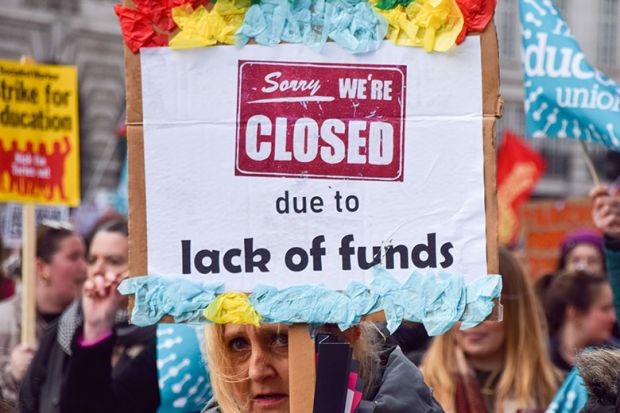
The hundreds of job cuts and course closures announced this month alone are widely seen to have underlined just what dire financial straits UK universities find themselves in.
The latest cuts come on top of tens of thousands in recent years, all of which have been presented as absolutely necessary to preserve institutional sovereignty.
Nevertheless, some university staff are sceptical about whether such statements tell the full story. Times Higher Education’s recent UK University Redundancy Survey highlighted suspicions that, in some cases, managers have used the undeniably difficult financial conditions across the sector as an excuse to remove more workers and subjects than is really necessary.
So what do the financial numbers actually say? To explore that question, Times Higher Education has analysed data from the most recent financial data from the Higher Education Statistics Agency (Hesa), published on 14 May, against universities’ own published accounts.
Proportion of Universities UK members in deficit
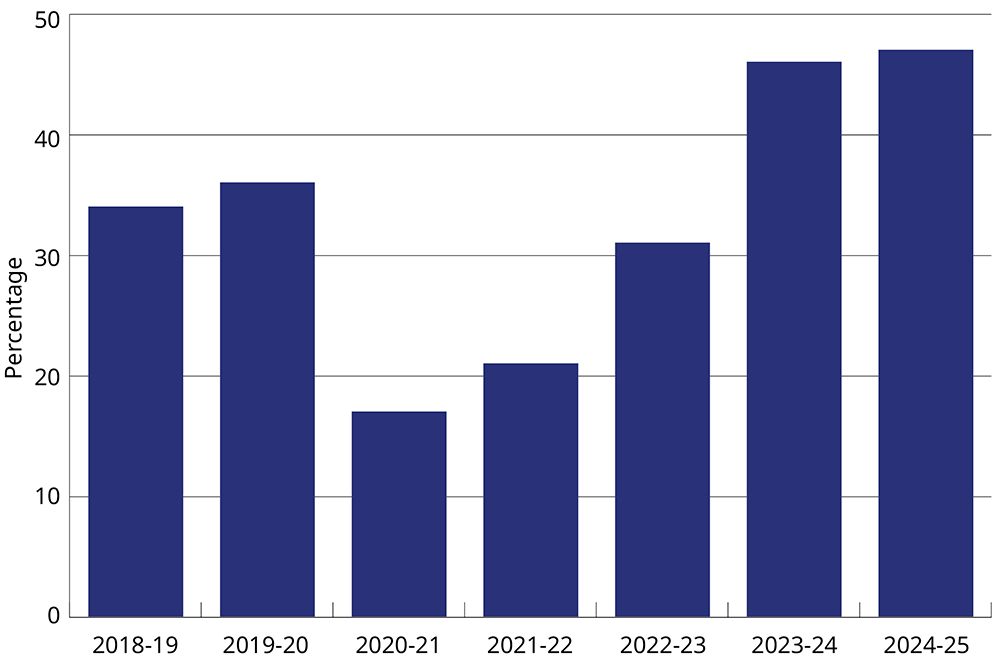
The financial metric that generates the most headlines tends to be the annual deficit: a university’s total income, including non-cash items, versus its total expenditure. Of the 133 members of Universities UK included in the Hesa data, 62 (47 per cent) were in deficit in 2024-25 – up slightly among the same cohort the year before.
The largest deficit among this group was the £82.7 million recorded by the University of Staffordshire. Other large losses included Coventry University’s £59.3 million, Queen’s University Belfast’s £51.6 million and Cardiff University’s £45 million.
However, these figures fail to take account of the volatile pension costs of recent years. When these adjustments are excluded, Staffordshire moves into a 3 per cent surplus. QUB’s and Cardiff’s deficits were both 10 per cent of income, while Coventry and the University of Bedfordshire both posted deficits of 18 per cent. But the largest proportional deficit was the 32 per cent recorded by Lincoln Bishop University.
Deficits and surpluses, however, are only among the many ways to examine the health of an institution – particularly when “cash is king”.
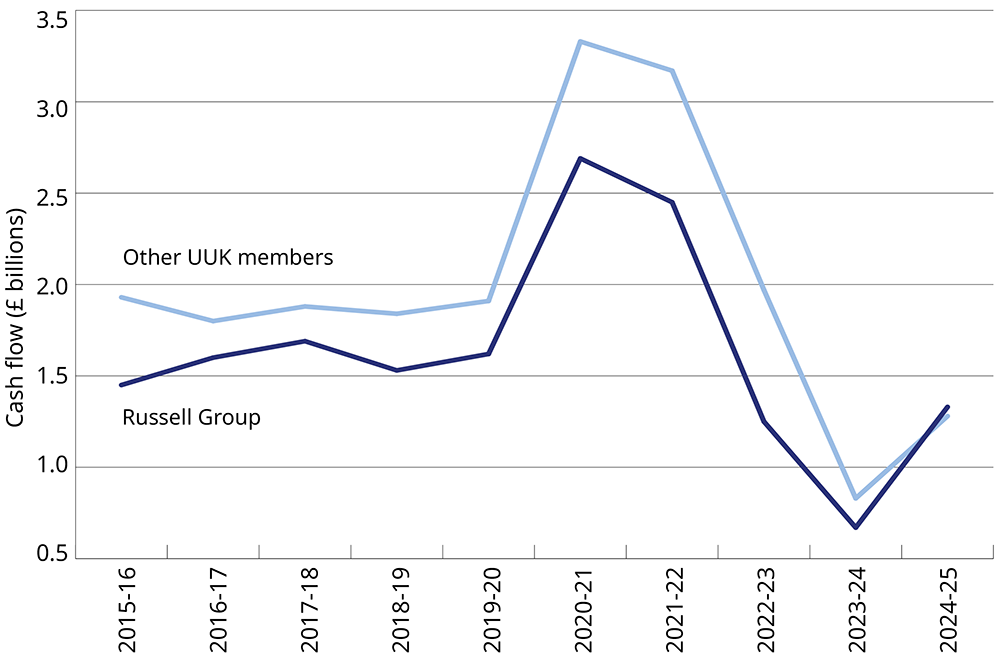
Net cash flow from operating activities is one of the better ways to observe university performance. And here the headline news is encouraging: after three years of plummeting figures, net cash flow almost doubled to £2.5 billion last year across the UK. Nevertheless, dozens of individual institutions still had a negative cash flow. Those included QUB (-£33.5 million), The Open University (-£30.5 million) and Bedfordshire (-£26.2 million).
Worse still, half a dozen institutions have recorded cash flow losses in three successive years: Lincoln Bishop, Birkbeck, OU, QUB, the University of the Highlands and Islands and Trinity Laban Conservatoire of Music and Dance.
Nor is the Russell Group exempt: seven of its members reported a deficit last year – and in 2024-25 the University of Cambridge recorded the largest year-on-year cash drawdown across the sector (down £41.3 million): the annual change in the amount of cash and “cash equivalents” it is sitting on.
But for the first time since the Hesa dataset was first published, in 2015-16, the Russell Group raised more cash from operations than the rest of the sector combined – and the reported £1.3 billion excludes the University of Nottingham, which filed its accounts late and is therefore excluded from all of Hesa’s analyses. And the value of the Russell Group’s assets rose by £914 million, compared with £700 million elsewhere, while its research income (£5.9 billion) and endowments far outweigh those of the rest of the sector.
Net cash flow from operations
Another way to measure financial health is through net liquidity days, which shows how long a provider would be able to continue to operate using the cash or borrowing it currently has available.
About 40 per cent of UUK members would manage fewer than 100 days – almost double the proportion from two years before. But the number with less than 30 liquidity days has halved to just four: London South Bank University (seven days), Cranfield University (20), Trinity Laban (24) and the University of St Andrews (27).
The University of Bristol (51) and Durham University (53) have the thinnest margins among the Russell Group, and Durham is also the only member reporting liabilities greater than its assets – by £45 million.
Phil McNaull, former finance director at the University of Edinburgh, said some commercial organisations want to keep their net liquidity days to between 30 and 60 in the name of efficiency – but deliberately sailing so close to the financial wind would be “quite a scary move for many universities” because they have less flexible income streams and a limited ability to raise cash quickly.
The fact that so many are doing so anyway “could either mean that they are taking a much more commercial approach to managing the working capital, or it could mean that they are [simply] down where they don’t want to be”.
Matt Atkinson, a former university chief operating officer who is now managing director of restructuring and turnaround at professional services firm Alvarez & Marsal, said having fewer than 30 liquidity days – the threshold at which institutions must notify the Office for Students – can be risky. But he said that the true level of risk depends on whether a university has a revolving credit facility (RCF) – an overdraft that makes money available for a set period unless certain covenants are breached. Not all universities have disclosed whether they have such a facility but Atkinson said this could be a further key dividing line between universities that manage to keep their heads above the water and those that don’t.
“If you’re a high-ranking Russell Group university, you can go and speak to a lot of lenders and say, ‘I’d like an RCF’ and you’re probably going to get a very, very open hearing,” he said. “That puts them in a position potentially to weather downturns. But if you are not quite as high in the rankings, you are not able to borrow in the same way.”
Atkinson also pointed out that, just as cash is concentrated, so is debt. Half the total debt due within one year across UUK members – £180.5 million – is held within just 10 institutions. And nearly a quarter of that figure is accounted for by the University of East Anglia (£42.2 million) and Durham (£40.8 million).

Despite all the lay-offs, spending on human capital continues to soar. Even before pension adjustments are taken into account, the average university spent 56 per cent of its total income on staff costs last year. And almost a third spent a record proportion. The highest rates were at the OU (77 per cent), Lincoln Bishop (76 per cent), and Abertay University (75 per cent).
At the same time, income from all tuition fees, domestic and international, rose just 2 per cent across the UK, which was the lowest on record. But, again, this varied hugely, from a 5 per cent rise across the Russell Group to a slight contraction elsewhere.
McNaull said this was because the Russell Group’s reputational advantage attracts international students, and that is borne out in the figures: the 23 of its members included in the Hesa analysis took in more money (£5.4 billion) from international fees than all other institutions combined. Almost two-thirds (64 per cent) of tuition fee income among this cohort came from overseas applicants in 2024-25, compared with just 47 per cent at universities elsewhere.
In addition, “If the bigger universities have the capacity to drop their entry requirements, they will immediately start to cannibalise the lower universities, who were taking in students at lower grades,” McNaull said.
Yet even within the Russell Group, fortunes vary considerably. While tuition fee revenue increased massively at some universities, such as UCL (£98 million) and the University of Birmingham (£91 million), it fell at other institutions, including the universities of Leeds (-£54 million) and Sheffield (-£47 million).
While it is easy to see gloom and doom in the data, McNaull said the large amount of “restructuring and reorganisation” that is happening could make a positive difference to the figures in subsequent years. However, redundancies do not amount to pure upfront savings. Across the 118 UUK members that provided data on their accounts, 16,800 people received severance payments in 2024-25 – on top of 11,300 in 2023-24.
That translated into a total of £441.9 million spent on compensation for loss of office – an average of £3.8 million for each university and an 83 per cent increase on the year before. Moreover, the total numbers across the sector will be much higher because many universities do not provide figures, either for the amount spent on redundancies or the number of jobs affected – or both.
Richard Watermeyer, professor of education at the University of Bristol, said the half a billion spent on severance packages is an “utterly extraordinary figure” – part of a “total financial Armageddon kind of scenario”.
“You’ve got the general sense of intensification of precarity amongst academics and there are no jobs [for] those seeking their first rung on the ladder...And I think there’s still a significant hangover from…the pandemic and pensions [strikes]…it’s a sense of total deflation.”
The University of Nottingham has recently proposed to make more than 600 job cuts, on top of 350 in the previous year. None of that will have shown up in the 2024-25 figures, but those figures do reveal that the university spent £11.3 million on compensation for loss of office in that year, on top of £13.8 million the year before – affecting almost 1,000 staff. After posting an £85 million deficit in 2024-25, Nottingham has said it will run out of money by 2031 if a major intervention is not made now.
Gregor Gall, an industrial relations expert who is visiting professor at the universities of Glasgow and Leeds, said the Nottingham announcement indicated that more redundancies were likely across the sector this year. But he was unconvinced of the need for so many redundancies in at least some cases: “Some institutions have made redundancies in order to maintain their surpluses, which indicates they prize maintaining the organisation to the detriment of its staff,” he said.
Nevertheless, he added, the financial crisis at universities is the “gravest since the sector’s expansion in the late 1960s” and “without changes on income issues, like over international students, it seems likely that those institutions that have already made cuts will not be able to avoid further cuts – even if not to the same scale as before”.
In THE’s redundancy survey, many respondents objected to what they saw as excessive spending on capital projects – often referred to as “shiny new buildings”. Yet capital expenditure dipped in 2024-25. Hence, “you could make a case that people are deferring investing in their buildings [in favour of] spending the money on restructuring,” said Alvarez and Marsal’s Atkinson.
Of the money spent on severance last year, £191.4 million (43 per cent) was accounted for by the Russell Group – almost treble the £69.7 million the group spent the year before. On top of the large payouts previously reported, Cardiff spent £24.3 million, Edinburgh spent £18 million and the University of Liverpool spent £13.1 million.
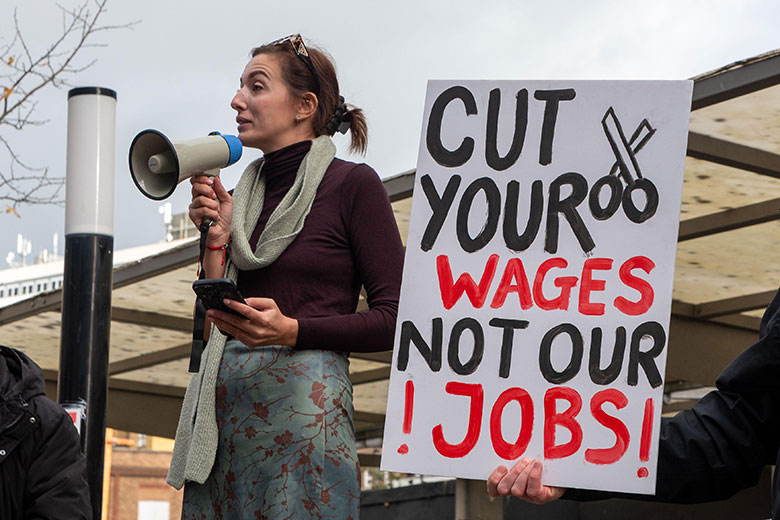
The THE survey also revealed a widespread sense that senior managers were at least partly to blame for the scale of redundancies that have occurred – while their own pay has continued to rise disproportionately. Do the figures bear that out?
Of the universities with the largest severance payments last year, many increased the salaries of their vice-chancellors – including Liverpool, QUB, Edinburgh, Sussex and Birmingham – where Adam Tickell even received a £28,000 bonus.
Across the 138 members of UUK, the median total pay package – including salary and pension contributions – awarded to vice-chancellors for 2024-25 was £335,500 – a 2 per cent increase on 2023-24. However, Dundee, the University of Kent and the London School of Hygiene and Tropical Medicine have not yet published their accounts, despite the deadline being the end of December (the University of Buckingham’s accounts are also unpublished but this is because it has a later financial year end).
The slight increase follows a 3 per cent rise the year before (from £320,500) and 4 per cent the year before that (from £307,000) among the same cohort.
Within the private sector, some studies find that executive pay can rise after redundancies because lay-offs may be interpreted by shareholders as decisive restructuring. But Richard McManus, professor of economics at Canterbury Christ Church University, said there should be caution about applying that logic to universities.
“Higher education does not have the same shareholder logic, and the current pressures seem persistent and structural rather than a one-off shock. That makes large pay increases less likely and harder to justify, [and] it does raise the question of whether some institutions have increased v-c pay or wider senior leadership costs despite redundancies or large severance programmes.”
Stripped of pension contributions, however, the average salary for all UUK vice-chancellors rose just 1 per cent in 2024-25, from £276,000 to £279,000 in the latest year. Among Russell Group leaders, that figure increased 3 per cent, from £339,500 to £349,500. This was well up from £321,000 in 2022-23 and £314,000 in 2021-22. Russell Group vice-chancellors’ average salaries have shot up by £50,000 in six years.
However, their average total pay package fell to £394,500 in 2024-25, from £402,000 the year before. This appears to be a result of a high rate of leadership churn in 2023-24, which meant that many departing leaders, such as the University of Leeds’ Simone Buitendijk, received large pay-offs – which are included in the analysis.
The other reason for the fall appears to be that the pension packages paid out in 2023-24 appear to have been considerably larger in many universities than last year.
McManus has conducted a separate analysis stripping away some of these large one-off payments. He finds that the median remuneration for current UUK members increased from roughly £313,000 to £323,000 – accounted for by a modest upward drift across many universities in the middle and top of the pack, counteracted by a sizeable fall at the lower end.
“The numbers do not really support a story of runaway v-c pay growth during a period of retrenchment,” said McManus, whose research has looked into benchmarking of senior pay. Instead, they suggest a sector where remuneration committees are probably exercising at least some restraint, albeit unevenly across institutions.
“Historically, benchmarking against peer institutions created persistent upward pressure on remuneration,” McManus said – even “without any single institution behaving outrageously. The latest figures suggest that mechanism may still be present but operating in a much more disciplined environment”, with remuneration committees potentially “also incorporating affordability, staff pay restraint, redundancies and institutional financial performance into the judgement”.
Vice-chancellor pay
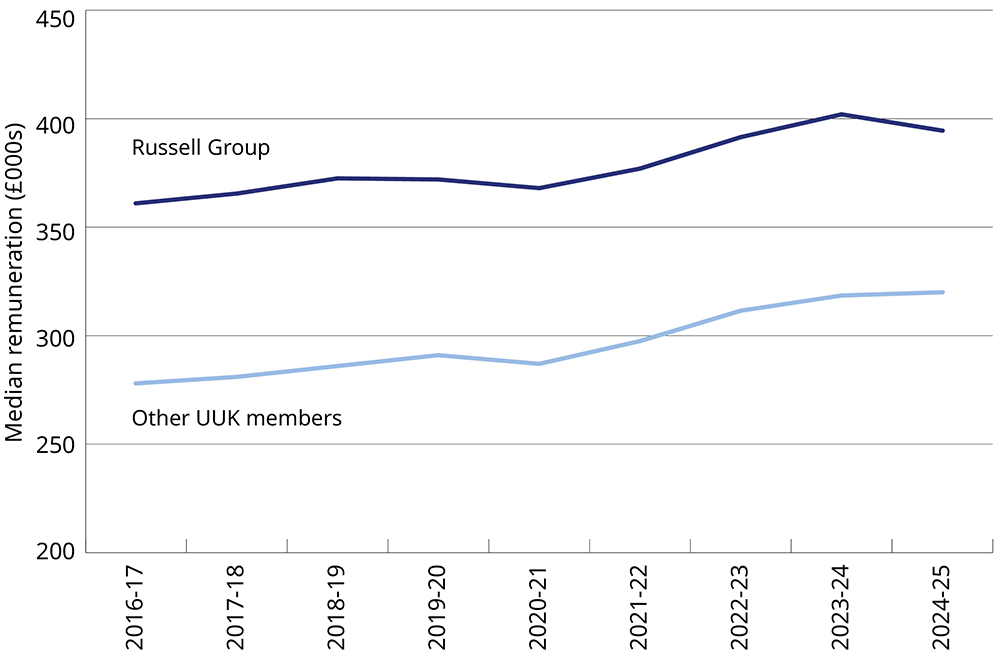
Meanwhile, another (unpublished) analysis of the Hesa data by Kim Peters, professor of management at the University of Exeter, found that the average ratio between a leader’s salary and that of the median employee has crept up slightly. Across UUK members it is now 6.8:1 – and 8.6:1 in the Russell Group.
“It shows that it is not just corporate CEOs who are being awarded an increasing piece of the organisational pie. V-cs are too,” she said. “While there are many different perspectives on why this is happening and whether it is reasonable, there is strong evidence that a large pay gap between leaders and those they seek to lead can contribute to problematic ‘us and them’ dynamics within organisations.
“Such division is likely to be especially problematic in a downturn. It is hard for a leader to argue that ‘we are all in the same boat’ and that staff should, consequently, make sacrifices for the institution when leaders are receiving ever higher pay packages and their staff are facing potential job losses.”
The largest award among the Russell Group went to Irene Tracey, who received a total pay package worth £666,000 from the University of Oxford, including a salary of £427,000. But that was topped by the £707,000 that London Business School paid its new dean, Sergei Guriev.

Elsewhere, £578,435 was split between the three people who led the OU during 2024-25, while £575,000 was shared by Buckinghamshire New University’s leaders; the outgoing Nick Braisby received an ex gratia compensation payment of £76,000 and £144,000 in deferred salary.
Following Duncan Ivison’s appointment, the University of Manchester is no longer the lowest v-c payer in the Russell Group – that is now the University of York.
The lowest pay package in the sector overall was recorded by Lincoln Bishop University, but that was because it was without a leader between September 2024 and the end of April 2025, and the acting-up allowance provided to its deputy vice-chancellor and executive dean of faculty during this period was not stated.
Some leaders have even asked to be paid less. At Plymouth Marjon University, Claire Taylor voluntarily requested a reduced salary with effect from January 2025.
“Vice-chancellors are very aware of negative media coverage that can come from having a package that’s out of kilter with other people,” said Nick Hillman, director of the Higher Education Policy Institute.
“These are extraordinarily high salaries. If you’re on a salary of well over £300,000, then refusing another £10,000 to keep your name out of the headlines is a very savvy thing to do.”
Performance-related pay was also at a record high (£2.5 million) – and the highest across UUK since 2017-18. For instance, as THE has previously reported, the private Regent’s University London awarded its vice-chancellor Geoff Smith a £145,000 bonus – the largest in the sector. Other substantial bonuses uncovered since then include a £59,000 bonus for Max Lu at the University of Surrey, and £22,000 for Mark Hallett at the Courtauld Institute of Art.
Given the financial context, Watermeyer said such payments feel slightly “unpalatable”. Reflecting the findings of the THE survey, he said: “You take the temperature across the academic and wider professional staff community in universities and I think that the general sense is leadership has failed,” he said. “So how on earth can we even be having that conversation about the extent to which they should be rewarded via remuneration for their achievements?”
To combat excessively high salaries, the House of Commons’ Education Select Committee recently suggested deferring senior leaders’ performance-related pay until after they leave office – a rule introduced for bankers after the 2008 financial crash.
The proposal has been met with a mixed reaction, with some arguing that it would incentivise long-term decision-making – because a leader who presided over the closure of an institution would receive nothing – but others suggesting that “private-sector management models” would not work for the sector.
Hillman said this is an area clearly in policymakers’ sights but cautioned that it would “trample on institutional autonomy”. He also observed that this year’s pay figures suggest that the big increases of past years look like a “historical artefact”, with average pay rises for leaders – in percentage terms – now in line with those for other staff.
“This is interesting, not least because many of them are presiding over major reform programmes and are being tested to their limits. When vice-chancellors’ pay became more transparent, it was often claimed this would encourage salary inflation, but this does not seem to be the case currently.
He added that the financial crisis in the sector “makes me think life for vice-chancellors will continue becoming harder but also that their remuneration will continue to be closely watched and held down more than in the past” – calling this dynamic a “supreme irony”.
Managing mergers can be particularly onerous – and commentators agreed that they are likely to increase. Earlier this month, King’s College London announced it was merging with Cranfield University – following last year’s announcement of a quasi-merger between the universities of Kent and Greenwich and 2024’s merger of City, University of London and St George’s, University of London.
And even Watermeyer conceded that the “super-sized nature” of merged institutions will force difficult conversations about whether v-c pay should be even higher.
“There really does need to be serious thinking around this because, as it is, we are struggling to recruit leaders into…standard-sized institutions. When these become monolithic, where do you recruit those people from?”
Register to continue
Why register?
- Registration is free and only takes a moment
- Once registered, you can read 3 articles a month
- Sign up for our newsletter
Subscribe
Or subscribe for unlimited access to:
- Unlimited access to news, views, insights & reviews
- Digital editions
- Digital access to THE’s university and college rankings analysis
Already registered or a current subscriber?