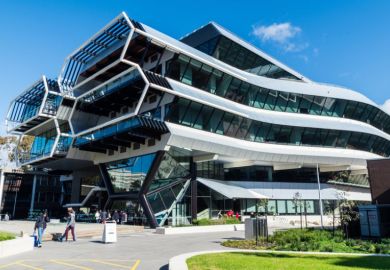
Credit rating agency S&P Global has put Australia’s top university on notice, saying rising staff costs and federal international education policies are “squeezing operating margins”.
The agency has changed its long-term rating outlook for the University of Melbourne from stable to negative, indicating that the institution risks being downgraded over the next year or two.
For now, S&P has maintained Melbourne’s long-term and short-term ratings at AA+ and A-1+ – respectively the second highest and highest markers of creditworthiness – while expressing doubts that the university can maintain its financial performance at that level.
“We could lower our ratings…if management is unable to control its expenses and narrow its operating deficits,” the agency cautioned. “The negative outlook reflects our view that the…operating margins may underperform our expectations.”
The warning underlines the pressure on Australia’s higher education sector, given that Melbourne is one of its most successful players. S&P’s assessment highlights the university’s “very strong financial profile” and “ample financial resources” to handle any downturn in its fortunes.
The university’s cash and investments of A$5 billion (£2.6 billion) are more than enough to cover its debts three times over, the agency says. Melbourne’s standing as the “top Australian university across two of the three major global rankings” guarantees that it will remain in “solid” demand.
Nevertheless, federal government policies to “trim” growth in international enrolments are “producing downside risks for the sector”, after Canberra introduced a “prioritisation threshold” for student visas and almost quadrupled visa application fees to A$2,500 in just two years.
Top Australian universities’ reliance on Chinese students adds to the risk, the assessment says. “Geopolitical tensions, currency movements or changes in visa rules could affect bilateral student flows.”
Melbourne’s chief operating officer, Katerina Kapobassis, said the revision of the university’s outlook reflected the “increasingly complex operating environment” facing the Australian sector. “We are already taking steps to actively manage these pressures and improve the long-term sustainability of our institution,” she said.
“We remain focused on balancing fiscal responsibility with strategic investments that allow us to deliver exceptional education and transformational research.”
The university’s audited accounts show that it has achieved surpluses for the past three years, although its 2025 figure of A$38 million – down from A$217 million the previous year – constituted a razor-thin 1 per cent margin.
However, under S&P’s figure of “net operating income” – calculated by excluding unrealised gains and losses – the institution has been in deficit for the past three years, the agency says. “The 2025 operating deficit reflects a continued trend of expenditure growth outpacing revenue growth. Revenue growth was tempered by a slight contraction in international student numbers [while] employee costs grew by nearly 5.7 per cent in 2025, largely reflecting salary increases under an enterprise bargaining agreement.
“We expect [Melbourne] to respond by cutting discretionary spending, pulling back on [capital expenditure] and managing staff headcount – including holding vacancies for longer.”
Register to continue
Why register?
- Registration is free and only takes a moment
- Once registered, you can read 3 articles a month
- Sign up for our newsletter
Subscribe
Or subscribe for unlimited access to:
- Unlimited access to news, views, insights & reviews
- Digital editions
- Digital access to THE’s university and college rankings analysis
Already registered or a current subscriber?