Australian students’ spending on degrees has grown four times as quickly as the government’s, after fees and subsidies were overhauled during the coronavirus pandemic. Yet domestic students are shouldering a smaller share of universities’ overall income than before Covid.
A Times Higher Education analysis of publicly funded universities’ audited accounts has uncovered conflicting trends of affluence and adversity over the past seven years. Explosive growth in universities’ money-making sidelines – particularly their international and investment operations – has masked the financial pain of students and individual institutions.
The sector’s overall prosperity is built on shaky foundations, with revenue prone to stock market fluctuations, inflationary spikes and international education policy hostility. Meanwhile, students and some universities are struggling to survive.
Mark Warburton, a former higher education policy chief in the federal civil service, said Australian universities’ earnings had grown fairly steadily – at about 5 per cent a year in nominal dollar terms – before the pandemic. Since then they have varied wildly, driven up and down by investment swings, erratic international income and an extra A$1 billion (£521 million) of research funding in 2021.
“We really need to think more constructively about how we secure the future of Australian higher education in an environment of such volatility,” Warburton said. “In the wake of the Universities Accord, we’ve got everyone running around saying we’re going to have 80 per cent of young people with tertiary qualifications, and carrying on as if that means there’s massive expansion coming for the sector. That’s an absolute delusion. The government’s shrinking the sector by putting the lid on international students, primarily for domestic political reasons, and pushing domestic students away from the big inner-city universities.”
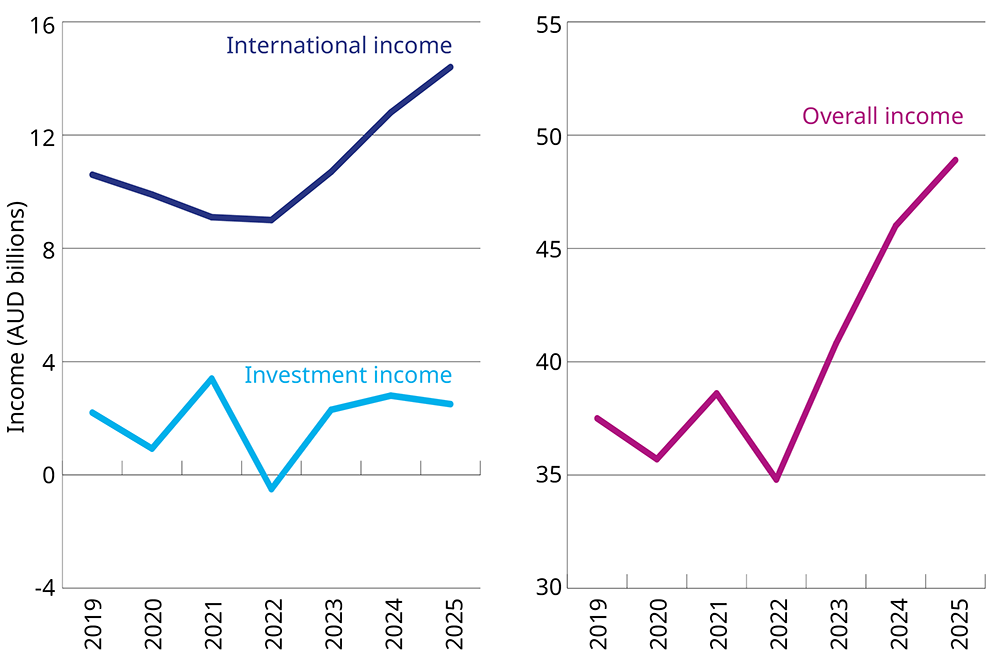
The accounts show that annual sector turnover has rebounded from about A$35 billion to A$50 billion in just three years, in a roller coaster ride of fluctuating fortunes. Universities’ combined income fell 5 per cent in 2020, rose 9 per cent in 2021, fell 10 per cent in 2022 and then rose by 17 per cent in 2023 and 13 per cent in 2024. Growth moderated to 6 per cent in 2025, when earnings reached A$49 billion.
The unstable figures reflect vacillations in investments more than enrolments. Portfolios that had steadily earned the sector about A$800 million to A$1 billion for the previous decade suddenly became more lucrative but far less reliable. Universities’ combined investments earned roughly A$2.2 billion in 2019, A$930 million in 2020 and A$3.4 billion in 2021, and then lost about A$530 million in 2022. Since then, they have garnered roughly A$2.5 billion annually.
International education earnings followed a V-shaped trajectory, falling from around A$10.6 billion in 2019 to A$9.9 billion in 2020, A$9.1 billion in 2021 and bottoming out at about A$9 billion in 2022. Since then they have rebounded to A$10.7 billion in 2023, A$12.8 billion in 2024 and A$14.4 billion in 2025.
Revenue of publicly funded Australian university sector, 2019-2025
Overseas students now provide almost 30 cents of every dollar of sector revenue, up from 24 cents in 2021. But the largesse is not distributed evenly. The five highest-earning universities – Monash, Sydney, UNSW Sydney, Melbourne and Queensland – monopolised 51 per cent of the sector’s international education revenue in 2025, up from 44 per cent in 2019.
Some smaller institutions have turned their fortunes around by feasting on overseas tuition fees. Charles Darwin, Murdoch and the University of Western Australia have more than doubled their international earnings since 2019, and Victoria University and the Australian Catholic University have almost doubled them. Most of these institutions were in deficit in 2022 or 2023 but none has recorded a deficit since, with three – Murdoch, UWA and Victoria University – posting nine-figure surpluses last year.
“My main concern is the number of unis that are seeing persistent losses, and what that means for their stability,” said Monash University policy expert Andrew Norton. “We’ve already seen with UTS and Wollongong, they have been in turmoil. [They have] fundamental problems with sustained losses, which they’re trying to correct but of course that antagonises the staff.”
The federal government’s contribution to universities’ revenue also fell slightly, from 47.2 per cent in 2019 to 46.1 per cent in 2025. The modesty of the decline suggests that changes in the cost patterns for domestic teaching are being overshadowed by fluctuations in international education.
Warburton said part of the policy intent of JRG had been to increase domestic students’ contribution to the costs of educating them from 42 per cent to 48 per cent. So far it had reached about 45 per cent, with students’ costs constrained by grandfathering arrangements – pre-JRG fees were maintained for students who had already begun their courses – and shifts in disciplinary preferences.
But it could still reach 48 per cent in the coming years, Warburton said.
THE’s analysis is based on the consolidated accounts of all 38 publicly funded institutions including the University of Notre Dame Australia, which has published financial statements since 2022.
Register to continue
Why register?
- Registration is free and only takes a moment
- Once registered, you can read 3 articles a month
- Sign up for our newsletter
Subscribe
Or subscribe for unlimited access to:
- Unlimited access to news, views, insights & reviews
- Digital editions
- Digital access to THE’s university and college rankings analysis
Already registered or a current subscriber?