Soaring revenue from the government and students left most of Victoria’s universities in robust financial shape last year, newly published financial accounts suggest.
The state’s eight public universities pocketed a combined A$14.5 billion (£7.7 billion) in 2025, some 7 per cent or A$969 million more than in 2024.
Income from overseas students rose at all but one of the eight, lifting their combined international earnings by 14 per cent or A$585 million to A$4.9 billion. The eight universities also shared a 7 per cent boost in their federal funding, which grew by almost A$400 million to A$5.9 billion, including an extra A$184 million –10 per cent more – in allocations through the Higher Education Loan Programme.
These increases easily offset a 7 per cent increase in the universities’ salary bills and a 5 per cent hike in their sundry expenses, which pushed their overall costs up by A$738 million or 6 per cent.
The good fortune was not universal, with two institutions – Federation and La Trobe universities – finishing the year in deficit. The University of Melbourne’s A$217 million 2024 surplus shrank to A$38 million last year, and Swinburne University’s surplus fell by more than half to A$29 million.
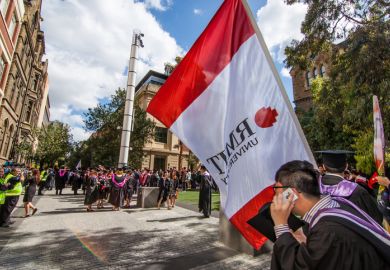
However, the other institutions substantially improved their financial standing, with Deakin University reversing its 2024 deficit to post a A$56 million surplus. RMIT and Victoria universities improved on their solid 2024 results to finish the year in the black by A$89 million and A$117 million respectively, while Australia’s biggest university – Monash – increased its A$308 million surplus in 2024 to A$580 million last year.
Monash boosted its income from foreign students by A$389 million to A$1.75 billion, about 41 per cent of its overall income of A$4.3 billion – both all-time records for Australian higher education. While Monash has the country’s most established network of offshore branch campuses, 88 per cent of its international education revenue was earned onshore.
Vice-chancellor Sharon Pickering said Monash had recorded an “underlying” operational result of A$201 million once investment income and philanthropic funds were excluded. “The stronger financial performance reflects higher student enrolments and increased international tuition fees, alongside ongoing disciplined cost management that constrained expenditure growth during the year,” she said.
“The university’s strong financial performance enhances its long-term resilience, ensuring it remains well positioned to manage periods of volatility and unexpected external shocks.”
Victoria University (VU) said its underlying surplus was A$36 million after investment income and “one-off items” were factored out. “The result reflects disciplined financial management [and] diversified and mission-aligned growth,” the university reported. “[It] positions VU well to continue…navigating uncertainty in the years ahead.”
Universities in other states achieved similarly robust results last year. Three of Western Australia’s four publicly funded universities, which published their financial accounts in April, posted nine-figure surpluses – providing buffers of between 15 and 22 per cent of their revenue – while the other, Curtin, finished the year a healthy 7 per cent ahead.
Queensland’s seven public universities also racked up solid results, with six posting surpluses.
These results are emerging as universities complain about government policies that lumber them with increasingly expensive regulatory burdens, short-change them of teaching subsidies and threaten their international operations.
The solid increase in earnings from overseas students occurred despite an increase in what were already the world’s highest student visa fees, although it pre-dated this year’s record visa rejection rates.
Register to continue
Why register?
- Registration is free and only takes a moment
- Once registered, you can read 3 articles a month
- Sign up for our newsletter
Subscribe
Or subscribe for unlimited access to:
- Unlimited access to news, views, insights & reviews
- Digital editions
- Digital access to THE’s university and college rankings analysis
Already registered or a current subscriber?