“Cold and calculated. I left without a thank you or goodbye from management. I worked there for exactly 10 years. I left without another job to go to. That’s how bad the situation was. Toxic.”
“University finances are so bad and required headcount reduction so high that people don’t want to survive this time. No one wants to teach in the new environment with so many colleagues being let go. I jumped with a payout!”
“All staff in our school apart from two courses were made redundant – and were offered the chance to reapply for our job, with interviews, for a worse salary, no pension and less holiday.”
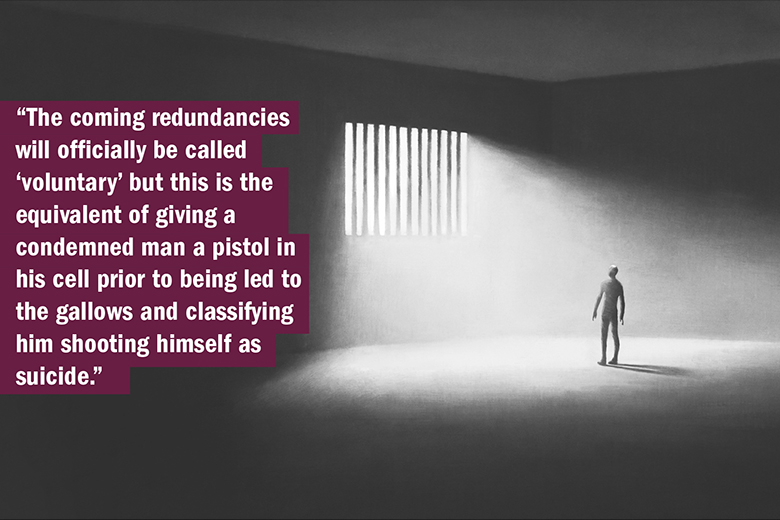
“The coming redundancies will officially be called ‘voluntary’ but this is the equivalent of giving a condemned man a pistol in his cell prior to being led to the gallows and classifying him shooting himself as suicide.”
“I am very unhappy in my new job. My mental health is suffering. I have no social life, no research opportunities, zero collaboration and a team I don’t relate to. It’s awful thinking this is probably my teaching ‘swan song’.”
These are just some of the thousands of comments submitted to Times Higher Education’s UK University Redundancy Survey that bring to life the vast human impact of the seemingly endless waves of redundancies that are sweeping across the sector.
Amid flatlining domestic incomes and a squeeze on student visas, UK universities have shed more than 30,000 jobs in the past three years, including more than 13,000 in 2024-25, the most recent year for which accounts are available.
Of course, 30,000 is only 6 per cent of a sector that still employs just over 500,000 people in that year, including nearly 250,000 people on standard academic contracts and just over 200,000 professional and support staff. But it still amounts to the largest upheaval in decades for UK universities.
The level of concern is reflected in the high number of responses received by our survey, which ran from 13 February until 12 March this year. In total, 1,095 people completed the survey, of whom 51 per cent identified as female and 43 per cent as male (1 per cent said neither and 5 per cent preferred not to say). The biggest age cohorts were 50-59 (35 per cent) and 40-49 (34 per cent). Another 16 per cent were in their 30s and 13 per cent were over 60. The majority – 67 per cent were academics, of whom 41 per cent are – or, at least, were – work in the social sciences, with 34 per cent in science and engineering and 21 per cent in arts and humanities. Another 26 per cent were in professional or support roles, while 5 per cent were senior managers.
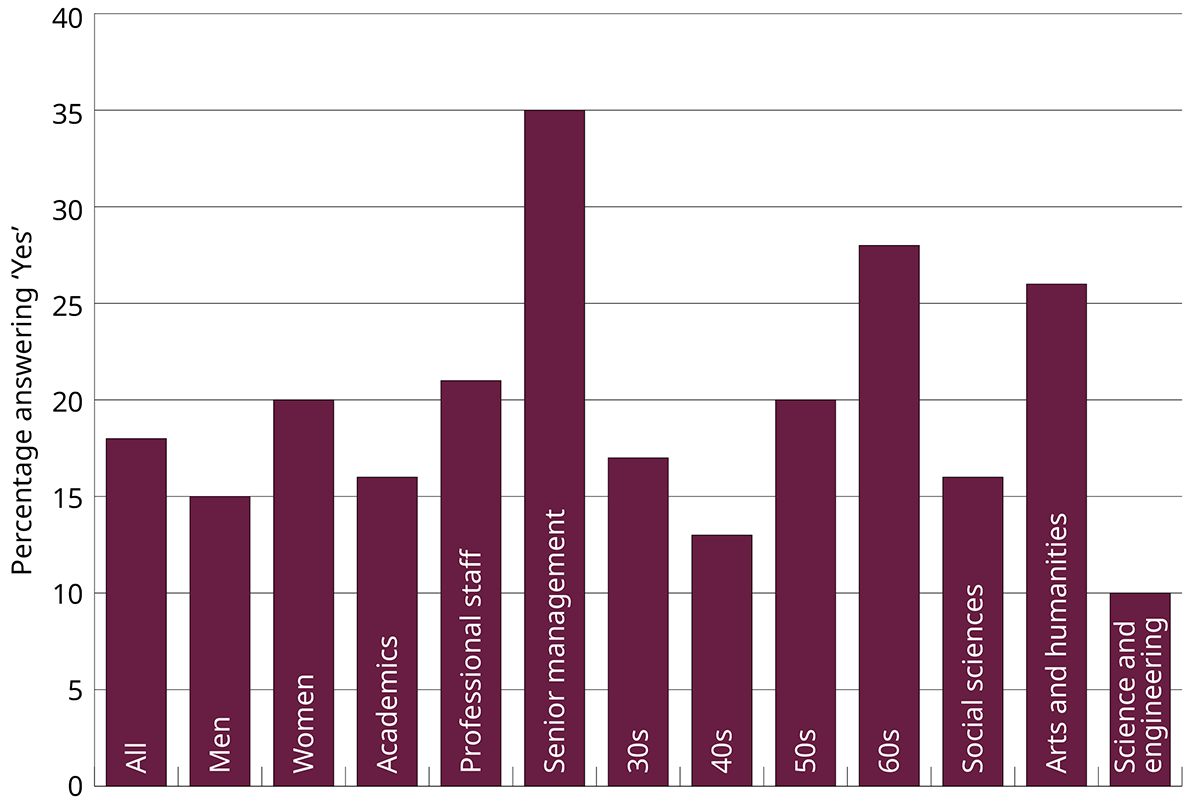
Of those 1,095 respondents, 198 (18 per cent) had been made redundant in the past two years. Interestingly, by far the most proportionally likely (35 per cent) to have been made redundant were senior managers. Women were also more likely to have experienced redundancy: 20 per cent had done so, compared with 15 per cent of men.
People in their 60s were the age range most likely to have experienced redundancy, followed by people in their 30s, and, among academics, those in the arts and humanities were the most likely (26 per cent), with science the least.
It is important to note that respondents were self-selecting, so those most affected and concerned by redundancy are likely to be over-represented. However, the scale of redundancies across the sector is such that few are likely to have been entirely unaffected. For instance, 68 per cent of respondents who have not personally experienced redundancy in the past two years had experienced it in their department or division. And the higher number of people affected by redundancy in the arts and humanities coincides with separate analysis by THE indicating that the majority of academic redundancies have indeed been focused in those subject areas.
Have you been made redundant by a UK university in the past two years?
Analysis has also found that redundancies have been particularly prevalent among those in precarious and teaching-focused roles.
Among our respondents who had been laid off, 86 per cent previously had permanent contracts, but 14 did not, compared with only 6 per cent of those who had not been laid off. One Classics academic in their 30s, for instance, has been “made redundant four times in 10 years as a result of fixed-term contracts”.
Of those made redundant, 87 per cent left as part of a broader redundancy round. For instance, a female biologist in her 30s explained that her university “decided to close the research centre I was director of and made redundant all who were paid from the REF 2021 funds allocated to the centre and those that were considered not to have a ‘significant teaching load’ – although what a ‘significant teaching load’ is was never defined”.
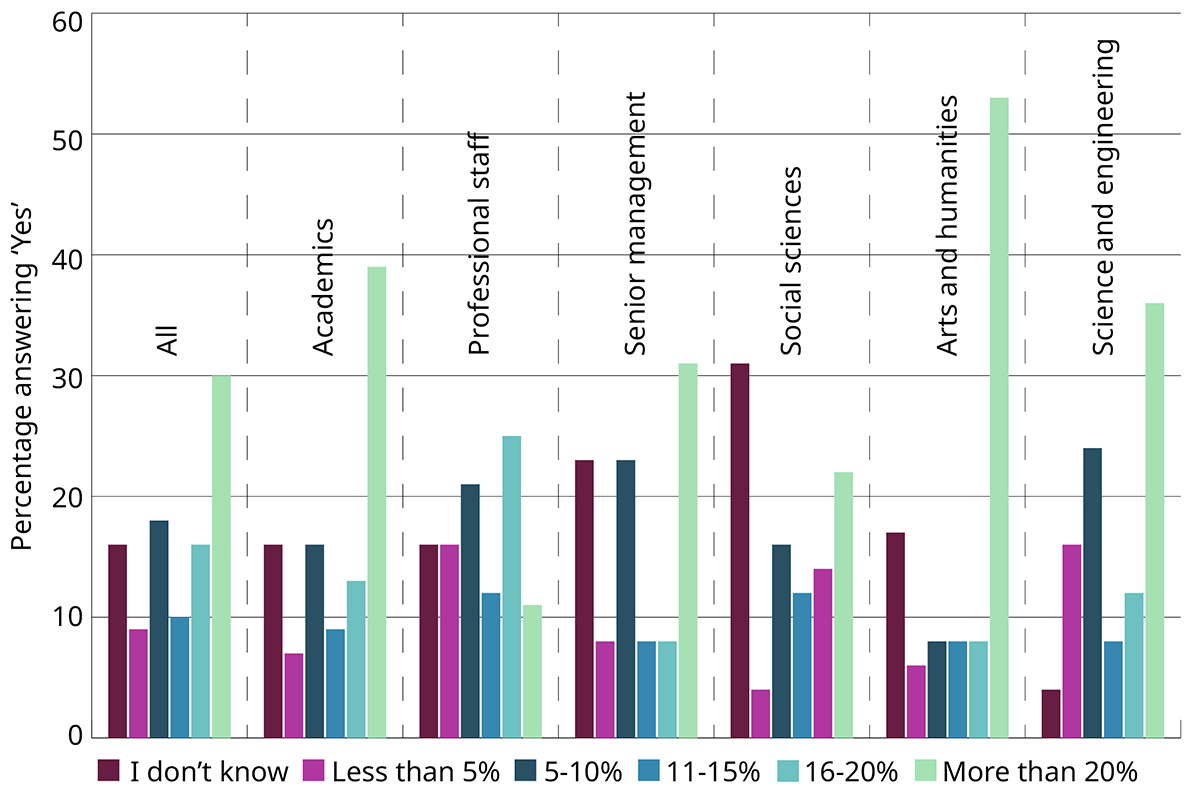
During those redundancy rounds, considerable numbers of departmental and divisional colleagues shared our laid-off respondents’ fate. Only 9 per cent of those respondents said that less than 5 per cent of their colleagues had been made redundant in the same round, compared with 30 per cent who said that more than 20 per cent had. That latter figure rose to 39 per cent among academics and fell to 11 per cent among professional staff, although the proportions losing more than 10 per cent of colleagues were more even: 62 per cent for academics, versus 47 per cent for professional staff – and even 46 per cent of senior managers.
The subject-group analysis further underlines the disproportionate hit taken by the arts and humanities: 69 per cent of academics in those subjects shared redundancy with more than 10 per cent of their colleagues, and 53 per cent with more than 20 per cent.
If redundancies in your department/division were part of a broader round, approximately what proportion of colleagues were made redundant?
“All staff were made redundant in my department, while our sister department was expanded by 2.5 times its previous size,” said a doctoral college academic in their 50s, who had been in their job for more than 20 years.
“Within my photography specialism, 100 per cent of permanent specialist staff were made redundant,” said another academic in his 60s. “The department has since been staffed by sessional workers on unsustainable workloads, in breach of working time regulations.”
The disproportionate impact on junior and senior staff is also clear in the comments. “There have been four rounds of voluntary redundancies and [the university has] also not renewed any of the fixed-term contract staff, most of whom were early-career researchers,” said a business and management academic.
And “out of the approximately 40 academic staff in [our] research centre, nine were placed at risk of redundancy and seven were made redundant, all over the age of 60 except me (one of the youngest female professors in the UK),” said a biologist in her 30s. “The two colleagues that were not made redundant were ECRs with line managers willing and able to fight for them.”
But academics were not the only ones affected. One respondent’s professional division, international recruitment, “lost all the management: one director, one head and two senior managers. I was one of them.”
The proportion of redundancies that were compulsory is also differentially spread among respondent demographics. Among those who have been made redundant themselves, 49 per cent reported that their redundancy was compulsory, rising to 59 per cent of academics (compared with 32 per cent of professional staff), 52 per cent among men (versus 47 per cent of women), and a huge 72 per cent of people in their 60s (versus 47 per cent for people in their 50s). The same proportion of arts and humanities academics had been made compulsorily redundant, versus 49 per cent in the social sciences and 59 per cent in science and engineering.
The precise scale of compulsory redundancies across the whole sector is not easy to calculate, however. Among people still in their positions who have witnessed redundancies in their department or division, 20 per cent did not know what proportion of those redundancies were compulsory, while 42 per cent believed that none of them were and 15 per cent opted for less than 10 per cent. Only 10 per cent thought that all their local redundancies were compulsory.
Across their institutions as a whole, 51 per cent believe there have been compulsory redundancies during the previous two years, while 26 per cent do not; the rest didn’t know. Only 4 per cent of respondents believed all the redundancies at their institution had been compulsory, and only 22 per cent thought more than 10 per cent had been; 27 per cent said none of them were.
Yet many respondents point out that “compulsory” and “redundancy” are slippery concepts. For instance, many casualised staff have been quietly laid off and many short-term contracts have not been renewed – which is not officially classed as redundancy. And one respondent noted that “many people have left the organisation through ‘compromise agreements’, which do not require consultation and are in effect hidden redundancies. Staff who are taken into these ‘protected conversations’ often do not know their rights, or simply feel bullied into leaving their roles.”
Moreover, redundancies that look voluntary on paper might not have been in practice. For instance, one learning technology support staff member’s redundancy was officially referred to as “‘mutually agreed resignation’ to avoid using the word redundancy”.
Another redundancy, of an academic in their 50s, was officially voluntary, but “the proposal was to cease provision of my subject area. I could not run the risk of compulsory redundancy given my personal circumstances and the limited employment opportunities in the area.”
An English academic in his 60s noted that his voluntary redundancy, too, felt “voluntary in name only. The strong threat of compulsory redundancy and an invidious ‘consultation’ process created a hostile environment that felt designed to strong-arm as many of us out the door as possible while allowing the university to escape reputational damage.”
An English academic in her 50s heard her senior leadership “bang on” about avoiding compulsory redundancies in two rounds. “However, many of these ‘voluntary’ departures were people who were told their programmes were closing…It’s hard to fathom how someone…can continue to work at the university when the programme they teach on is closed.”
Many of a sociologist’s colleagues deemed “at risk” chose voluntary redundancy “knowing that if they didn’t they would very likely face compulsory redundancy, on much less favourable terms – a classic case of jumping rather than being pushed. Staff also at least felt they had some control over this decision.”
But some respondents reported that they and their colleagues had to fight for a voluntary option via industrial action. And others were never offered it at all. One criminologist’s department went “straight to compulsory redundancies, saying they couldn’t afford voluntary. The [redundancy pay] cap was £20,000. [Even] colleagues who had been there 30 years could get no more than this.”
And one peace studies academic said her vice-chancellor “doesn’t believe in voluntary redundancy because you ‘lose the wrong people’. It’s also an ego thing.”
Another problem with unearthing the reality of redundancies is the frequent requirement for laid-off staff to sign non-disclosure agreements (NDAs) in return for an enhanced redundancy package.
Just under 35 per cent of laid-off staff reported being required to sign an NDA. One respondent, for instance, was “aware of several senior colleagues with admin roles…who were taken into meetings, given an NDA and a package, and escorted out/given a week’s notice. These were done quickly and quietly. It was framed as ‘you will notice that some colleagues have decided to leave’...in an all-staff email.”
Notably, 38 per cent of men were asked to sign an NDA, compared with only 31 per cent of women – though this possibly reflects the higher number of men in science and engineering; 46 per cent of that group were asked to sign an NDA, versus just 19 per cent of those in arts and humanities and 37 per cent in social sciences.
According to one sociologist, everyone accepting voluntary redundancy in her university was expected to sign an NDA and “drop all grievance and constructive dismissal claims”. That was the same in the case of a social scientist in their 60s. “But I refused [to sign] even though it cost me some financially.”
A global health academic in her 30s also “refused to sign for an extra £200”, adding that her university was “absolutely disgusting and has a horrible culture”. A lab manager in his 50s was “offered the absolute minimum package that could be legally justified, so would not have signed an NDA”.
Even in the absence of an NDA, an academic in learning and teaching pedagogy in her 60s was “told to keep quiet and not tell my students”.

What reasons were cited for the redundancies? In academic departments, by far the most popular response was “financial issues across the wider university”, cited by 45 per cent of respondents (giving more than one answer was possible). Only 19 per cent had heard the redundancies attributed to falling student demand for courses offered by their specific department, while 14 per cent had heard the blame directed at anticipated changes in future student demand for courses offered by their university generally and 12 per cent at an anticipated drop in future student demand for courses offered by their specific department. Strategic and structural changes were also mentioned.
Those in science or engineering departments were disproportionately likely (48 per cent) to have heard university-wide financial issues blamed, while 24 per cent of arts and humanities people had heard falling student demand for courses offered by their specific department blamed, versus 17 per cent of scientists.
A global health academic in her 30s was told that her department’s staff-student ratio was too high “despite our course over-recruiting and doing extremely well. Despite us all being burnt out and overworked.”
A set of redundancies in a chemistry department was blamed on a new course that was “supposed to start but closed down due to insufficient applicant numbers. While the department appointed two new academics who were supposed to deliver the course, it made me redundant after 17.5 years of service but not them,” said an academic in their 50s.
One university “forced an expansion” on its English for academic purposes (EAP) centre “despite the director advising the future numbers wouldn’t support it”, according to a former worker in her 40s there. “They hired new teachers and paid £1 million to renovate extra offices/classrooms and less than two years later, when we didn’t get the student numbers, announced widescale compulsory redundancies. We had to strike to get a voluntary package.”
And while another university’s lecturers said its students’ English-language ability was not good enough, “the university took the decision to pretty much remove academic English support for international students”.
An English literature academic in their 30s heard redundancies attributed by managers to “everything except their own incompetence and financial mismanagement. The university had a black hole in the finances because of investments abroad which were failing. The strange thing was that some successful courses were being closed while others with low demand were being kept.”
There was also a sense among some respondents that they had been personally targeted.
The lab manager in his 50s was “moved from a (permanent) administrative role back into an academic department in order to justify my redundancy. That academic department was closed due to ‘falling student numbers’, although the university had to turn students away in order to justify this, and the department was still highly profitable and carrying out world-leading research at the time of its closure. Another person was given the role I had been filling.”
Since the manager is not a UK national, “at the same time, the university informed the Home Office that I would no longer have earnings sufficient for me to act as a sponsor for my wife and daughters to remain in the UK (they have subsequently been forced to leave). Significant racist language was aimed in my direction during the process, leaving me with little doubt as to the reasons for my being targeted.”
A chemistry academic in his 50s also felt that stated rationales were just a facade to disguise personal grudges: “I was the only one in the pool out of three academics [to be made redundant]. I was selectively and racially targeted. The business case was completely false.”
An English academic in their 30s had a sense that many laid-off colleagues “were in vulnerable positions having given birth or having need of money to care for families. Many of these were migrant staff or single mothers and could not fight unfair dismissals. I think they targeted those people on purpose: they would go silently and the unfairness and injustice would be hidden.”
There is also a sense among some respondents that those with chronic illnesses were singled out. Among around 200 compulsory redundancies in one respondent’s institution were several “long Covid sufferers in recovery”. An academic in their fifties said that their illness was “specifically cited” as a reason for their redundancy: “My illness was seen to be costing the university money and I was told there was no longer a role for me.” And a laid-off employability professional in her 50s, with more than 20 years’ prior service, “had recently had cancer and had been more or less sent to Coventry by senior leaders. My performance was still good, but I get tired easily and I needed some minor adjustments.”
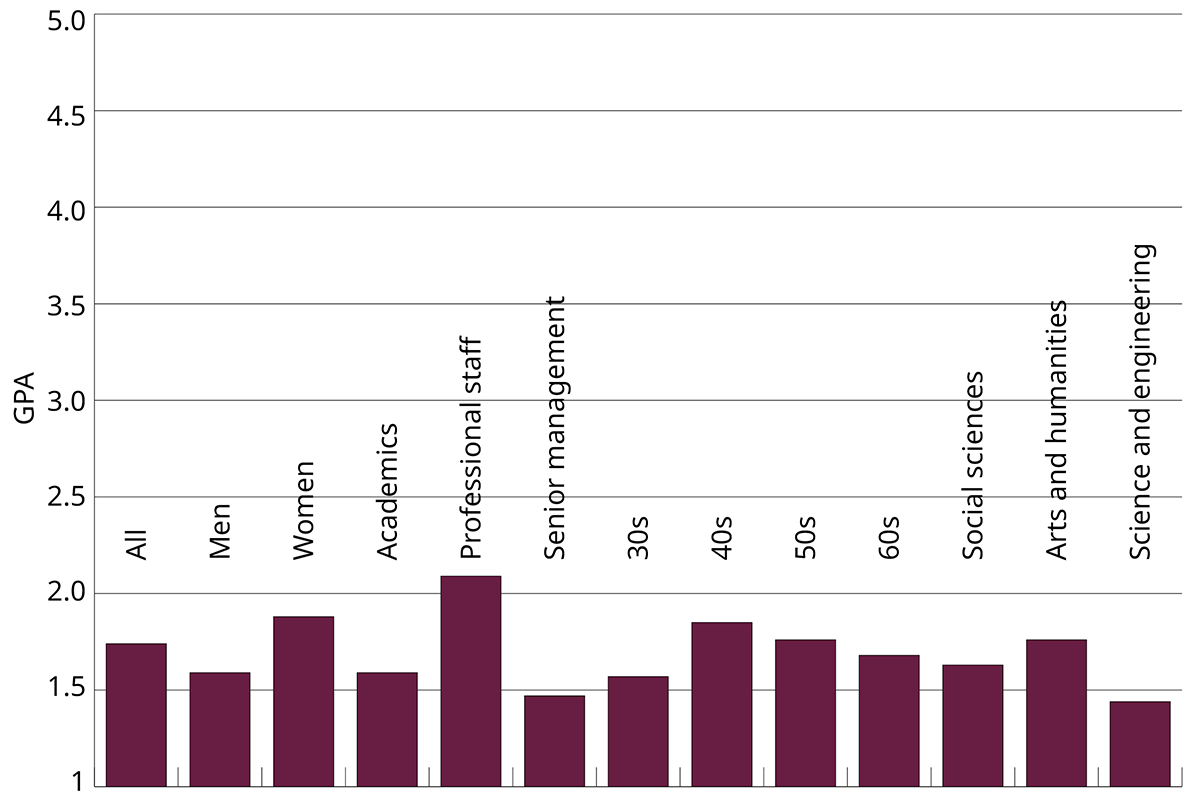
Indeed, there is a common sense among laid-off staff across the board that they got a raw deal. Asked whether their “position or performance justified your being made redundant ahead of colleagues”, only 8 per cent agreed, 5 per cent strongly. On a five-point Likert scale, where 1 means “strongly disagree” and 5 means “strongly agree”, that translates into a grade point average (GPA) of 1.74.
However, while the individual sample sizes aren’t huge, the demographic differences are interesting. Women are more likely than men to agree that they deserved to be made redundant, and professional staff are more likely than academics or indeed any other category to agree. People in their 40s are much more likely than people in their 30s to agree, and those in the arts and humanities are more likely to agree than those in science.
To what extent do you agree that your position or performance justified your being made redundant ahead of colleagues?
“My performance was consistently rated as outstanding over the entirety of my career at the institution: [my redundancy] was all about numbers and cost-cutting,” said one academic.
A film studies lecturer in his 60s was “one of the more productive and fully engaged members of staff. I was ethics lead for our school, and I sat on the academic board of the university.”
A digital skills training professional in her 40s was laid off alongside her colleagues despite the fact that they were “the only ones doing our role in the whole of the university and we received amazing praise for our efforts from the registrar the day that we had our first HR meeting!”
And despite being fixed term, a social scientist in their 30s “taught the largest modules and had a very high workload”.
The sense of a historian in her 30s was that “those who had been at the university longer were favoured” when it came to redundancy decisions. But a sociologist in her 50s had been the “top performer in my department, with three grant applications pending. But voluntary redundancy was targeted at over-55s because older staff are more expensive.”
And an English academic in their 30s noted that managers had “a matrix which they rigged towards those who had been there the longest and would cost more to make redundant. They did not care about the Equality Act nor gave any reasonable adjustments. They called your bluff if you said it was unfair. You could take them to court.”
A research and innovation support staff member in her 40s noted that in her department “there was no broader skills assessment undertaken to ensure the best staff were retained. Equally, equality impact assessments completed as part of the restructuring process were not transparent, not informed by evidence or the voices of lived experience, and were deeply biased. I feel that this has resulted in more marginalised staff being made redundant.”
The photography academic whose courses are now being delivered by sessional staff was “voted lecturer of the year in both 2024 and 2025 by students. Over 100 students signed a petition opposing my redundancy, citing measurable harm to their education. My teaching feedback scores were consistently strong. There was no performance basis for selecting me ahead of colleagues – the selection was retaliatory.”
Some respondents note that they are pursuing employment tribunal claims for unfair dismissal. One is a creative arts and media academic in her 60s, who saw her role “immediately replaced by a cheaper associate lecturer, so clearly [the issue] was not redundancy but restructuring. I was put into a pool of one, with no pre-pool consultation. A fully costed counter proposal was submitted by senior leadership in another department but was rejected without explanation.”
It is also important to note that some of those who took voluntary redundancy were happy to do so. One management science academic in his 40s was “a very high achiever. Hence, it made sense to take voluntary payout because I knew I’d gain a job relatively quickly. I have moved from a top-10 traditional university to a post-92 university, but in the same city, so there has been no real impact and I have moved the payout into my savings.”
A male mathematician, too, was “quite happy” to “jump before giving them the chance to push me…since I was only 18 months from the state pension age”.
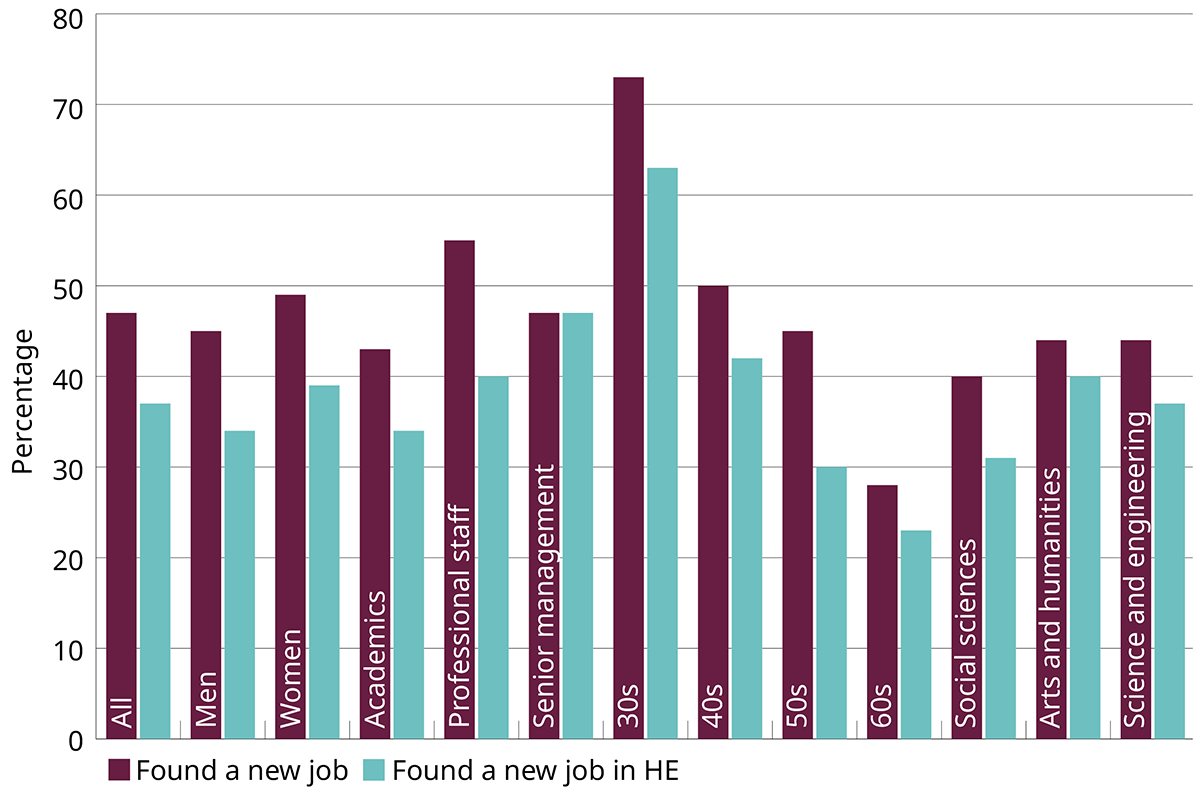
So how have laid-off staff fared in terms of finding new jobs? The picture is decidedly mixed. Overall, 47 per cent have succeeded, and that blanket figure belies significant variations between specific groups.
Women are slightly more likely than men to have found a new job (49 versus 45 per cent), although it is also true that a slightly higher proportion are actively looking for one (76 versus 73 per cent) – which could reflect the higher proportion of men among the over-60s (54 versus 43 per cent).
Professional staff and senior managers are more likely than academics to have found a new job. Perhaps surprisingly, there is little difference between subject groupings in terms of job hunting, with 44 per cent of both arts and humanities and science and engineering academics having found one, along with 40 per cent of social scientists.
Less surprisingly, the likelihood of finding new jobs declines steadily with age. While 73 per cent of those in their 30s have found new jobs, that falls to 28 per cent of those in their 60s.
It is important to note, however, that significant numbers of the latter group have taken early retirement, as reflected in the fact that only 55 per cent of them are actively looking for another job, compared with 88 per cent of those in their 40s. Only 38 per cent of those in their 60s who are without a job consider finding a new job a financial necessity, compared with 87.5 per cent of those in their 30s and 92 per cent of those in their 40s.
Among those that have a new job (94 people), 78 per cent are still working in higher education. And albeit with relatively small sample sizes, the breakdown is interesting. All senior managers with a new job are still working for universities, compared with 80 per cent of academics and 71 per cent of professional staff.
The likelihood of remaining in the sector falls with age before rising again for those in their 60s, perhaps reflecting the diminished opportunities for a career change in late working life. Perhaps surprisingly, those in arts and humanities are more likely (89 per cent) than those in other disciplines to have found new university jobs even though layoffs have been higher in those subjects, perhaps reflecting the fact that arts and humanities academics have fewer obvious alternative career options. The figures for social science and science and engineering are 76 per cent and 83 per cent respectively.
If you have been made redundant in the past two years, you have...
Some laid-off respondents have very much landed on their feet. A management scientist in his 40s found his new job “after signing the settlement agreement but before my departure date, so it lined up seamlessly”.
Overall, 38 per cent of laid-off staff moved into a new job straight away, and another 32 per cent within three months. A full 88 per cent are still in the UK, with almost all the rest elsewhere in Europe.
Those moving into a different sector (a small sample size of 21) tended to take longer to find their new roles: only 24 per cent did so immediately, and another 24 per cent within three months. Five individuals have gone into other forms of education – secondary or further. Another three have entered the Civil Service.
The disability support services professional was “already working part-time in another role, so I continue to do this while also looking for a new role. The redundancy financial package has made this possible.”
A social scientist over 60 moved into what they call “semi-early semi-retirement”, holding on to a visiting professorship role: “I’m incredibly happy. In comparison to working for such an abusive, Kafkaesque employer.”
But others have not been so lucky. A laid-off politics academic in his 50s found another job – but has lost it since through another redundancy. Meanwhile, a former learning and development support staff member in her 40s “knew I was under threat of redundancy last February and started applying for jobs immediately. I took voluntary severance and left in October, by which point I’d applied for around 40 jobs and had numerous interviews. I then took the decision to go freelance to keep the wolf from the door. I’ve now found a permanent role in a different sector, taking over a £10K pay reduction.”
Indeed, eroded pay and conditions seem to be common for those who have found new employment, in or out of the sector. A physical education academic in his 50s has found various part-time roles but only managed to recoup approximately 50 per cent of his former salary.
A historian in her 30s now has to work two jobs – “one of them still teaching in a university, the other in a role that’s academic-adjacent but involves university work. That second job is also financially precarious due to issues in the sector.”
An interior architecture and design academic “did find another job, but at a £20,000 lower salary. There are no jobs! So now I keep thinking ‘I’m grateful I have a job’. I am 61, single and after teaching with an excellent record for 25 years, I ended up in this dire situation because of the greed of the university management, particularly the vice-chancellor.”
The lab manager in his 50s is “currently working as a supply teacher, which is a low-paid, zero-hours role”.
Regardless of whether they went back into HE or switched sector, many respondents (41 and 43 per cent respectively) who have found a new job are now on worse terms and conditions than they were before. Those who switched sector are slightly more likely (29 per cent) to be on improved terms than those who remained (26 per cent), though, to repeat, the sample size for the former is small.
Among those who remained in the sector (73 respondents), 45 per cent now have a lower level of seniority than before, and only 18 per cent a higher one.
One former middle manager in library services has “returned to a teaching post after nine years in management. The conditions in the department are not bad, but this is not a role I wished to do or go back to.” Another senior manager has stepped down into a role as a communications lecturer, “which I prefer, but my salary is halved and it’s a financial struggle”.
A student services professional in their 40s now faces “longer working hours, worse office premises and a less good pension”, while an economist in his 60s has lost “more than a third of my previous income”. And since his new employer is far away, he incurs “additional accommodation and other costs”, so his “standard of living is worse”.
A former professional staff member is even worse off: “I am a temporary worker with no benefits.”
Meanwhile, for a female biologist in her 30s, the problem with her new role is not so much the terms and conditions but the fact that it is “entirely teaching-focused, with no space to accommodate my internationally recognised research”.
The management scientist who moved from a pre- to a post-92 university said the Teachers’ Pension Scheme pension he is now entitled to is better than the Universities Superannuation Scheme, “but overall conditions are worse: more teaching, less research, sick benefits appalling”.
An English literature academic in his 50s who has moved to an Irish university noted that “Irish HE seems to be less down the path to the calamitous situation in which UK universities find themselves. Most notably, it retains a sense of the value of intellectual ambition which was being radically undermined in some sections of my previous university.”
Still, he “greatly preferred my old job because it was a permanent post and because I’d dedicated the best part of three decades of my life to my previous institution. His new position is “a stop-gap and I think it’s the end of my academic career. I was an associate professor. I am now on a temporary (eight-month) contract (teaching cover) as a lecturer.”
But others are more positive about their new lot. A historian who has moved into research services feels that although their contract is now shorter, “workload management is taken more seriously in professional services – even academic-related – than in academic and research roles”.
A psychologist in her 40s who has moved to Canada with lower seniority but better T&Cs is unambiguously positive about her move: “The UK higher education system is crumbling. Here, I actually feel valued and supported.”
A fashion design academic in her 40s now has “slightly fewer benefits but I have the same pay on four days [a week] as I had on five”. A business and management academic in her 40s now has “job security and the benefits that go with a permanent contract”. And a linguistics and education academic in her 50s now finds herself in a plum role, in which “pay is higher and the job is much less demanding”.
Those who have remained in the sector are more likely than those who have left to say they prefer their new job to their old job, with a GPA of 3.51, versus 3.14. Those in the arts and humanities are much less positive about their new roles (2.94) than scientists (3.40) and social scientists (3.94), albeit on small sample sizes. The same caveat applies to the observation that those in their 30s (3.26) and 60s (3.22) are less positive about their new roles than those in their 40s (3.75) and 50s (3.65). There is little difference between academics and professional staff.
A historian in her 30s has found a new university job, “but it is not an academic job and I have taken a significant reduction in salary and prospects. My work environment (team, management, culture) is better, but I am bored and depressed in a role for which I am significantly over-qualified.”
The former library manager finds it “difficult to quantify” whether she prefers her new position. “I came to hate my old job, which originally I had loved, because of the disinvestment in my team, increasingly psychologically unsafe working environment, lack of support from senior management, and poor/stressful working conditions. So in many ways I am relieved to be out of it. The forcing of me out of it in a brutal and humiliating way, and into potential destitution however, was not how I would have chosen to leave. I would prefer any job that doesn’t do that!”
That sense of simply being glad to be out of a toxic situation, regardless of the impact on income or T&Cs, is common.
“The redundancy process was poorly handled in my previous department, so, despite the loss of pay and conditions, I am feeling happier in my new role in a new department than I have for many months,” said a philosophy of education academic in her 40s.

And while a linguistics academic in her 40s has seen redundancy “kill my trajectory towards senior lecturer and permanence”, she prefers her new two-year, externally funded research job “because I can finally do research full time without teaching or admin. My old job had all three, but I was at 110 per cent in my workload and research was proving difficult.”
Indeed, 49 per cent of those who have moved to careers in other sectors disagree that they would have liked to find another job in the university sector, 24 per cent strongly – compared with only 43 per cent who agree, 19 per cent strongly.
The former learning and development professional, who now works in local government, is “fed up with HE after 12 years. The leaders are generally incompetent, most couldn’t run a piss-up in a brewery. I have loved working in HE and very much aligned to its purpose, but they don’t value their people.”
A business academic in his 50s, who had been at his university more than 20 years before moving to the housing sector and then retiring, added: “The HE sector has been in crisis for some time and the job has changed out of all recognition since I started. I had the best of it and was glad to leave now.”
A human resource management academic in her 50s who is now a self-employed management and leadership trainer and also does some part-time associate lecturer work, considers the HE system to be “broken” by pressure to hit the Office for Students’ progression targets. This “means we are made to pass international students with poor levels of English, lack of academic ability and [who are] in some cases plainly cheating”.
Accordingly, only 34 per cent of those who have left the sector agree that they would like one day to return, against 52 per cent who disagree, 38 per cent strongly. The former learning and development professional “wouldn’t rule it out”, but “there would need to be significant change in the way HE is governed and led, instead of the car crash it is now.”
Of those who have been made redundant in the past two years, 53 per cent – 106 individuals – still have no job. Of those, 64 per cent are academics, and of those, the largest share – 42 per cent – are social scientists, compared with only 20 per cent who are scientists or engineers.
The majority – 57 per cent – held their last university job for more than 10 years, and 27 per cent for more than 20 years; 94 per cent lost their jobs as part of a redundancy round. Only 18 per cent have been unemployed for more than 12 months; 33 per cent lost their job in the past three months and another 22 per cent within the past six months.
Their unemployment is largely not for the want of trying to find a job. Three-quarters (75 per cent) are actively looking for a job – although “it is really more like ‘jobs’ than ‘job’ because there aren’t any jobs in my field, so I am forced to apply for a number of low-paying temporary gigs. It is hard to make ends meet,” said an English academic in her 50s.
Two-thirds (66 per cent) of unemployed respondents agree that finding another job is a financial necessity for them, 52 per cent strongly. Only 16 per cent disagree, 8 per cent strongly.
“I can take part of my pension next year but it’s not big, so I need to earn something,” says a former senior manager in her 50s. “I still have a mortgage and a child to see through university.”
A former EAP lecturer in her 60s has “some income but it does not cover my daily bills, so I am eating into savings”, while a former employability professional in her 50s predicts that she will “lose my house soon”.
But the picture isn’t universally negative. The redundancy package received by a former disability support professional in her 50s “allowed me to pay off all existing debts”. She now works part-time freelance, “although the hours can be variable, so if I can get another salaried part-time role it would help when freelance hours are low – but is not a necessity as such.”
A social scientist in his 60s, by contrast, no longer feels any financial need to find any kind of paid work and is “loving early retirement”.
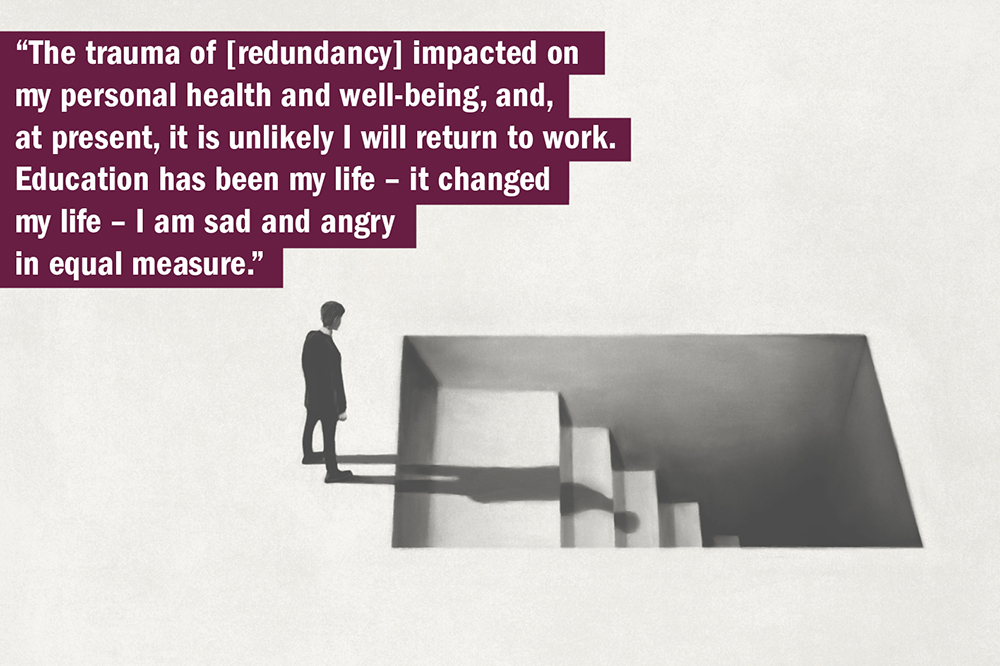
It is also worth noting that not everyone who has stepped out of the job market has done so because they are financially comfortable. When another academic in their 50s explained that they “had to take early retirement from HE as the bottom line is that we have to live”, they weren’t referring to the need for an income. “The trauma of [redundancy] impacted on my personal health and well-being, and, at present, it is unlikely I will return to work. Education has been my life – it changed my life – I am sad and angry in equal measure.”
A Japanese studies academic in his 50s also needs “time to process what has happened and get energy to find and do another job. I will almost certainly not return to academia – though I know I could (outside of the UK).”
A former professional support officer in knowledge exchange and entrepreneurship training in her 30s “suffered a psychiatric injury as a result of the process. I have not been well enough to participate in the activity of seeking work [since then].” She is instead “working fully as a [employment tribunal] claimant in person to prove my dismissal was unfair”.
But the need for income in most cases is such that only 15 per cent of those looking for another job are confining their search to the university sector.
For instance, a sociologist in his 40s is applying for “a much larger proportion of jobs in the Civil Service and thinktanks than in the university sector as there are simply not enough available jobs in HE right now”.
Others positively yearn to switch sector. An estates professional in his 40s would “very happily work elsewhere than the university sector. Professional services staff are sadly treated as second-class citizens.”
And though a male respondent in his 50s is not currently seeking work, when he “eventually” does, he will “consider something more gentle. I was in a senior academic manager role and therefore want to slow down a little and decompress.”
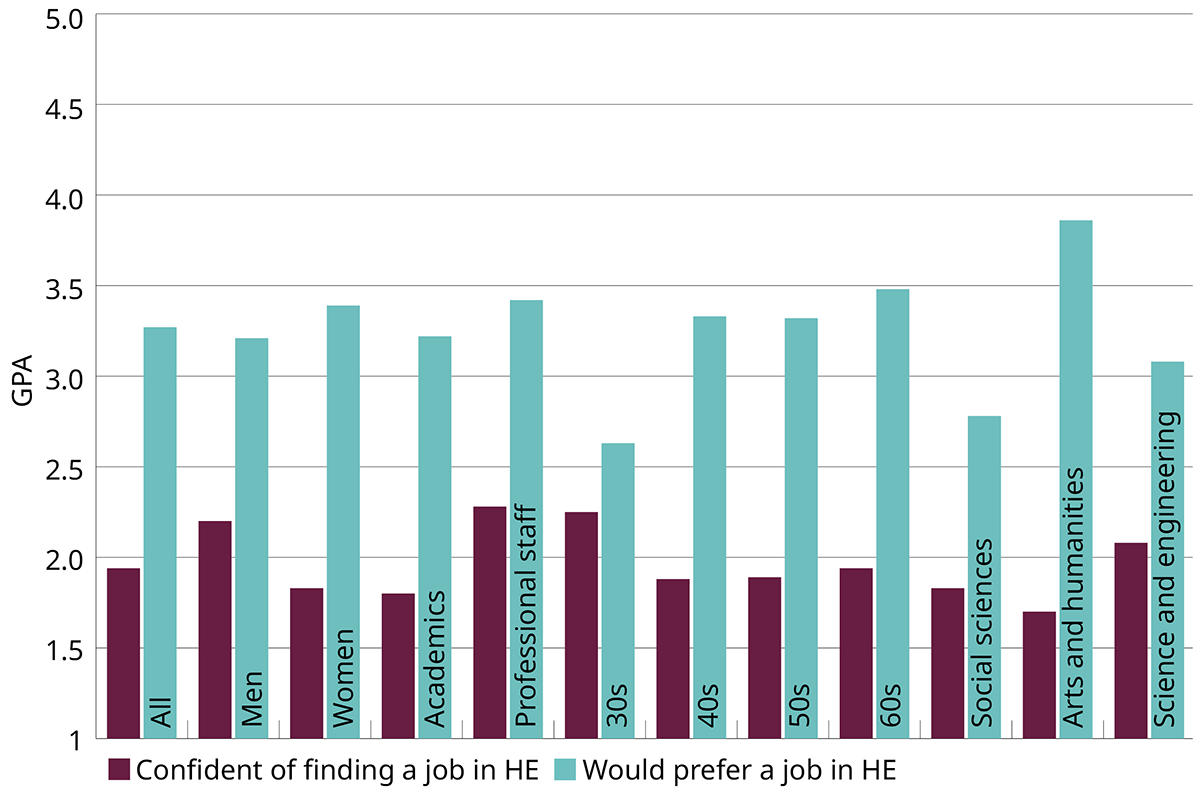
Overall, however, 44 per cent of unemployed respondents agree that they would prefer to find a new job in the university sector, 25 per cent strongly. Only 29 per cent disagree, 14 per cent strongly.
Arts and humanities academics are the most likely to agree that they would prefer another university job, with a GPA of 3.86, with social scientists (2.78) less keen than scientists and engineers (3.08). Women (3.39) have a slightly stronger preference than men (3.21) and professional staff (3.42) have a stronger preference than academics (3.22). People in their 30s (3.26) have a weaker preference than those in their 40s (3.75) and 50s (3.65) – though all these figures are subject to the caveat that the sample sizes are small (40 individuals or fewer).
But many respondents are torn.
“I find the university system in this country increasingly divisive and toxic,” says an English academic in her 50s. “However, my mortgage lender would really prefer to see me in salaried work, and if a university offered me a position, I’d have to take it.”
A former senior manager in her 50s is considering “widespread” sectors due to fears that if she got another university job, she might be laid off again: “With the cuts to arts and humanities, I can’t see any job in HE being sustainable.”
A sociologist in her 50s will reluctantly find a new university to host her if she wins a large grant she has applied for. But she has a long list of reservations: “Managers are continuously implementing new initiatives totally unsuited to our sector, and academics are miserable and insecure, their expertise given very low status [and their work having] little autonomy or flexibility. University-sponsored AI is ruining learning and assessment, fragmentation of teaching and marking is lowering teaching quality, admin staff subject academic staff to constant and intense surveillance, and workloads make taking holiday almost impossible, resulting in a big rise in sickness absence – which in turn further intensifies workload.

The EAP academic in her 60s agreed: “I have enjoyed working with students, so being able to continue doing this would be great. But the atmosphere in the HE sector is toxic, negative and draining/stressful, so at times I think it is better to move on.”
But an art and design academic in his 60s noted that “leadership cultures” and “staff are well aware – through [union] networks, THE reporting and word of mouth – of which institutions have toxic working environments. Some HEIs are renowned for bullying, cronyism, and retaliation against those who raise concerns. Governance failures are widespread and systemic, not exceptional. I would need significant confidence in an institution’s culture before returning to the sector.”
Of course, even if respondents want a new university job, they may well struggle to find one given the paucity of jobs being advertised – not to mention the huge competition they will face from other laid off staff. Accordingly, of those looking for another job in the university sector, 77 per cent are pessimistic about their chances of success, 36 per cent strongly so. Only 5 per cent are optimistic.
Women are less optimistic than men, academics less than professional staff and arts and humanities academics less than scientists.
Jobseekers’ perspectives
“Two positions in my field have come up since I was made redundant, both junior, and for both I was told they couldn’t afford to hire someone at my level and wouldn’t take me at a lower level,” says a former English academic in her 50s who has been unemployed for more than 12 months and is very pessimistic about finding another academic job.
An East Asian geography academic in his 60s has “some great publications that would add to a Research Excellence Framework score in many departments”. Yet apart from the competition, “universities are actively ageist in their recruitment of academics, making the excuse that they’re supporting early career researchers when really they just want to pay less and recruit someone more docile.”
A film and cultural studies academic in her 40s has “applied for two jobs and did not get them. In one instance, they told me they’d received 226 applications (it was a part-time post) and did not [even] consider them all.”
Another academic puts it more pithily still: “I’m 59 and in the humanities. What are the chances?”
Of course, the chances of remaining in higher education are higher for those who are more mobile.
The East Asian geographer would “rather go overseas. That’s where the interesting and exciting work is these days. The UK is boring and stressful, with overwork a standard feature.”
And another human geographer in their 40s has already moved with their partner to the EU “because UK academia is on a hopeless downward trajectory. I was made redundant while on a fellowship abroad and am now applying for more permanent jobs. My partner’s visa costs for the UK were also a big factor in the decision.”
But these are the exception. Overall, only 20 per cent of respondents agree that they would even be willing to move to anywhere in the UK for a university job, never mind abroad; 68 per cent disagree that they would, 47 per cent strongly.
Women (with a GPA of 1.98) are less mobile than men (2.47) and professional staff (1.81) less than academics (2.27), but there are no clear age trends, with those in 50s least mobile (2.00) but those in their 30s second least (2.13), with the usual caveat about sample sizes.
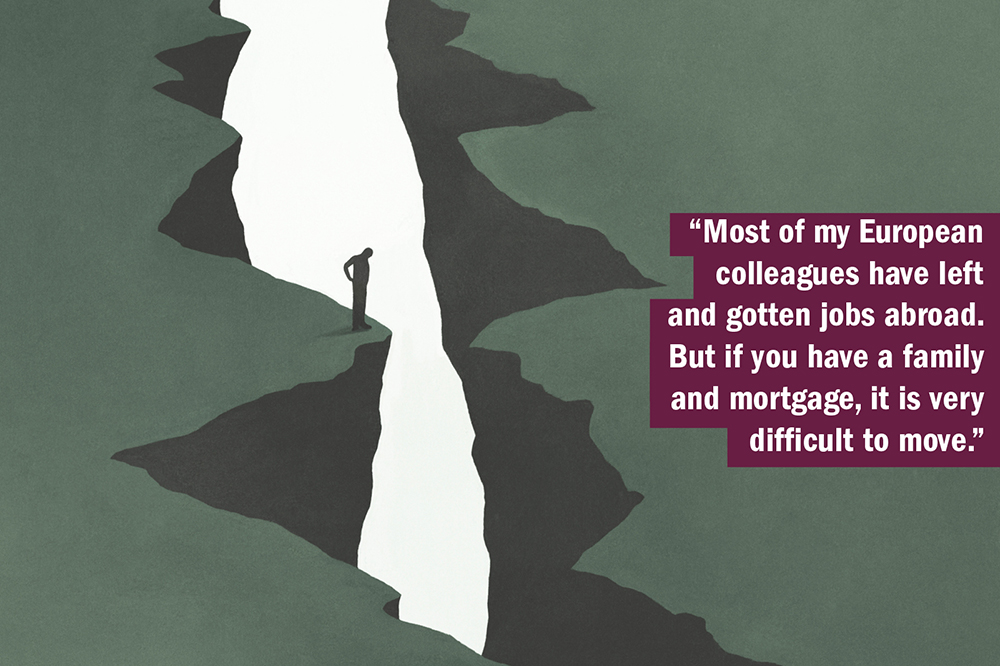
“Most of my European colleagues have left and gotten jobs abroad,” says a social scientist in her 30s. But “if you have a family and mortgage, it is very difficult to move”.
The two-body problem frequently comes up in responses. “I’d commute if I only had to go in a couple of days a week and could get there in a couple of hours,” says an English academic in her 50s. “But my partner works here and we can’t afford to maintain two households.”
Others are unconvinced that the upheaval would be worth it given the risk that the position they moved into would also be culled. Three years ago, a sociologist in his 40s “would’ve said that I would be willing to move anywhere in the UK for a permanent academic position. But I’ve lost a lot of confidence in the sector so it now feels risky to move due to the lack of job security.”
Indeed some respondents have even lost confidence in themselves.
“There are no jobs in my area in HE right now, and I also think the trauma of being made redundant so soon after returning from cancer treatment has ruined my self-worth,” said the former employability support professional in her 50s. “I have been humiliated in my professional life and I don’t think I will ever be able to be in the same room as former colleagues.”
Such comments are a stark reminder that behind all the bleak statistics about sector redundancies lie some even bleaker stories about the impact of all that on individual human lives.
POSTSCRIPT:
- Part two of our write-up of the UK University Redundancy Survey will be published next week, focusing on the experience and perspectives of those who have not (yet) experienced redundancy personally
Register to continue
Why register?
- Registration is free and only takes a moment
- Once registered, you can read 3 articles a month
- Sign up for our newsletter
Subscribe
Or subscribe for unlimited access to:
- Unlimited access to news, views, insights & reviews
- Digital editions
- Digital access to THE’s university and college rankings analysis
Already registered or a current subscriber?