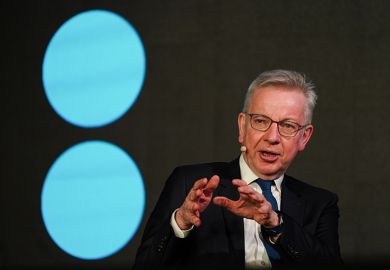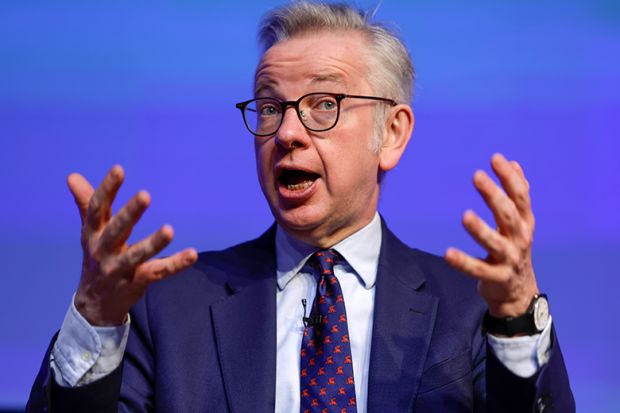
It was during an otherwise forgettable interview on Sky News in early June 2016 that Michael Gove uttered 10 words that would become “one of the most controversial statements of the EU referendum”, according to Full Fact. “The people of this country have had enough of experts,” the justice secretary and key Brexit campaigner said.
Gove has since clarified that he was cut off by journalist Faisal Islam and was really trying to say that Britons had had enough of experts from acronymic economic organisations that had been so wrong in the past.
Three weeks before the UK would vote to leave the European Union in a bombshell referendum, few seemed to notice this distinction. But reflecting on the moment 10 years later, Gove told Times Higher Education that he stood by the sentiment.
“Even though that phrase wasn’t what I intended to say, I actually think it’s true. Someone might be an expert in a particular field, but because they’re an expert in that particular field, it doesn’t mean that their expertise in one domain qualifies them to be regarded as an oracle in another.
“And then the second thing is that, as the work of people like [psychologist] Philip Tetlock have pointed out, it’s often the case that experts, even in their own domain, are less skilled at predicting what might happen than the wisdom of crowds.”
Broadcaster-turned-public policy researcher Nick Ross said Gove became a champion overnight of “those who were pro-Brexit but didn’t bother with the details” and Islam called it “Oxbridge-Trump” politics in his immediate reaction.
But rather than being “anti-knowledge” or “anti-enlightenment”, the former education secretary sees it as “an appeal to reason and to the scientific method”.
“There’s a tendency both towards groupthink and also towards an unwillingness to be truly empirical that marks out some people who would consider themselves to be experts. Science advances by…challenging the method rather than a settled revealed truth.”
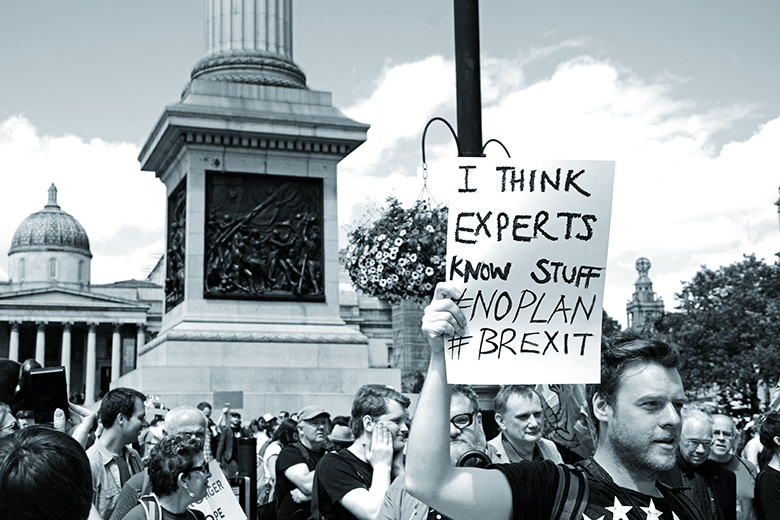
In the heat of the Brexit debate, Tanja Bueltmann, professor of migration and diaspora history at the University of Strathclyde, said she might have forgiven Gove for a “silly” comment.
But she added: “For him to now basically double down on it, in my mind that is outright dangerous and a very deliberate choice because he wants to play into certain narratives.”
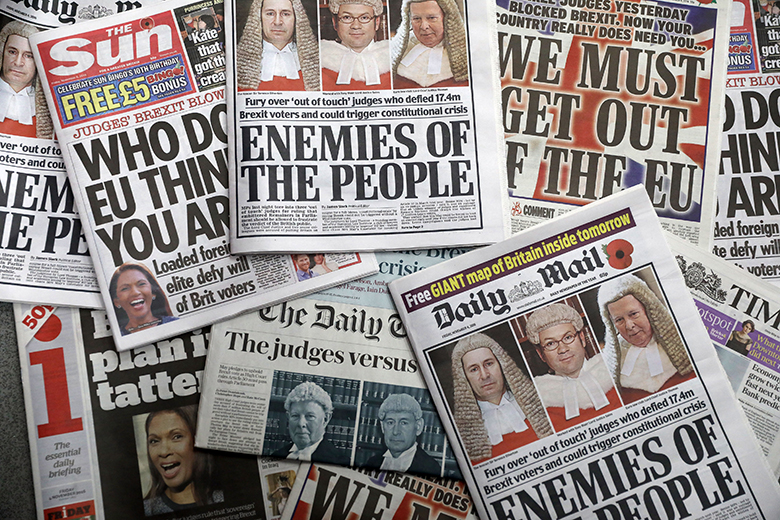
Bueltmann said it had negative consequences immediately for academics and equated the comment to the labelling of judges as “Enemies of the People” by The Daily Mail in late 2016.
“It casts a group of people in a very negative light as a blanket accusation without any grounding really and then that’s appropriated in all sorts of ways.”
Others see it in the same vein as Boris Johnson’s “fuck business” dismissal of corporate concerns around Brexit in 2018, and the “alternative facts” promoted around the size of Donald Trump’s inauguration crowd.
“They didn’t trust business, they didn’t trust experts,” said Anand Menon, professor of European politics and foreign affairs at King’s College London and director of the UK in a Changing Europe initiative.
“All that sort of stuff was made easier in the context of a referendum where you could argue on that weird thing called the will of the people. It’s what made it inherently populist.”
Menon said people should take what experts say “with a pinch of salt”, but to go to the other extreme and encourage people not to listen to them at all was “ridiculous”.
“For me, the danger of it came in that it captured and reinforced the mood that just meant we could do fairytale politics.”
Nick Russell, emeritus reader in science communication at Imperial College London, said expertise is a “two-edged sword” and that experts tend to be harshly viewed for mistakes.
“You need it, and yet on the other hand, experts tend to be rather narrow-minded and don’t see the general picture.
“Of course, like anybody else they can get it wrong. If an expert gets it wrong, they get it even more in the neck than anybody else would because they’re supposed not to get things wrong.”
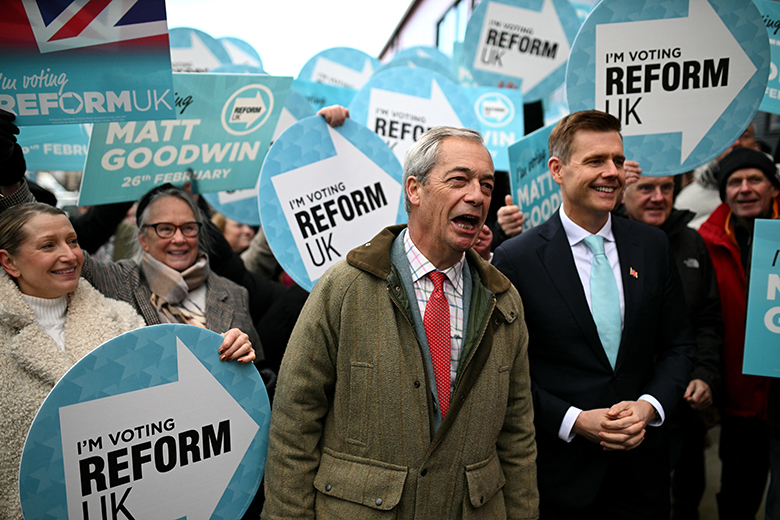
Russell said the referendum result and the rise of Nigel Farage’s Reform UK party demonstrate a shared political movement of people fed up with the status quo.
“A large number of people are very unhappy with the lives that they lead and the societies they live in, perhaps experts were one of the scapegoats that Gove could see could be aimed at.”
Research has shown that Reform voters tend to be the most cynical about universities – a sector currently facing a student debt and funding crisis which a Labour government once on the side of universities has few plans to fix.
Did a mistrust of experts contribute to this? Gove is sceptical.
“I think the problem with higher education is the people in it. I think that the people who lead our higher education institutions have continually demonstrated that they prefer wokery and the performative over scholarship.”
Recent UK polling suggested that the proportion of people who view scientists in a favourable light fell from 89 per cent in 2019 to 82 per cent – although it remains at a very high level.
And another major study of more than 70,000 people across 68 countries showed a relatively high level of trust in scientists. Respondents expressed their trust in scientists’ qualifications but were less sure about their honesty or their concern for others’ well-being.
For Bueltmann, people still value expertise – but have been frustrated by “what they think experts do” as a result of a media campaign, and by people who happen to be “experts in public discourse”.
She cites the example of Matt Goodwin – once seen as an expert on the far right who has since become a Brexit politician with his own academic writings recently called into question over claims, denied by the former University of Kent professor, over artificial intelligence use.
The “experts” remark was far from Gove’s only clash with academia during his years in the spotlight. He later compared economists warning about Brexit to scientists used by the Nazis to discredit Einstein, labelled education experts “The Blob” for their grip over teacher training, classroom standards and qualifications, and fought them over curriculum changes in a battle he described as “Govey versus academia”.
Looking back on that time, he said it is important that academics are challenged because the arguments that they use, especially outside of their own field of expertise, are “no more meritorious than anyone else’s”.
“Therefore, they need to be tested on everything from curriculum through to all sorts of political questions. It’s perfectly legitimate to engage in that debate.”
Other issues Gove has with higher education today include: lazy groupthink, a lack of original research, the process of academic promotion, the “bloat” at administrative level and the way research councils work.
“I think what we’ve had is a terrible combination of fibbery by some institutions and wokery by others, and those have been the two corrosive assets in higher education more than anything.”
One the most notable run-ins came when Louise Richardson, former vice-chancellor of the University of Oxford, said she was “embarrassed” that Gove was an Oxford alumnus – and that the development of Covid-19 vaccines proved him wrong.
Gove, who was chair of the Covid-19 operations subcommittee, admitted to an “irony” that during the pandemic he was very keen to hear from and benefit from expertise – but reiterated that any mistrust of higher education had come from its own actions.
“Part of the problem with our universities has been that you’ve had vice-chancellors and other people in positions of administrative leadership who have been diverted from their core task by politically correct faddism, and that has been far more corrosive of scholarship than anything I’ve said.”
Simon Usherwood, professor of politics and international studies at The Open University, said Gove’s comment in 2016 tapped into a “secular decline” in trust generally – but the pandemic showed it was not evenly spread.
“I think Covid has further strengthened public trust in medical doctors, who I think have always enjoyed relatively high levels of trust, but that was further boosted by the experience of Covid and the vaccines.”
But Bueltmann said the pandemic demonstrated how many self-taught experts viewed their own research as on a par with scientists – led by a president who promoted taking unproven drug hydroxychloroquine to ward off Covid-19 because he had “heard a lot of good stories” about it.
“There’s been an overall escalation of this idea that you don’t need to listen to these people or that all views are equal,” she added.
“Covid is the best example for that. We had people who were just saying things and they [were] basically cast as equal to scientists in their views, and that’s just not the case.”
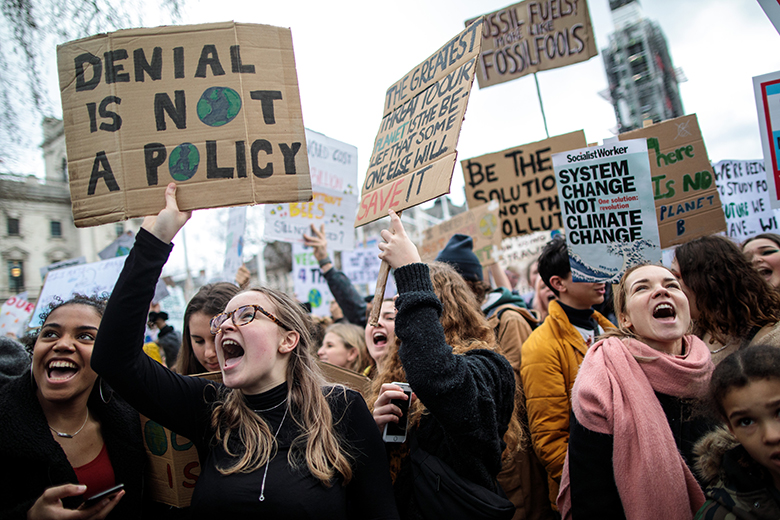
Another occasion when Gove was happy to listen to experts was during his tenure as environment secretary. In a 2018 speech entitled “What We Owe to Scientists”, he praised the work of climate advisers and urged the public to listen to the evidence.
But David Shukman, visiting professor in practice at the London School of Economics and former science editor of BBC News, said Gove’s infamous phrase proved “incredibly damaging” for both the Covid response and climate change.
He sees it as part of a pattern of pushing back against “nanny states”, which later saw deputy prime minister Dominic Raab tell people to “enjoy the sunshine” ahead of a heatwave despite warnings from skin cancer charities that this might lead to hundreds of deaths if people did not take adequate precautions.
“There was this terrible combination of Trump and the Brexit campaign where all kinds of stuff seem to be legitimised and were normalised. It was part of a pattern that’s just proved incredibly depressing [from a climate point of view] and is now on steroids.”
Shukman said examples throughout modern history – such as the Vietnam War – have shown people unwilling to follow the government’s lead, but scepticism today has been amplified by the “rocket fuel” of social media.
“I think the questioning of expertise has never been so persistent and aggressive. I think for a lot of people, it’s incredibly difficult to know who to trust.
“I think there’s probably always been a strand of distrust…the doctor says I should take this medicine, but my neighbour says I don’t need to. That’s nothing new, but I think there is this extraordinary amplification now and the ease with which genuine evidence can be challenged.”
Many would point to 2016 as the year when social media first began to become polluted with the types of misinformation and disinformation that are commonplace today. Does Gove feel any responsibility for that?
“No, I mean the key thing is…some of the worst nonsense on social media is peddled by academics, so the responsibility rests with academia and academics in demonstrating appropriate leadership and using evidence and engaging in arguments properly. They can’t insulate themselves from proper democratic scrutiny.”
From a climate perspective, Shukman said the questioning of experts on social media sits neatly with the decades-long propaganda campaign from the fossil fuel industries to question and challenge scientific facts and, indeed, with former Tory Cabinet minister Owen Patterson labelling the environmental lobby the “Green Blob” – a phrase inspired by Gove’s own.
“The trouble is because he’s such an influential person, and the phrase was so catchy, and it was at such a fevered time, it then entered the country, and I think didn’t launch a movement, but it gave it a faster gear,” added Shukman.
The questioning of climate change is particularly ironic for some because Gove is seen as a fairly green Tory politician. Shukman said his inaugural speech as environment secretary “could have been written by a climate scientist”, and agrees with the idea that one can “have had enough” of some experts, but not others.
“If you’re a senior government minister and you’re saying something that was particularly targeted at economists, whatever the conclusions…he was opening a door to what became a very attractive way of thinking for a lot of people.”
Shukman said there are legitimate challenges to some issues in science, such as the process of peer review, but others where experts have “given us the answer” already – including the role of carbon dioxide in the atmosphere, or the airborne spread of Covid-19.
“There are circumstances where we probably can be legitimately questioning how good is this science and then other times when you can think, well, let’s just make a judgement.
“We have an accumulation of evidence over years, decades, and it’s got us to a point where we can trust it, which I think is different to this idea that [Gove] conjures up.”
For Usherwood, the rise of artificial intelligence – and particularly the prevalence of AI “slop” in our culture – will also be a boon for experts.
“I think that there’s a lot more awareness of the value of people who know what they’re talking about. I think [AI] has reminded people that having people who do know their onions is something that has real value and provides a sense check in a time when a lot of people have got simple answers to complicated problems.”
And he said the failure of Brexit to bring about the “sunlit uplands” promised by campaigners has shown that voters should have listened to the economists a decade ago.
“I think it’s just highlighted that maybe the world is as complicated as experts often say it is.”
But Menon disagrees that any Brexit voters will have changed their minds because the country is too polarised.
“I don’t think there are many Leave voters around saying, ‘I wish I’d read the modelling from the National Institute of Economic and Social Research’. It is very hard to admit you were wrong.”
He thinks the core of the issue can be traced not to a failure of economists, but to the sluggish economy itself.
“I think there’s a generalised lack of trust in people of authority, people with authority, and that’s everything – doctors, academics, economists, government MPs, and in my mind, that’s very closely linked to the fact that we’ve not had growth for nearly 20 years. Governments and experts have failed to deliver.”
And Bueltmann is equally despondent – not just for the UK, but for the world.
“We seem to be at a kind of watershed of humanity and where we’re going here, because these patterns are pretty much everywhere. Coming from a German perspective as well, that’s maybe quadruply scary to me because some of these dynamics have existed previously, and nothing good came of them.”
Even though it has already been a topic of discussion for a decade, Gove is pretty certain he will be talking about “experts” for a while yet.
“The phrase did take off, and I suspect that probably whatever I may say in the future or whatever else I said in the past is brought up, this is probably the one thing I’ll be most remembered for.”
World news in 2026 has been dominated by examples of post-truth politics, including a US president attacking democracy in thousands of ways, Gulf states arresting citizens for sharing videos of missile attacks, and the first “post-reality political campaign” in Hungary. Perhaps the most worrying thought is that if a major politician made a similar comment to Gove’s today it would struggle to stand out.
Register to continue
Why register?
- Registration is free and only takes a moment
- Once registered, you can read 3 articles a month
- Sign up for our newsletter
Subscribe
Or subscribe for unlimited access to:
- Unlimited access to news, views, insights & reviews
- Digital editions
- Digital access to THE’s university and college rankings analysis
Already registered or a current subscriber?