Universities are turning to new models to serve “cold spot” towns and cities, as campus closures and limited funding risk more places being left without any provision.
Several parts of the UK without a university have long coveted the benefits higher education can bring to an area but financial challenges are restricting institutions’ ability to expand.
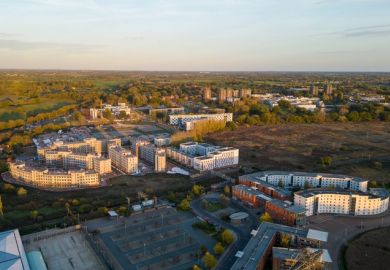
In many cases universities are instead retrenching such as in Milton Keynes where long-held hopes of expanding face-to-face higher education options for local students were dealt a blow recently when The Open University scrapped plans to open a physical campus in the city.
Officials are still committed to the fight. Opening an alternative institution will “retain many talented young people within the city who currently leave to study elsewhere and don’t come back”, said Sam Crooks, a local councillor.
Additionally, “if located in the city centre, it will enhance the city’s night life and provide the scope for new hospitality and other retail opportunities,” he argued.
As well as regions that have never had their own university, some areas are being abandoned by existing institutions.
The University of Brighton, for example, closed its Eastbourne campus in 2024 while the University of Wales Trinity Saint David (UWTSD) moved students from its Lampeter site to Carmarthen last year.
More recently, the University of Essex has announced it will close its Southend campus in 2026, blaming falling international student numbers.
In response, Daniel Cowan, leader of Southend-on-Sea City Council, said the body had established a task force to “explore every viable option for maintaining and expanding university-level provision in the city”.
“Across the UK, cities with established university presences consistently see higher levels of inward investment, wage growth, innovation, business creation, and opportunities for young people and adults alike,” Cowan told Times Higher Education. “It is vital that Southend does not lose out due to decisions made elsewhere.”
Crooks said one of the main barriers to establishing a university in Milton Keynes was the lack of money available. At a time of significant financial strain for UK universities, whether or not a university goes ahead with a new campus often appears to come down to the availability of external funding.
In Blackpool, for example, plans are under way for a new campus known as University Centre Blackpool, developed in partnership with Lancaster University and a local college. Much of the funding has come from the UK government through its “towns fund” and “levelling-up fund”.
A new campus is also being developed in Blackburn in partnership with the University of Lancashire with £20 million of levelling-up funding.
These outposts are envisioned as a way to widen access to higher education. In 2025, three years after Anglia Ruskin University opened a new campus in Peterborough, for example, 57 per cent of students at the outpost came from the greater Peterborough area. Forty per cent of those said they would not have pursued higher education if it had required moving away.
As Crooks and Cowan suggested, locals also believe their areas will benefit economically from hosting a university.
According to Rob Johnson, senior analyst at Centre for Cities, the reality is more complicated. Although universities can be “catalysts in local economies” and attract private investment – particularly for things like student accommodation – they are far from a golden bullet to solve a region’s economic problems.
Universities are also attracted by what is already in place. In 2022, the University of Chester opened a campus in Warrington, for example, which has a strong nuclear sector. If a town or city doesn’t have existing industries that the university wants to tap into, it might not be that attractive to institutions, Johnson said.
The economic impact of university branches is also smaller than that of full universities, he continued, and these are more vulnerable to closure.
In the face of this, providers and councils are increasingly exploring new models, often including further education colleges. While working with external partners via franchising was once seen as the key to addressing cold spots, the latest ventures appear to have more direct university control after the the scrutiny subcontracting has faced.
“If there is going to be movement, it’ll be those things which are, by their nature, different from just the university model, and probably slightly smaller scale, but I think more realistic and [that have] more scope to grow,” Johnson said.
Cranfield University already operates MK:U, a small campus in Milton Keynes offering degree apprenticeships. Neil Withey, director of MK:U, said having a “part-time campus” with sponsorship from local employers is a “cost-effective way” of widening access.
“MK:U remains the fastest-growing part of [Cranfield] at this point,” he said. “I do see it as a future opportunity.”
Meanwhile UWTSD is now planning to set up a vocational teaching centre to replace lost provision in Lampeter, its vice-chancellor Elwen Evans told THE last year.
John Goddard, emeritus professor of regional development studies at Newcastle University, said Labour’s devolution agenda can bring opportunities for expanding higher education provision in cold spots, but a lack of cohesion across government departments could be a barrier.
“You’ve got these silos between the different government departments dealing with higher education, research, business [and] skills,” he said. “They’re all doing their own thing and none of them are all concerned with geography, what goes on where.”
While the Ministry of Housing, Communities and Local Government is responsible for devolution, Goddard said nobody in the department was “interested in the role of universities”.
At the same time, universities are, he said, taking a “very narrowly defined economic point of view” in light of the economic crisis, with the current system meaning there are no disincentives for closing a campus.
“You could argue that there [should be] some sticks and carrots in this process and a stick might be: ‘Well, if you close this campus you’re going to suffer.’”
Register to continue
Why register?
- Registration is free and only takes a moment
- Once registered, you can read 3 articles a month
- Sign up for our newsletter
Subscribe
Or subscribe for unlimited access to:
- Unlimited access to news, views, insights & reviews
- Digital editions
- Digital access to THE’s university and college rankings analysis
Already registered or a current subscriber?