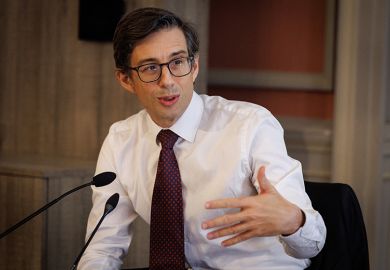
The Open University has scrapped plans to move to a new campus in central Milton Keynes, with its new vice-chancellor insisting that its founding mission as a “university without walls” is more important than ever.
Speaking to Times Higher Education, Dave Phoenix said that he expected the OU to focus on working in partnership with other institutions – schools, colleges, local authorities, businesses and other universities – to ensure that it has a presence “within every region across the UK and beyond”.
But this means that proposals to move to the middle of Milton Keynes, announced in 2023, which would have seen the distance learning pioneer offering undergraduate courses taught primarily in-person for the first time, have been dumped.
Instead the OU will seek to renovate its existing base at Walton Hall in the city with a view to allowing students to stay on campus for “block release” periods of study, while learning online for most of the time.
Phoenix, who has led the OU since July, said he could not justify spending hundreds of millions of pounds on a new campus when there was already a “degree of oversupply” in traditional face-to-face university courses.
“What we don’t want to do is replicate what everybody else is doing. We want to design facilities for what education might look like in the next 20 years. And I honestly think in the next 20 years there will be less need for people to go and spend three years within a campus-based environment,” Phoenix said.
“Investing in facilities that support an element of face-to-face [education] through block release on this [Walton Hall] campus is much more aligned with our mission and history.
“Setting up partnerships will give us physical presence in different locations, but it won’t all be the same grey, traditional, ‘this is the university, it’s in this building’ presence. It will be tailored to what those individual learning communities need.”
Milton Keynes City Council remains committed to developing an undergraduate higher education institution in the heart of the city, which has a population of more than 300,000.
But the OU’s decision follows the failure three years ago of MK:U, a partnership between Cranfield University and the council, to win government funding for a new campus, and De Montfort University’s withdrawal from Milton Keynes more than two decades ago.
Phoenix, who previously led London South Bank University for 11 years, argued that the OU could serve local communities more effectively in partnership with Cranfield, a postgraduate-only engineering institution located about eight miles from the city, and with further education institution Milton Keynes College.
The OU is partnering with the college on a new institute of technology and on launching new degrees in computing and technology-related skills, while it is exploring the possibility of collaborating with Cranfield on a digital-focused innovation park.
Phoenix, a biochemist who completed an MBA at the OU early in his academic career, said that this chimed with his broader vision of using partnerships “to make sure that we have a presence within every region across the UK and beyond”. This could include providing resources in schools, collaborating with employers to operate learning centres that offer apprenticeships and work-based learning, or delivering courses in partnership with further education colleges.
Other universities are also likely partners, with Phoenix confirming he was in discussions with a number of vice-chancellors about drawing on the OU’s pedagogical expertise to avoid “cold spots” developing when funding pressures force universities to withdraw from some provision.
“There’s a group of universities where we’re having some discussion about language provision; we could probably provide that language offer or supplement language offer in cold spot areas,” Phoenix said.
“It may be that a university wants to maintain a subject base but hasn’t got enough students; we could provide a number of modules either for them to recognise or we could do joint awards, but it would enable them to offer a breadth of subject that would enable them to keep the subjects going with a narrower range of expertise.
“There are other institutions I’ve had some initial conversations with about the fact that what they really see sustainability for is the postgraduate [sector] with uncapped fees and research development, but they don’t want to lose access to the undergraduate [market], so could we provide that undergraduate offer either as an OU programme linked to that university, in partnership with progression routes to their postgraduate [courses], or where we do shared delivery?
“Partnership to address cold spots but also to address issues of the breadth of the offer where the optionality is being reduced as staff groups decrease is an area that we’re quite interested in pursuing.”
This would answer the Westminster government’s call in the Post-16 Education and Skills White Paper for greater collaboration between higher education providers, and Phoenix suggested that universities might be more open to partnering with the OU than neighbouring institutions which they might traditionally have seen as rivals.
“We can enable universities that want to work with us to specialise in a way that meets their mission,” said Phoenix, who won plaudits at LSBU for his creation of a skills group incorporating Lambeth College, a new technical college, a school and a sixth form.
“That partnership allows us to say to them, ‘You focus on your mission. We’re not setting up another great big university next door, we’re coming to work with you in the areas you want us to work in.’”
Phoenix arrives at the OU as it returns to a financial surplus after two straight seven-figure deficits, with the institution’s accounts for 2024-25 posting a £4 million upside. Significant savings have come from staff cuts, with 346 full-time equivalent staff leaving last year and another 320 having agreed to leave already this year. The OU has now just over 7,000 staff.
Further economies will be required, with this year’s savings target standing at £35.6 million, and another £22.7 million eyed in 2026-27, primarily because the OU’s student numbers have continued to decline from their Covid-era peak, standing at 136,999 last year, down 25,087 from 2020-21.
Yet Phoenix argued that when it came to financial sustainability the OU had a “stronger foundation” than many campus-based universities, primarily because it had “levers to pull that we haven’t yet pulled in terms of new opportunities”.
He said the OU had achieved “significant” growth in enrolment this year, in part because of more active use of clearing and new interest from school-leavers who want to learn more flexibly outside a traditional campus environment, and this is something that Phoenix intends to lean into further in coming years.
Other opportunities he identified included greater expansion into the postgraduate education market, which currently represents a small part of the OU’s activities; block release programmes which bring students on to campus for short periods of time; and increased efforts to recruit international students directly to distance learning courses, as opposed to the partnership model which currently underpins the bulk of the OU’s offshore delivery.
Phoenix told THE that he had been wowed by OU staff’s “passion for the mission” of the university since he had arrived, but felt that the institution had been “a bit more inwardly focused over recent years than I would have anticipated”.
“For such a large-scale operation and with such coverage, that level of external focus and public ambition is lower than I would have hoped, especially given the energy inside,” he commented, attributing that to the financial and regulatory upheavals of the past decade, and also the fact that the OU has “been through a number of internal challenges over the last decade, and universities as a whole have got a tendency to have long memories, and that can also cause perhaps more inward reflection”.
Foremost among those internal challenges was the employment tribunal judgment against the OU, issued just under a year ago, where it was found to have failed to protect criminology professor Jo Phoenix (no relation) from harassment for fear of being seen to express support for her gender-critical beliefs. A panel ruled that Phoenix was forced to quit because of a “hostile environment” created by colleagues opposed to her views.
A report by former Office for Students chief executive Nicola Dandridge subsequently made a range of recommendations aimed at better balancing free speech provisions with equality, diversity and inclusivity goals.
Vice-chancellor Phoenix said that the majority of the recommendations had now been implemented but acknowledged that it would “take time to make sure that we’re truly bringing people together” in open discussions on contentious topics. The broader challenge across the sector as a whole was creating an environment “where there really is freedom of speech and academic freedom” and ensuring that leaders had “the confidence to differentiate between people’s right to speak out and poor behaviour”, he added.
Phoenix expressed determination to overcome these challenges and develop the OU’s level of ambition, arguing that the current policy environment was not entirely dissimilar to the circumstances of the Wilson government’s foundation of the university in 1969, with ministers looking to drive up skill levels and reduce inequality, and looking to technological innovation to drive growth in a financially constrained environment.
The OU’s mission was “more important than it’s ever been”, Phoenix said, adding: “There’s a chance for the OU to be a real disruptor again in the same way it was in 1969…What we’re now asking is what does a 21st-century university look like; a university without walls; a university that is truly embedded across society.”
Register to continue
Why register?
- Registration is free and only takes a moment
- Once registered, you can read 3 articles a month
- Sign up for our newsletter
Subscribe
Or subscribe for unlimited access to:
- Unlimited access to news, views, insights & reviews
- Digital editions
- Digital access to THE’s university and college rankings analysis
Already registered or a current subscriber?