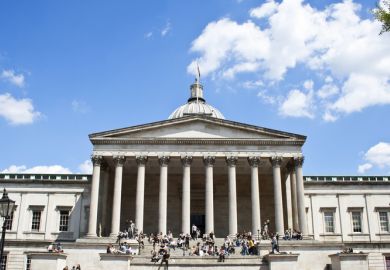
UCL will close its Institute of Advanced Studies (IAS) this summer, stating the interdisciplinary research centre is no longer financially sustainable.
A statement on 23 February explained the Bloomsbury-based research institute will be “disbanded” at the end of July 2026 because it “in its current form is not sustainable”.
The current academic year “should be a year of transition and winding down for the IAS”, explains the post, adding faculties “should work to support interdisciplinarity in new ways and contribute to plans for a UCL-wide interdisciplinary space”.
The centre, whose website states it “conducts innovative research, debate and dialogue across any kind of boundary, intellectual or institutional”, was established in 2015. It currently hosts several dozen research fellows – including postdoctoral fellows, visiting fellows and “creative fellows” – and a handful of permanent academics and professional services staff.
Among the IAS’ 12 research clusters are the Centre for Collective Violence, Holocaust and Genocide Studies, the Gender and Feminisms Research Network and the Sarah Parker Remond Centre for the Study of Racism and Racialisation.
According to the statement, “conversations between the IAS deputy directors, Dr Pushpa Arabindoo and Professor Stephen Hart, and senior management are ongoing” about how research across different disciplines would be supported at UCL.
Describing the closure of the IAS as a “huge loss for UCL and for the academic and intellectually engaged community”, the announcement explains the “IAS has always been about community”.
“Over the past ten years, an exceptional group of scholars and academics from across the world have brought their research to the IAS and joined in conversation with each other. The IAS community also encompasses over 20 Research Centres and Networks which found a home under the IAS umbrella, and whose directors and affiliates come from every faculty at UCL,” it adds.
Reflecting on its role as a “utopian island” for academic exchanges at UCL, the IAS adds: “Intellectual exchange and conversation provide the ground for serendipitous opportunities, an often unaccounted for but indispensable element of research. But an increasingly utopian one in the current climate of academia.”
“Maybe the IAS is, after all, a utopian island because of its often immeasurable research impact, engagement and outputs. An island sitting (unprotected) in a sea of hard facts and numbers,” it says.
Register to continue
Why register?
- Registration is free and only takes a moment
- Once registered, you can read 3 articles a month
- Sign up for our newsletter
Subscribe
Or subscribe for unlimited access to:
- Unlimited access to news, views, insights & reviews
- Digital editions
- Digital access to THE’s university and college rankings analysis
Already registered or a current subscriber?