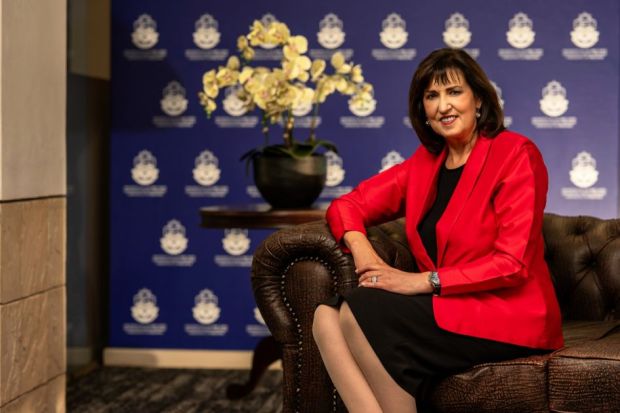
Hester Klopper has had a challenging first year as vice-chancellor of the University of the Free State (UFS) after violent student protests brought the institution to a standstill.
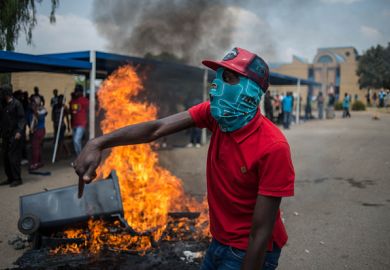
In October, the university’s three campuses suffered arson attacks and vandalism amid demonstrations over controversial new requirements for students to settle all their outstanding tuition debts before they could register for the new academic year. University activities were suspended and numerous students were arrested for their involvement in the protests.
Klopper, who joined the university in February 2025 having previously been deputy vice-chancellor at Stellenbosch University, said she had been “caught off guard” by the extent of the unrest.
“Embedded in the constitution of South Africa is the right to protest,” she said, “[but] what was a surprise last year was the violence in the protests, and of course we can’t accept that”.
She continued: “We are for protest, we are for the fact that you want to show that you don’t agree but we can’t put other people’s lives at risk. So, it was the nature of the protests that I think caught us off guard.”
The violence was not limited to UFS. Protests also erupted at the universities of Fort Hare, Cape Town and the Witwatersrand. Klopper said it was “sad” to see historical buildings and records “gone forever,” especially as she believes part of leadership’s role is to help protect universities’ “legacy for future generations”.
But positive outcomes have emerged from the disruption, Klopper said. “The lesson we’ve learnt is that you can never, ever engage too much.”
In times of crisis, university leaders need to look inward, she said, and ask: “What is it that we’re not hearing? Who is it we’re not speaking to?”
Another “inflection point that we’ve not seen in the past” was the extent of the local community’s role in the disruption. She noted that, unlike its other campuses, the university’s Qwaqwa campus is in a rural location and plays a significant role in job creation, transport and electricity provision and accommodation for local residents. Therefore “it was difficult to make sense of who the key players were who we should be speaking to”.
“It’s a work in progress. It never gets to a point where you can sit back and think, ‘no we’ve done it’. It continues,” she said.
The Student Representative Councils from all campuses were invited to engage with the university following the unrest to address students’ concerns, and Klopper said UFS has introduced more financial planning awareness to support students with money worries as well as promoting the university’s bursary schemes.
“You can’t manage from a distance as a vice-chancellor. You need to be there. You need to be present, and you need to see students and speak to them. So, when I walk around on campus, I will greet them, I will ask them about what they are studying, and I will often ask them if they’ve had a proper meal that day.”
For Klopper, it’s about “showing that you really care”. This personal touch, she believes, is something that “women leaders bring differently” to the role.
Klopper is the university’s first female vice-chancellor in its 122-year history, and she believes many barriers are still present for women trying to crack the upper echelons of higher education. Sexism within academia can be “subtle” but nonetheless women have to “work harder” to get the same respect as men in the profession, she said.
“As a woman leader, you’ll be at the table, there will be discussion, you will make a contribution, it passes, and then later when one of the men says exactly what you said, suddenly it will be like, ‘that’s a good idea’.”
Persistence has been key, she said, adding: “It’s about being courageous with a presence but leading in a different way”.
She said she is trying to be “intentional” in how the university develops career pathways that enable women, specifically black women, to stay in education, with research recently showing that although similar numbers of men and women enter higher education as a profession, women are much more likely to leave academia once they have had children. “It’s not just getting them in the system, it’s about retention in particular,” said Klopper.
In the future, Klopper wants to build on the university’s innovation capacities and ultimately believes “it’s time for Africa to be pan-African”. Universities in Africa need to develop partnerships “between ourselves”, she said.
The “decolonisation agenda” should not just be about the curriculum alone and instead should take a much broader approach to the very ecosystem of the region’s higher education sector, she said.
“It’s about how do we do business with one another? How do we engage with one another? It’s a different way of doing it on the continent and starting to give recognition to ourselves. We don’t need to emulate what’s in other parts of the world. We can really own up and be very proud about how we do things.”
Register to continue
Why register?
- Registration is free and only takes a moment
- Once registered, you can read 3 articles a month
- Sign up for our newsletter
Subscribe
Or subscribe for unlimited access to:
- Unlimited access to news, views, insights & reviews
- Digital editions
- Digital access to THE’s university and college rankings analysis
Already registered or a current subscriber?