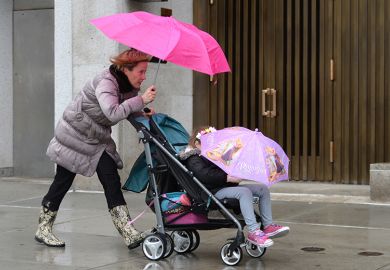
A third of women no longer work in academia eight years after having a child, according to new research that suggests extra childcare responsibilities are hindering women’s abilities to climb the career ladder.
A report by the London School of Economics and Political Science examined the impact of having a child on both women and men in Danish academia and found that the former face a significant hit to their career prospects.
These child-related barriers form part of a “leaky pipeline” that sees women leave the sector and creates further gaps between men and women in senior leadership positions, it said.
The report found that men and women’s academic careers typically “evolve in parallel” before parenthood but “following the birth of the first child, their trajectories diverge sharply”.
After women become mothers, their likelihood of being employed at a university declines by 23 per cent in the period after birth, and they are 29 per cent less likely to be employed at a university eight years after becoming a mother, the survey of 3,700 academics and 2,500 PhD students found.
Comparatively, fathers experience a “modest but persistent” decline in university employment, with their employment probability dropping by 9 per cent after birth and stabilising at roughly 14 per cent lower eight years later. Consequently, the paper said, there is a “child penalty” of 15 per cent for women compared with men.
Female academics were found to do almost five times more childcare than their male counterparts, with 55 per cent of female researchers getting up in the night to take care of their child most or all the time, in comparison with only 11 per cent of men.
Women’s likelihood of having a tenured position – either an associate or full professorship – drops after motherhood and remains 23 per cent lower than men’s eight years later. Fatherhood has no detectable impact on men’s likelihood of tenure.
Overall, the report said, children explain “roughly 70 per cent of women’s under-representation in academic employment”.
“We find that the effect of parenthood on the first leak in the academic pipelines is the main culprit in explaining the gender gap in tenure,” the authors write.
This could not be attributed to differing aspirations between women and men as most PhD students of both genders said they aspired to do research following their studies.
Women and men also placed the same importance on career advancement, the desire for intellectual challenges, their degree of independence, benefits and job security, “[showing] that among PhD students gender differences in preferences for an academic job are not driving the leaky pipeline”.
“These patterns provide evidence on sources of the first significant leak of the academic pipeline, highlighting the childcare constraints women face due to motherhood.”
The report notes that “increased paternal involvement over the last decades – while meaningful – has not managed to reduce the impact of parenthood on women’s career progression”.
Female academics faced similar child-related penalties regardless of their partner’s paternity leave uptake.
However, the research found that male academics who took at least two months of paternity leave experienced significantly worse career outcomes than men who took no leave, “consistent with the idea that time away from research and greater childcare involvement carry substantial career costs, regardless of the caregiver’s gender”.
Karleen Gribble, adjunct professor in the School of Nursing and Midwifery at Western Sydney University, said she felt “validated” by the report and that it reflected her experience as a mother to disabled children in academia.
“What I saw as a young mother was that there was not a way for me to be an academic playing by the rules that were in place and for my children to be OK. This was especially because I had children with disabilities.
“I needed either to give up on the idea of being a researcher or to make my own rules, which I did by undertaking my research on an honorary basis. I have been extremely successful and impactful as a researcher but have had to do this as a volunteer. As the report shows, many women just walk away and who knows what they might have been able to contribute to the benefit of society. Who knows what we are missing?”
She said many women undertake research “for free” as a result of motherhood, while others might work “until 2am to get everything done and still are not on par with men or women without children”.
Gribble added that ensuring career support is available to casual and honorary academics and ensuring they are eligible for grants and fellowships could help.
She continued: “I have shown that it is possible to combine motherhood and research, but this has been at extreme financial cost – so much so that even though I am a professor and in Elsevier’s top 2 per cent of world researchers, I still owe the Australian government money for my undergraduate study. I’ve never earnt enough money to reach the threshold to pay it back.”
Register to continue
Why register?
- Registration is free and only takes a moment
- Once registered, you can read 3 articles a month
- Sign up for our newsletter
Subscribe
Or subscribe for unlimited access to:
- Unlimited access to news, views, insights & reviews
- Digital editions
- Digital access to THE’s university and college rankings analysis
Already registered or a current subscriber?