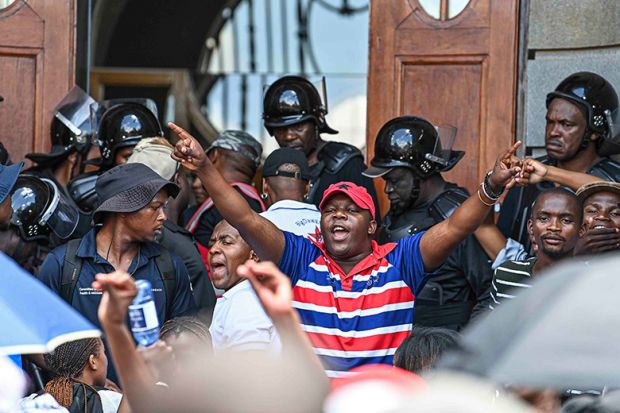
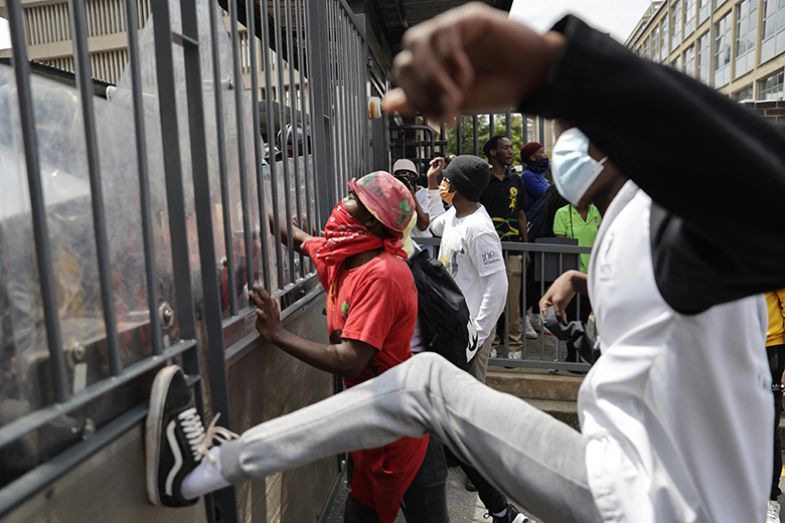
When buildings at South Africa’s University of Fort Hare were petrol-bombed in October following a wave of violent student protests, it sent shock waves through the country’s higher education sector. But the shock wasn’t because this was a unique event.
“The first thing that came to mind was, ‘Oh my God, it’s happening again’,” said Pikolomzi Qaba, a PhD scholar at Durban University of Technology, who described the current mood in South Africa’s troubled higher education sector as “sombre”.
Fort Hare is a relatively small university, whose main campus is located in the remote town of Alice in the Eastern Cape province – about 75 miles from the provincial capital, East London, where its other campus is located. However, the university is culturally significant, having been the alma mater of Nelson Madela and Desmond Tutu, among other significant black leaders of the anti-apartheid movement.
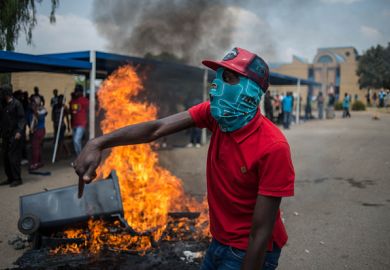
Reporting varies on exactly how many university buildings, across the two campuses, were destroyed by the fires, but it was at least four and possibly more than six. Exam papers were burnt, as well as historical genetic materials, seeds, soil and crop science data. The cost of repairing the damage is estimated as being between R250 million and R500 million – between £11 million and £22 million. Two students from the university also ended up in hospital after sustaining injuries in clashes with the police, and both campuses were shut down, with all students ordered to leave.
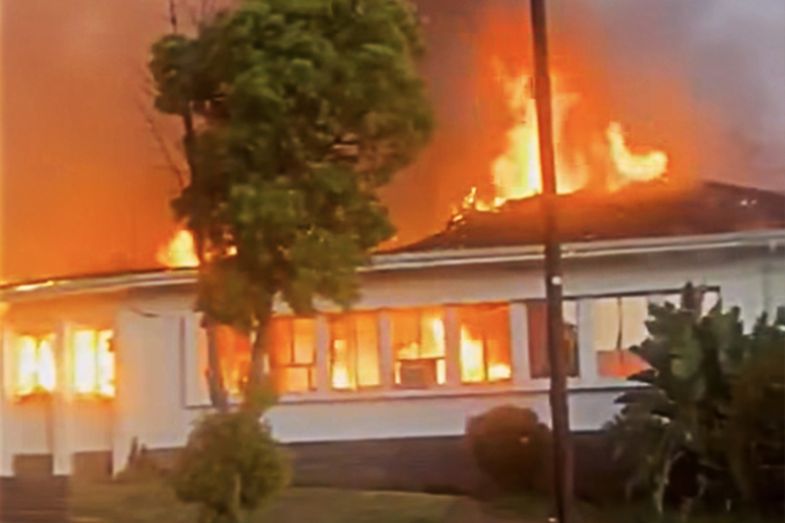
Just over a week later, the historically white-only University of the Free State (UFS) was also forced to shut down all three of its campuses after students torched buildings and blocked roads in protests over new requirements that students settle all their outstanding tuition debts before they could register for the new academic year.
But while these were the most dramatic instances of student grievances descending into direct action, they are far from the only ones. Earlier in 2025, Johannesburg’s prestigious University of the Witwatersrand saw students go on hunger strike – also in protest at being excluded from registration owing to historical debt.
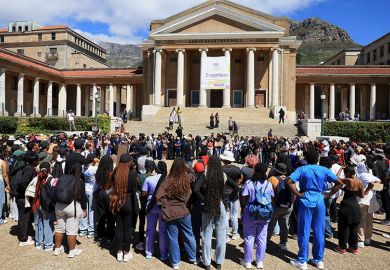
And even the country’s most prestigious institution, the University of Cape Town, has seen its fair share of trouble. In February – a decade on from the Rhodes Must Fall protests that saw a large statue of the British imperialist Cecil Rhodes removed from its campus and that morphed into the Fees Must Fall movement against tuition fees – students protested over tuition fee debts once again, as well as accommodation grievances. About 80 of them occupied university buildings.
All of this comes on top of the roughly R786 million of damage across 13 institutions that resulted from the Fees Must Fall protests between 2016 and 2018, sparked by the government’s plan to raise tuition fees. And while the worst destruction occurred during that initial wave of protests, which also demanded the “transformation” of South African universities in the wake of the segregation imposed by apartheid, campuses have continued to experience periodic unrest ever since, reflecting the fact that while that initial proposal on fees was ultimately withdrawn, sharp tensions persist over higher education funding, management and governance.
Yet there is also a sense that tensions on campus are being exploited by malign actors from beyond the student body. In Fort Hare’s case, South Africa’s minister of higher education, Buti Manamela, told the country’s Select Committee on Education, Sciences and the Creative Industries that protests “got overtaken by criminal elements, who may or may not be students”.
The students had been protesting for a number of days prior to the arson, demanding the removal of Fort Hare’s vice-chancellor, Sakhela Buhlungu. Student leader Asonele Magwaxaza told local news the students were angry and frustrated because their participation in university governance “has been suppressed and compromised...We have been writing to the council, to the management, but they are arrogant. They are not responding.”
He added, somewhat cryptically, that “this thing that is happening is not only of students” but was “a collective project between students and stakeholders of the university”.
For his part, Buhlungu – who has vocally tried to root out corruption at the institution and survived a second assassination attempt in 2023, which left his bodyguard dead – told local media that the university had received information that the protests were an attempt to interfere with the imminent release of a report naming 33 high-ranking politicians implicated in academic fraud at Fort Hare. Other staff members have also been killed or kidnapped as the university sought to clean up its reputation.
“The criminals are amongst the staff and students,” Buhlungu said. “Watching those students torch the staff centre and then cheer…” he trailed off, shaking his head.
Before apartheid came into effect, Fort Hare was South Africa’s equivalent of an “Ivy League” university for black African students, according to Pedro Mzileni, senior lecturer in education at the University of Zululand in KwaZulu-Natal. However, the institution – which also educated the long-serving Zimbabwean leader, Robert Mugabe – “never recovered” from the country’s 1959 Extension of University Education Act, which introduced apartheid into the country’s higher education by law and “cut off” Fort Hare from its previous “intellectual culture”.
Mzileni told Times Higher Education that “criminal cartels” do indeed “infiltrate student protests” to progress their own agendas – “giving student protests a bad name”. Often, their agenda is to maintain corrupt financial practices at universities, and Mzileni believed that these lie behind the problems at Fort Hare, with criminal enterprises initially targeting Fort Hare’s procurement process to extract money from it.
The university, he said, had “started being viewed as a way of making money, rather than an intellectual institution”. However, this phenomenon cannot be divorced from the Eastern Cape’s impoverished economic conditions, he added.
That perspective was endorsed by Jonathan Jansen, now a professor of education at Stellenbosch University and formerly UFS’ first black vice-chancellor. He said corruption is increasingly centred in South Africa’s poorer and more rural areas: places where “people are down on their luck and the community has nothing else to go for than the public university: that’s what makes Fort Hare so vulnerable”.
Jansen, who published a book in 2023 entitled Corrupted: A Study of Chronic Dysfunction in South African Universities, added that other South African universities are “more or less under control at the moment”, though he conceded that this doesn’t mean corruption is “not happening: it’s just it’s much better camouflaged, in a way. But that is why commentators or activists are so surprised by Fort Hare: not because it’s happening but because of how blatant it is”.
Indeed, for Jansen, the levels of corruption at Fort Hare, and its successive controversies, mean that its reputation is now beyond redemption: “It’s over for Fort Hare,” he said.
However, across the sector, corruption is “nothing compared to what it was 15 years ago”, Jansen said, largely due to greater vigilance, in both the sector and wider society. Mechanisms have been put in place to monitor financial probity “in a much more systematic way”, including internal and external audits and a requirement for universities to submit rigorous financial statements to the Ministry of Education. This is “no longer just paperwork”, he said: “It’s much more difficult to get away with murder.”
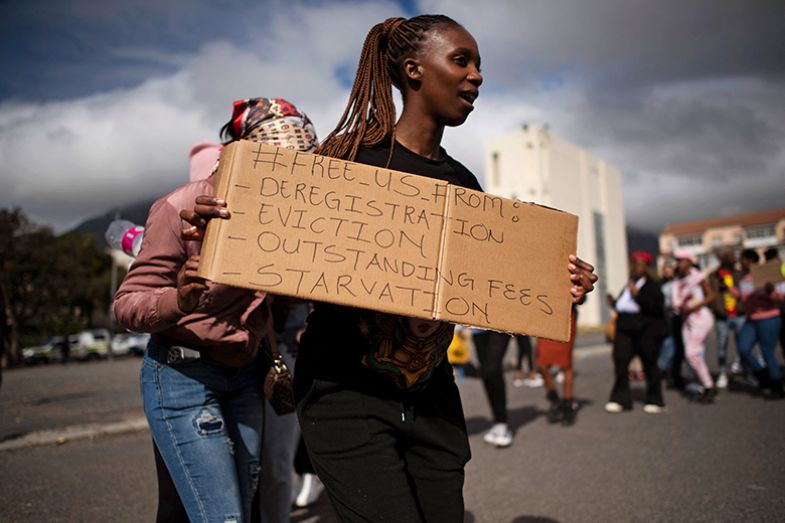
Rather than universities, he said, corruption is now more targeted at sector-wide organisations. One example is the National Student Financial Aid Scheme (NSFAS), the country’s state-backed student financing agency, which was accused in 2023 of paying out R3.1billion (£140 million) a year to 158,000 “ghost” students who don’t exist, and which continues to be accused of failing to distribute students’ promised funding consistently and on time.
By contrast, some very real students took to the streets earlier this year over delays to the issuing of their NSFAS funding. Durban’s Qaba – who called, in the wake of the Fort Hare fire, for a national conflict resolution service to be established for South African higher education – said students often take out their grievances for the failings of the student loan system on their individual institution, rather than on the government or NSFAS itself. UFS is a case in point: as well as requiring students to settle historical debts before they can reregister, it also required new students to secure funding before it will admit them – even if the delays are the fault of NSFAS.
The funder’s chief executive, Waseem Carrim, told reporters in August that the scheme had “quite a significant budget shortfall” of R10.6 billion for the 2025 academic year owing to a mismatch between its allocated budget and the amount of money to which students were entitled.
He added that the NSFAS was owed R45 billion by students who took loans before 2018, while corruption had been detected in several of its divisions; the board, he said, was committed to working with the government to root out the problem.
The funder’s chair, Karen Stander, explained that the budget shortfall was due to an increase in the number of students qualifying for higher education and an increase in the proportion eligible for accommodation support due to the cost-of-living crisis. This, she said, had coincided with a real-terms decline in state resources.
“We must face the truth: the root cause lies in a funding model that promised more than the resources available without adjusting eligibility criteria accordingly,” she said.
While the South African government is clearly not able or willing to meet students’ far-reaching demands for low-cost, high-quality provision, it did significantly increase its higher education spending following then-president Jacob Zuma’s announcement in 2017 – in response to the frequently violent and destructive Fees Must Fall protests – that the government would fund fees and accommodation costs for all students with an annual family income of less than R350,000 (£16,000).
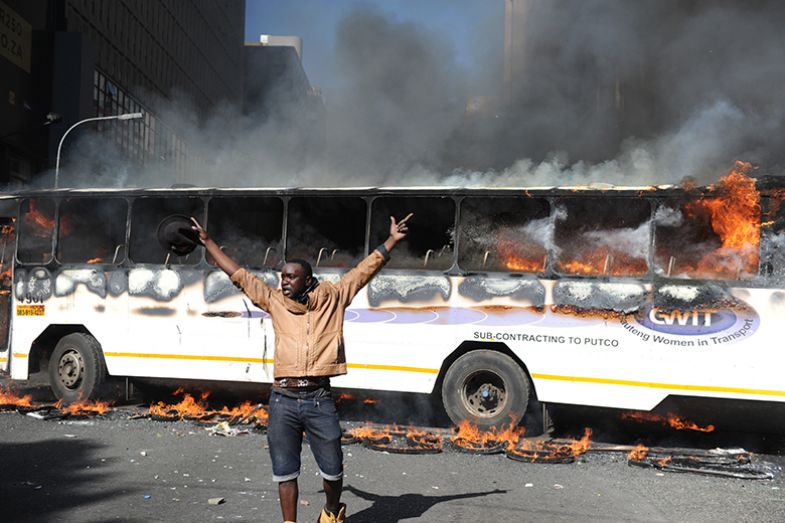
Since then, higher education spending has increased from about R15 billion a year to just over R40 billion, with the increase primarily focused on poorer institutions. That amounts to an extra R200 billion more over eight years, explained Adam Habib, vice-chancellor of SOAS University of London, who led Wits during the first wave of Fees Must Fall protests. However, he warned, this vast sum is not being spent wisely.
“If you can tell me that we’re producing a better-quality education in those places, then I would say that’s R200 billion well spent. But I fear we can’t do that,” Habib told Times Higher Education.
He conceded that this view had proved controversial when he raised it with vice-chancellors last year at a conference in his native South Africa. However, reflecting Jansen’s concerns about corruption, he said the fact that university buildings continue to be burned suggests to him that “the cash going into these institutions has created a war of all against all, for different factions to mobilise resources”, he said. “I think this is an outrageous wastage of scarce resources.”
He also blamed leaders of South African universities for not taking a firm enough hand with student protesters. He said that while there was “legitimacy” to the aims of the Fees Must Fall movement, he was “very critical” of how students protested, with the violence and destruction creating “an existential crisis” for Wits’ executive team.
“You can’t say that you are advancing the cause of a free education and then burn university buildings down. It’s just not legitimate,” Habib said, reiterating views he articulated in his 2019 book, Rebels and Rage: Reflecting on #FeesMustFall. He said the use of violence in student protests would “destroy” South Africa’s universities, with Fort Hare just the latest example of this “utter outrageousness”.
But Habib is also deeply critical of “politicians and even some intellectuals, who tend to explain the violence away as a product of structural violence, as if structural violence is therefore a justification for individual acts of violence”.
To bring an end to the cycle of violence, Habib believes three things need to happen: a change in institutional culture, followed by “acculturation” of this change, and, finally, a holding to account of people who break the rules. Progressives, he added, approve of the first and the second of these steps, “but they are terrified of the third”.
He said some commentators had blamed police for the violence at the Fort Hare protests, but “this crude [left-wing] populism is precisely why we are in this mess”. And he called for all those who had stoked the tensions – including trade unionists and politicians – to be held accountable.
While eight people have been arrested for the Fort Hare violence, as well as a further eight at UFS, none have yet been charged.
“When somebody breaks the rules, when somebody is violent, you arrest them,” Habib said. “That’s what normal societies do. You don’t excuse it. You’re not right-wing for arresting somebody who’s trying to burn a building…To excuse it because you’ve learnt the word ‘decolonisation’ is nonsensical.”
Despite the tensions, however, academics generally remain optimistic about the South African higher education system’s capacity to move forward – as long as there is political will from all stakeholders. Mzileni noted that the country’s high youth population – a third of all South Africans are aged between 15 and 34 – presents an “opportunity”. But there needs to be a shift from the “neoliberal” mindset that sees money spent on higher education as expenditure to one that sees it as part of a wider an investment in post-apartheid transformation, he said.
“Once you shift public policy to work for the ordinary folk, you are going to resolve the fundamental problem of racism and inequality in South Africa,” he said. “We need public policy to dismantle those injustices, and that’s how we will have a working higher education system for all.”
For Habib, the underlying tensions in South Africa’s higher education system are “transnational problems, not domestic ones”, likening the lack of action on violence to the “populist posturing” that has led to “witch trials” of university leaders and academics in the West, too. In the US – such as the case of former Harvard University president Claudine Gay – these are driven from the political right, of course, but Habib also mentioned the case of former University of Dundee vice-chancellor Iain Gillespie, who was publicly castigated by MSPs for his role in creating the vast deficit that led to the institution having to be bailed out by Scottish taxpayers.
Habib added that what South Africa needs is not new policy but “the courage to manage”, adding that no Wits buildings were burnt during the Fees Must Fall protests because “the executive made difficult decisions”, such as bringing in private security personnel to crack down on disruptive protests – just as he had done at SOAS during recent pro-Gaza demonstrations, when a “small number” of students were expelled for “serious violations or repeated breaches of our Code of Conduct that threaten the safety of our community, individual rights or the functioning of the institution”.
“This isn’t impossible to do,” he said. “But it requires political will – and that’s the challenge of our time. We need to find our courage…as vice-chancellors and executives, our integrity and courage as academics, and our political courage as leaders of…institutions and parties. We need to stop pandering and start being pragmatic but principled.”
Register to continue
Why register?
- Registration is free and only takes a moment
- Once registered, you can read 3 articles a month
- Sign up for our newsletter
Subscribe
Or subscribe for unlimited access to:
- Unlimited access to news, views, insights & reviews
- Digital editions
- Digital access to THE’s university and college rankings analysis
Already registered or a current subscriber?