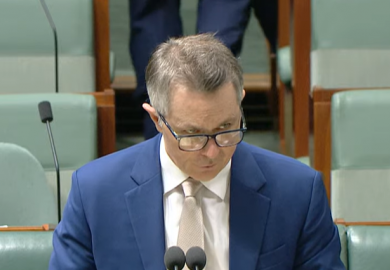
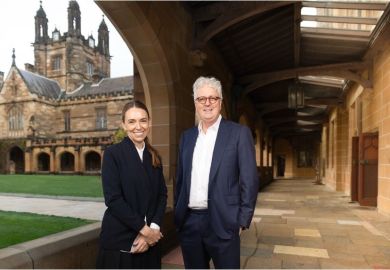
The seat-warming boss of Australia’s proposed higher education steward has played down concerns about the body’s independence, saying its founding legislation will not preclude frank policy advice.
Barney Glover said the bill to establish the Australian Tertiary Education Commission (Atec) would not prevent the body commissioning its own research and publishing the findings through an annual “state of the system” report.
Glover is acting chief commissioner of the interim Atec, which is carrying out the agency’s preliminary functions pending legislation to establish the body permanently. His substantive role is commissioner of another statutory agency, Jobs and Skills Australia (JSA).
Critics say JSA, which is authorised to publish its own research, has independence that Atec in its proposed form will lack. But Glover said the two bodies would have very similar roles, with both empowered to make “very strong” policy recommendations.
In Atec’s case, this would include providing counsel on student fees. Although the bill only specifies an advisory role on government funding contributions, Glover said this entailed advising on student contributions “by implication”.
He told a public hearing of the Senate’s education and employment committee, which is inquiring into the Atec bill, that the proposals would facilitate the dismantling of the unpopular Job-ready Graduates (JRG) fee hikes.
“Should the legislation be passed, the Atec will provide…in a timely and public way, through the state of the system report, very detailed advice on pricing and costing,” Glover said. “[This] should lead to…JRG considerations by government more rapidly than two years. That would be my view. That’s a contestable view, I appreciate.”
He said the proposals would spawn a valuable “contesting of advice” to the government, with Atec and the Department of Education both offering their views “freely and frankly”.
“This is for the betterment of policy development in this country. Depth of expertise…in the Atec will add great value. [Its] independence is strongly invested in the independence of the commissioners – their skills and expertise to guide the agency.”
He said that although the legislation as drafted was “fit for purpose”, some aspects “could be more explicit. Amendments that have been raised…would potentially, if agreed by government, lead to improvements in the bill.”
Consultant Claire Field said “straightforward” amendments would allow for “a robust agency that could get on with the important work that it needs to do” without obtaining ministerial permission to publish reports – a “key differentiator” between the powers of JSA and Atec as proposed.
But Field, a former civil servant and regulator, said Atec’s annual reports – which would cover the sector’s financial sustainability and whether it was meeting the needs of industry, students and underrepresented groups – would be a “really important step forward for the sector”.
She said that even with the bill’s “flaws”, Atec would be a “more independent voice” than the Department of Education, and the annual reports could provide evidence “for the robust debate and hopefully funding changes that…the sector needs”.
Monash University policy expert Andrew Norton, a staunch Atec critic, said the bill needed a rewrite if only to clarify the commission’s power to advise on fees. “It’s not really clear whether that was a deliberate attempt to avoid the issue, or just an issue with the way those particular clauses were written.”
Register to continue
Why register?
- Registration is free and only takes a moment
- Once registered, you can read 3 articles a month
- Sign up for our newsletter
Subscribe
Or subscribe for unlimited access to:
- Unlimited access to news, views, insights & reviews
- Digital editions
- Digital access to THE’s university and college rankings analysis
Already registered or a current subscriber?