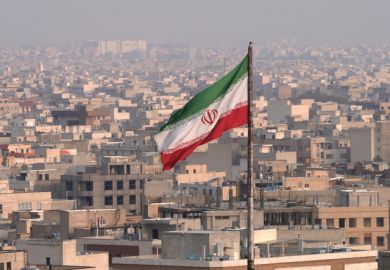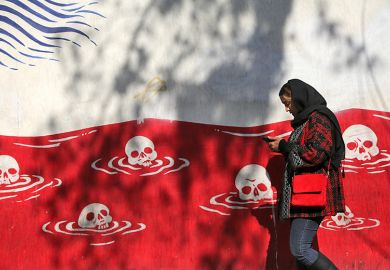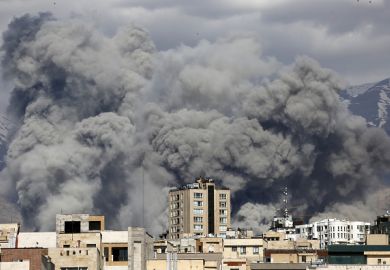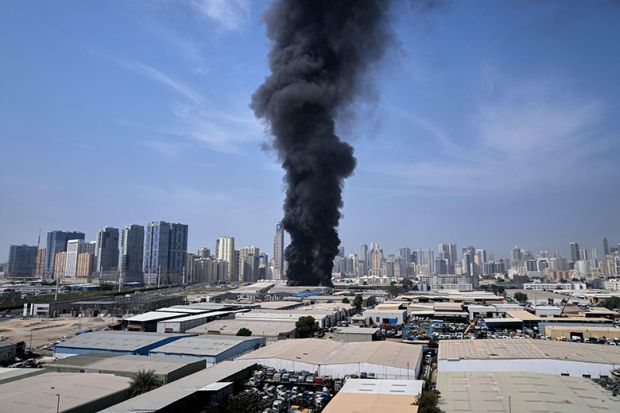
The outbreak of fighting across the Middle East could prompt universities to rethink expansion plans in the area, with attracting staff and students likely to become ever more difficult amid the increased instability.
Israel and the US’ joint attack on Iran over its nuclear weapons programme has plunged the region into chaos, with Tehran retaliating by bombing countries previously considered safe in a bid to target US military bases. Jordan, Bahrain, the United Arab Emirates, Kuwait and Qatar have all been hit by missiles in recent days.
Many countries in the region have already ordered their universities to close their doors and shift to online learning until further notice following the airstrikes, and staff and students have been caught up in the chaos.
But experts have warned that the conflict may also bring far more severe longer term consequences for the region’s higher education sector, which has become increasingly important to Gulf States as they look to diversify away from oil, and seek to take a leading role on the world higher education stage. Qatar and Abu Dhabi have become major hubs for Western universities looking to expand into the Middle East in recent years.
Maia Chankseliani, professor of comparative and international education at the University of Oxford, said regional escalation is “already raising the cost and complexity of internationalisation for Gulf universities”, and it will prompt some partners “to pause new campus commitments, intensify risk planning, and make the higher education ambitions embedded in…national strategies more difficult to deliver on current timelines”.
There will be “financial and reputational” repercussions which “outlast the immediate crisis”, added Chankseliani, as in recent decades the Gulf states have “positioned themselves deliberately as a serious site for higher education expansion, attracting branch campuses, research partnerships and internationally mobile students”.
Qatar’s Education City in Doha alone hosts several major international universities, including Carnegie Mellon, Georgetown, Northwestern, Weill Cornell, and HEC Paris, and New York University and Sorbonne University have campuses in Abu Dhabi.
“These partnerships depend on long-term horizons, predictable regulatory environments and a widely shared perception of stability. While the institutions already substantially committed in the region will proceed, many institutions in earlier planning phases might slow negotiations, revisit assumptions, and seek much stronger contractual protections around force majeure and staff and student safety before committing,” she said.
Mayssoun Sukarieh, senior lecturer in the department of international development at King’s College London, said the extent of the impact depends on how long the conflict lasts.
“If it concludes soon, without major costs to Gulf economies and without affecting regional stability, then I do not expect significant consequences for UK and US campuses operating in the Gulf,” she said. “On the other hand, if the war is prolonged and leads to instability in the region – potentially including instability in Iran – this could have serious consequences for the UK and US higher education industry in the Gulf states.”
Institutions operating in Doha have relied “heavily on state support” and on lucrative state-funded scholarships that have attracted students from across the Arab world, she said, adding that economic instability caused by the conflict could “accelerate structural changes”.
“I think universities will only rethink when the endeavour is not ludicrous for them; after all, we know that the higher education sector is in crisis, and the only reason to stop expanding to the Gulf or to halt their activities there would be profit.”
Vincenzo Raimo, an international higher education consultant, said that in previous episodes of disruption, the region has “reverted to business as usual very quickly once escalation pauses”, and that institutions have shown they can “pivot very quickly, reassuring students and staff, shifting teaching online, and activating duty-of-care protocols”.
But he said for universities considering new commitments, including branch campuses, joint ventures and major capital projects, any conflict will mean “greater board-level scrutiny, with leaders and governors seeking firmer assurance on scenario planning, duty of care for staff and students, and the implications for insurance, security costs and reputation if perceptions of safety deteriorate”.
Even where projects proceed, Raimo added, it wouldn’t be surprising to “see longer timelines with added safeguards and clearer break clauses written into agreements”.
Arshin Adib-Moghaddam, professor in global thought and comparative philosophies at SOAS University of London, said it was “inevitable” that there will be serious short- to middle-term repercussions for the higher education sector, adding that a potential war could make parents “think twice” about sending their children to the region, and it would become “rather more difficult” to recruit world-renowned scholars.
“If there is no successful effort to establish a viable security architecture that is strong enough to prevent war, the insecurity thus ensued will make it that much more difficult to establish an internationally viable higher education infrastructure,” said Adib-Moghaddam.
Register to continue
Why register?
- Registration is free and only takes a moment
- Once registered, you can read 3 articles a month
- Sign up for our newsletter
Subscribe
Or subscribe for unlimited access to:
- Unlimited access to news, views, insights & reviews
- Digital editions
- Digital access to THE’s university and college rankings analysis
Already registered or a current subscriber?