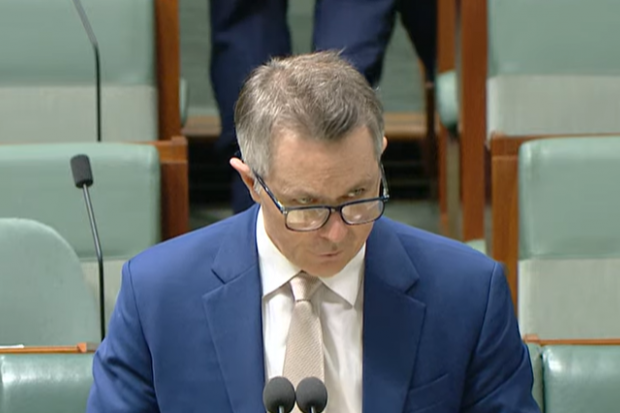
The bill to establish the Australian Tertiary Education Commission (Atec) has passed the House of Representatives, with most cross-bench MPs voting in support.
“While the legislation still needs to pass the Senate, this is an important step forward,” education minister Jason Clare said. “This is big structural reform that will help us build the sort of education system Australia needs now and into the future.”
The Liberal-National party opposition, which voted against the bill, had introduced an amendment to broaden the National Tertiary Education Objective (NTEO) – described by shadow education minister Julian Leeser as “an iron rod that gives guidance to the new regulator”.
Independent MP Monique Ryan had also tabled an amendment empowering Atec to advise on student contributions – considered a vital area of reform, as fees for arts degrees nudge A$54,000 (£27,910) – while fellow independent Kate Chaney moved amendments to give Atec independence, more control over its staffing, two additional commissioners, an explicit role as “steward of the research sector”, and the power to publish recommendations “on its own initiative”.
The government voted against all the amendments but promised to consider them alongside recommendations from a Senate committee’s inquiry into the bill. The committee is due to report on 26 February and has scheduled a public hearing in Canberra on 13 February.
Chaney said the Australian Universities Accord had made “a powerful case” for Atec. “I agree with that case in principle,” she told parliament. “But I will not support a bill that creates an Atec that’s not independent, not adequately constituted and not equipped to do the job it was created to do.”
The Liberal Party has ramped up its criticism of the bill and the commission itself. Former education minister Dan Tehan said the government wanted to “outsource decision-making to bureaucracy” so that it could “hide behind three faceless regulators”.
Tehan said his 2021 Job-ready Graduates reforms had cut fees in areas of workforce need, including nursing, teaching and engineering. “This has presented a real dilemma for those of you on the government side because you don’t know what to do about it. So…you’re going to outsource it to three bureaucrats and hope that they can come up with a solution. In a sector which says all the time, ‘we’re over-regulated’, you’re going to put more regulators in place.”
Leeser said the NTEO, which had been recommended by the accord, focused on “irrelevant” considerations – including social development and environmental sustainability – while overlooking “obvious” things such as teaching, learning, research, scholarship, productivity, student experience and “innovation across the sector”.
He warned that the bill’s drafting would taint Atec’s decisions with “deeply political but otherwise irrelevant considerations. It’s basic principle of administrative law that in making a decision, a body like Atec must have regard to relevant considerations and must not have regard to irrelevant considerations.
“Failing to do this means your decision is liable to be overturned on judicial review. You’re opening yourself up to every green lawfare activist who wants to challenge a decision about a provider in the courts, because it doesn’t adequately deal with climate change or the latest progressive social trend.”
Julian Hill, assistant minister for international education, said Atec’s predecessor – the Universities Commission, first established in 1943 – had “set the system up for incredible success” before it was deemed to have “run its race” at the time of the 1988 Dawkins reforms. Now the Dawkins reforms had also “run their race”.
“The government’s judgement, flowing from the accord, is that we need to move past the system that we’ve created where every university – metropolitan, regional, research intensive, teaching intensive, highly ranked or focused on access – operates under the same incentives, the same funding structure and the same requirements,” Hill said.
“This is a huge reform. I think it’ll take years or decades for Australians to look back and realise just what a significant moment this is.”
Register to continue
Why register?
- Registration is free and only takes a moment
- Once registered, you can read 3 articles a month
- Sign up for our newsletter
Subscribe
Or subscribe for unlimited access to:
- Unlimited access to news, views, insights & reviews
- Digital editions
- Digital access to THE’s university and college rankings analysis
Already registered or a current subscriber?