High-profile US institutions looking for new presidents are likely to favour candidates who “can make headway but not headlines” as vacancies at the top mount amid the political turmoil.
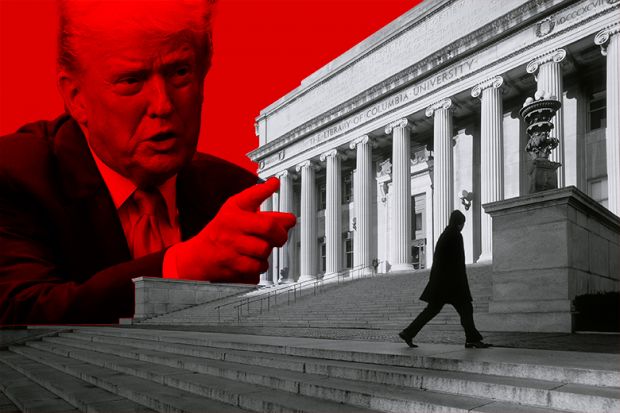
Columbia University’s search for its fourth president in just three years has extended into 2026, while there are also big decisions to be made at the University of Southern California and the University at Buffalo (SUNY).
The University of Michigan is still seeking a permanent successor for Santa Ono, who last spring was approved for the University of Florida presidency, before this was then controversially overruled by the state government. Reports suggest Syracuse University chancellor Kent Syverud has been lined up for the role, although this has not been made official.
Scott Bass, provost emeritus at the American University and professor of public administration and policy, said the potential for unanticipated interference and the “turbulent” period facing presidents will likely raise concerns for individual candidates when choosing to apply for such positions.
Claudine Gay at Harvard University, Elizabeth Magill at the University of Pennsylvania and Minouche Shafik at Columbia were all forced out of their jobs following pressure from Congress.
“Congressional leaders’ public efforts to ridicule and embarrass the previous sitting presidents of Columbia and Harvard, leading to their eventual demise, serve as painful reminders of the vitriol that the person sitting in the president’s position can trigger,” said Bass.
Decisions over who holds presidential positions at some universities have also been influenced by the Trump administration.
Pressure over diversity, equity and inclusion programmes at the University of Virginia led to James Ryan’s eventual exit – a position that has only recently been filled by Scott C. Beardsley, who was promoted despite calls to postpone the process while a new board was appointed.
Amid such uncertainty around large public research universities, Richard Chait, emeritus professor of education at Harvard, said there will be “more and more refuseniks” and that the leadership vacancies will not attract the same volume of applications from talented individuals.
Advice on higher education leadership and strategy
“The university presidency has just changed so dramatically that I think it shrinks the traditional candidate pool. These presidents are not just in the public eye, but in the public cross hairs.”
Astrophysicist Ray Jayawardhana, who currently serves as provost of Johns Hopkins University, was recently named Caltech’s next president. According to reports, he was chosen partly because of his skills in communicating with the public.
On top of White House pressure, leaders must deal with the professionalisation of college athletics, the commercialisation of research, questions of free speech and identity politics, and the safety of students following several recent attacks.
Chait said a new criterion for selection will be a candidate’s “political radioactivity” – how they will be viewed by the public at large, state governors and federal leaders.
While the Trump administration may not have any direct control over their selections, Chait said it will be in the background.
“It’s a little bit like somebody choosing a spouse and saying ‘I wonder how my parents are going to react’.”
While Columbia’s search continues, Alan Garber at Harvard and Larry Jameson at Penn have both had their interim roles extended – two leaders Chait describes as calm, measured and “non-controversial”.
“I suspect that some younger would-be presidents are going to sit on the sidelines until after the next presidential election. The current climate favours people…who are older rather than younger, who are battle tested, who have track records, people who are not out to make a name for themselves.
“I think universities are looking for presidents who might make headway but not make headlines.”
Several institutions, particularly private ones in the Florida, have appointed leaders who previously worked in government.
Morton Schapiro, former president of Northwestern University, which is also searching for a new leader, said many former politicians have performed just as well in top college jobs as more traditional academics.
Though he said the role of president is tougher now, he believed there was still good availability of talented candidates who know that they will likely outlast the Trump administration.
“I haven’t seen any increase in the number of really talented deans, provosts, and others who are saying [they] don’t want to be a president because of Trump and the politicisation and having to testify before Congress.
“I always testified before Congress. It was never easy, but it was like going to the dentist…you survived it.”
And Hollis Robbins, professor of English and special adviser for humanities diplomacy at the University of Utah, said most universities will be “hunkering down for a new normal” and preparing for the next big crisis.
“The people who have stepped down have stepped down. I think you’re just going to see a pretty boring year of competent people [appointed] because I think that the problems facing the best colleges and medium-sized colleges around the country are not politics any more…it’s artificial intelligence.”
Register to continue
Why register?
- Registration is free and only takes a moment
- Once registered, you can read 3 articles a month
- Sign up for our newsletter
Subscribe
Or subscribe for unlimited access to:
- Unlimited access to news, views, insights & reviews
- Digital editions
- Digital access to THE’s university and college rankings analysis
Already registered or a current subscriber?