Institutional neutrality is a “mythology” that universities have resorted to in difficult situations and looks increasingly untenable as campuses are drawn further into geopolitics, sector leaders have said.
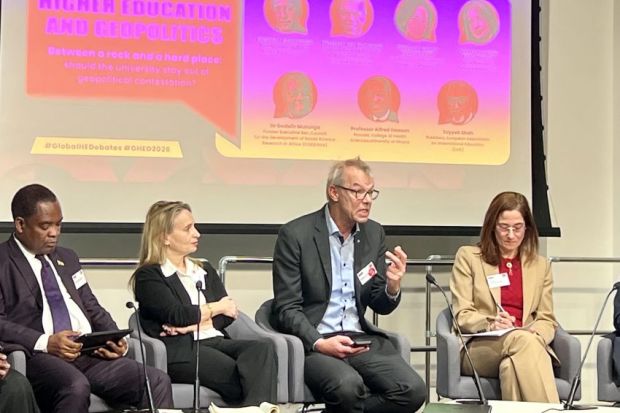
Speaking during a debate at King’s College London, Jan Palmowski, the secretary-general of the Guild of European Research-Intensive Universities, opposed a motion that universities should be politically neutral, saying they were already heavily involved in geopolitics.
“If we look at Ukraine right now, their institutions are full out in support of their society, in terms of their defence research, research on mental health and societal repercussions,” Palmowski said. “In the UK, almost every university applied to be part of the Defence Universities Alliance. So by default alone, these universities have voted to be part of geopolitical discussions.”
Palmowski, a former pro vice-chancellor at the University of Warwick, stressed that institutions needed to be more vocal about how knowledge was produced, exchanged and used as geopolitical competition was intensifying.
“Knowledge must not be used for state power at the expense of others,” he said, adding that navigating global tensions would involve making difficult decisions and that the debates would be “messy”.
“The days are gone, I hope, when we can assume ourselves to be superior just because we’re universities,” he added. “There are difficult questions, there are inconsistencies, but not to face those would be an abdication of duties.”
These views were echoed by Adam Habib, vice-chancellor of SOAS University of London, who described institutional neutrality as a “mythology”.
“The political experience of Western universities since the Second World War has never been institutional neutrality, it has been plurality,” he said.
“Every now and then, people use neutrality as an excuse to avoid having a difficult conversation.”
Habib argued that university leaders should instead focus on protecting diverse viewpoints and ensuring that rules were applied equally to those supporting competing political causes.
Joanna Newman, vice-chancellor of Goldsmiths, University of London, took a different view on the question of neutrality, saying that she was partly in favour of it.
“Universities aren’t campaigning organisations,” she said, stressing that institutions should provide an environment in which disagreement was fostered and students were confronted with uncomfortable challenges to their beliefs.
“We’re in danger in this world at the moment of confusing endorsement with understanding, and performance with thought,” she said.
“It’s easier to signal that we’re on the right side than to engage seriously with difficult ideas.”
Register to continue
Why register?
- Registration is free and only takes a moment
- Once registered, you can read 3 articles a month
- Sign up for our newsletter
Subscribe
Or subscribe for unlimited access to:
- Unlimited access to news, views, insights & reviews
- Digital editions
- Digital access to THE’s university and college rankings analysis
Already registered or a current subscriber?