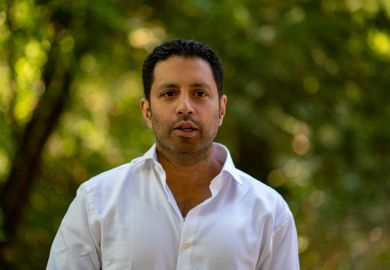
Institutional neutrality is a “myth” and an overcorrection to the volume of political statements from universities, according to the author of a new book.
Although the idea dates back to the 1960s, institutions are increasingly opting out of taking positions on political and social issues, especially since the 7 October Hamas attacks on Israel – including the University of Florida just last month.
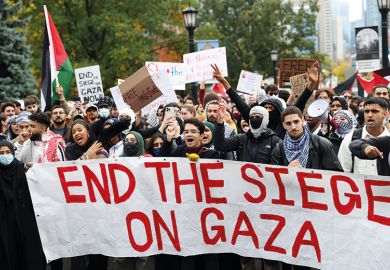
Many students urged their universities to take stances on Israel’s actions in response to the attack, although this risked angering or alienating other campus groups.
“It was a fraught issue and a hard one to manage and I think many universities responded by saying it would be easier just to get out of this business entirely,” said Brian Soucek, Martin Luther King Jr. professor of law at the University of California, Davis.
“The Trump attacks have made the timing particularly unfortunate, because this is a time when I think university speech is more needed than ever.”
In his book, The Opinionated University, Soucek argues that neutrality is “often nothing but quietism in the face of value-laden attacks”.
Many institutions pursuing neutrality cite the University of Chicago’s Kalven Report, which urges universities not to speak out on social and political issues. But even this “deeply individualist” document compels universities to respond when these issues pose a threat to its very mission, Soucek explained.
“Nobody can deny that what the Trump administration is doing counts as an attack on the university’s mission and its values, and yet we see surprisingly few universities speaking out on those attacks,” he told Times Higher Education.
He said the very idea of neutrality is “illusory” and allows universities to hide behind their own policy. Instead, he advocates for “opinionated” institutions.
Some have argued that the proliferation of political statements on all sorts of societal issues, particularly in the wake of George Floyd’s murder, are ineffectual and worsen campus tensions.
“It wasn’t just universities, we were getting emails from our local dry cleaners about what they thought about Black Lives Matter, and I think part of the cynicism was that many of those statements weren’t accompanied by action,” said Soucek.
But he added that institutional neutrality was an “overcorrection” to “statement culture”, and that universities should instead use their actions rather than their words to demonstrate their priorities.
Soucek includes a number of examples in his book of where institutional speech can mitigate some of the harms that First Amendment free speech rights can cause when they allow damaging speech to occur on campus.
“Giving institutions the ability to speak out against that kind of speech, to engage in institutional counter-speech, I think can go a long way in supporting those students who have been attacked,” he added.
In the face of continued pressure from federal and state legislatures, and encouraged by organisations such as the Heterodox Academy and the Foundation for Individual Rights and Expression, universities and their leaders are embracing neutrality.
Soucek, who serves on a committee for academic freedom with the American Association of University Professors, admitted he is “undeniably on the losing end” with the arguments in his book.
But he urged university presidents who have decided to speak out less not to impose the same doctrine on units within their university.
“I think we really lose something when those communities of experts speak out on topics within their expertise, and I think we lose something when they’re silenced from engaging in shared governance.”
Register to continue
Why register?
- Registration is free and only takes a moment
- Once registered, you can read 3 articles a month
- Sign up for our newsletter
Subscribe
Or subscribe for unlimited access to:
- Unlimited access to news, views, insights & reviews
- Digital editions
- Digital access to THE’s university and college rankings analysis
Already registered or a current subscriber?