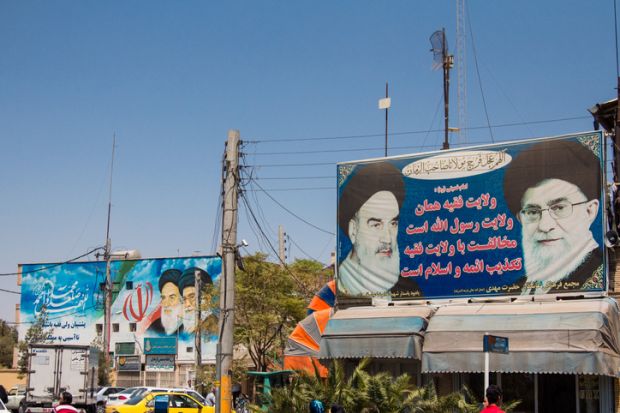
Ministers have been urged to take action after student societies described the late Iranian supreme leader as a “martyr” and held mourning events on UK campuses.
Several Islamic societies posted statements following the death of Ayatollah Ali Khamenei in US-Israeli airstrikes over the weekend, describing “unimaginable loss” and telling Shia communities in the West they “must remain aware and ready” and “this is not an end to resistance”.
Thinktank the Henry Jackson Society has written to the education secretary, Bridget Phillipson, and the home secretary, Shabana Mahmood, to urge them to investigate the statements.
“Given the apparent coordination and national scale of these statements, we now seek clarification…regarding the application of the Prevent duty and wider national security assessment,” says the letter, signed by former Conservative security minister Brandon Lewis, who now chairs the HJS.
Universities are expected to comply with the government’s counter-terrorism Prevent duty that aims to reduce the risk of radicalisation.
“Where messaging frames the death of a political and religious head of a hostile foreign regime in terms of ‘martyrdom’ and ‘resistance’, it is reasonable to ask whether a formal review has been triggered,” adds the letter.
“This is not a question of restricting lawful speech. However public confidence in the Prevent framework depends on consistency. If comparable language were used in relation to other extremist movements, scrutiny would be immediate and visible.”
One of the groups who posted the statement, the Ahlul-Bayt Islamic Society at UCL, has sought to explain their actions, saying the supreme leader had a role for Shia Muslims as “broadly analogous to that of the Pope within Catholicism”.
His death “is experienced not merely as a political event, but as a profound communal and spiritual shock”, the society says on Instagram, adding that it was not “incitement, endorsement of violence, or unlawful mobilisation” and the Prevent duty had not been breached.
The group cited UCL’s own freedom of speech code and statement on academic freedom as protecting “lawful expression”, adding these protections “do not depend on whether observers agree with, admire, or recognise the figure being mourned”.
A UCL spokesperson said they were looking into the social media posts “which have led to a number of complaints”.
“We recognise that the recent events and escalation of conflict in the Middle East and the wider region are causing significant distress for many members of our community.
“With students and staff from a wide range of backgrounds, our priority is to ensure that everyone feels safe, respected, and supported.
“UCL has in place a range of dedicated, expert support, both practical and emotional, for students and staff affected by conflict.”
Register to continue
Why register?
- Registration is free and only takes a moment
- Once registered, you can read 3 articles a month
- Sign up for our newsletter
Subscribe
Or subscribe for unlimited access to:
- Unlimited access to news, views, insights & reviews
- Digital editions
- Digital access to THE’s university and college rankings analysis
Already registered or a current subscriber?