Serial vice-chancellors are more common than they used to be but the club of people who have run more than one Russell Group university is still decidedly small.
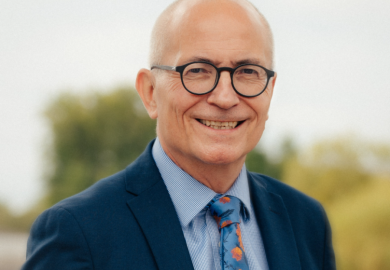
Its latest member, Charlie Jeffery, is adjusting to life on England’s south coast having taken over as vice-chancellor of the University of Southampton, after moving down from his former base in the north, where he was in charge at the University of York for seven years.
“The draw really was the different range of disciplines here, compared to York,” he told Times Higher Education in his as-yet undecorated office on the university’s Highfield Campus.
“York is a brilliant university but it doesn’t have the big-scale engineering that we do. There is a different kind of medical school here, which is deeply connected with a major research-intensive hospital,” he added.
Jeffery said it was “exciting” to think about all the opportunities for innovation at his new home “if you connect the creative arts with new technologies”, adding that he hopes his white office walls will soon be filled with artwork by his new students.
Despite the differences between the two institutions, Jeffery said one thing that connects them is “thinking about the social value that the universities bring” at a time where that has “come into question”.
Prior to becoming a university leader, Jeffery was an academic in political and social studies and has always taken a keen interest in the policy discussions of the day.
He said higher education faces a “dual crisis”, part of which is financial because “the old ways in which we have funded what we do in research and student education don’t work anymore”.
“The other part of the crisis is social value,” Jeffrey added. People are questioning whether degrees provide the benefits that they might once have done and whether the student loan system is working, he said. “I think we have to tackle those two challenges in tandem because the financial challenges [are] in good part about various choices government has made.”
He pointed to the long freeze in tuition fees, the gaps in research income and the constant tinkering with visa and immigration rules as three ways in which policy has left the financial model “challenged”.
But Jeffery does not believe the government will be minded to act while institutions’ social value is also under question “because other priorities come to the fore”.
According to Jeffery, a key driver of a perceived erosion in degree value is the “Plan 2” student loan system that is widely seen as unfair.
Campaigners have called for reform of these loans, which were taken out by those who started courses between 2012 and 2023 – after tuition fees were tripled to £9,000 – and must pay them back as a proportion of their salary for 30 years. Ministers have proven reluctant to act because of the scale of the cost involved.
“That wasn’t our doing, but it reflects on us…so I think we have to work harder to make sure our students are equipped to achieve in a context that is pretty uncertain”, Jeffery said, pointing to artificial intelligence as a key cause of much of this uncertainty.
Jeffery believes Southampton has a distinctive approach to generating social value, referencing the “triple helix” of research and education combined with impact.
“And we have to make sure that our students are exposed to the kinds of things that they’re going to need in their careers, so that they can bring their talents to that national ambition [to drive economic growth],” he said.
“I think that’s a great place for a university to be in this moment when we’re talking about industrial strategy and mayor’s local growth plans,” he added.
When “AI is transforming the labour market, we have to make sure that our students are equipped to flourish. I think Southampton’s got a brilliant vision of that, as did York,” Jeffery said. He added that he had recently completed his institution’s own widely rolled out training course on the use of AI tools.
Jeffery also said he believes that his new institution is well placed to contribute to the prime minister’s recent announcement that £1 billion of UKRI funding will be diverted to developing regional innovation clusters. Established in June, Southampton is part of a regional combined authority with Portsmouth, Hampshire and the Isle of Wight, with the election for its first mayor set for May 2028.
“That opens up all sorts of possibilities for connecting that brilliant research and innovation and what our students can take with them as they graduate into the economy around us,” he said.
Jeffery said he wants to build on Southampton’s strong track record in producing spin-outs. For instance, the institution houses the Optoelectronics Research Centre, the largest academic photonics centre in the UK. Since 1989, it has produced 18 spin-out companies that have generated more than £100 million and more than 650 jobs.
On starting companies, “It’s a fantastic skill set to build while you’re at university and to take with you...so I think nurturing that entrepreneurial thinking is something which I’d like to see even more of,” he said.
Register to continue
Why register?
- Registration is free and only takes a moment
- Once registered, you can read 3 articles a month
- Sign up for our newsletter
Subscribe
Or subscribe for unlimited access to:
- Unlimited access to news, views, insights & reviews
- Digital editions
- Digital access to THE’s university and college rankings analysis
Already registered or a current subscriber?