For Tod Laursen, chancellor of the American University of Sharjah (AUS), 28 February this year was a turning point for higher education in the Middle East, marking a departure from stability into an age of uncertainty.
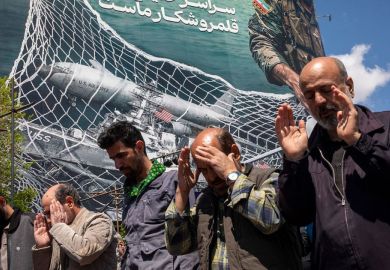
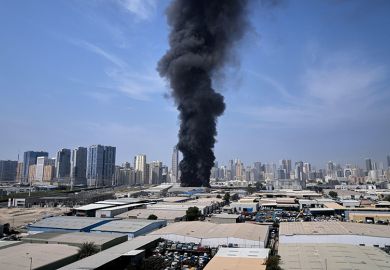
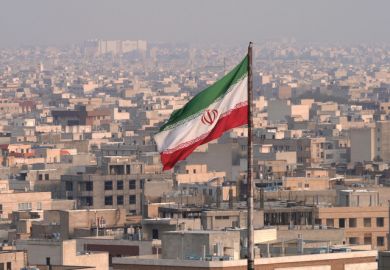
It was on this date that Israel and the US launched their attacks on Iran, resulting in retaliatory strikes against American allies, including the United Arab Emirates. Universities across the country – and across the Middle East more widely – were ordered to close their doors and resort to online teaching.
Laursen, who was the founding president of Abu Dhabi’s Khalifa University, and has worked in higher education across the Middle East, Africa and the US, said this required letting go of what he considered to be the “norm” for higher education, and instead embracing the unknown.
Originally he had anticipated the university to be teaching online for a short period, noting that initially the missiles were intercepted. However, pressure increased again at the end of March, when Iran declared that US universities in the region would become “legitimate targets” of attack. The university remained online for the rest of the academic year.
This was the “scariest” and most “nerve-racking” period of the conflict, Laursen said, as “then we had to not only hold classes remotely, which we’d been doing for some time, but we really had to hold the density down in the buildings that were in the core of campus because you just didn’t know [what was going to happen]”.
Despite the strikes, nearly 900 staff and students remained living on campus, and they valued communication above all. Students wanted information about the “basic stuff”, including details on: “Will the food outlets be open? Where can I get groceries? How are the security checks at the guard gate going to work?”
In response, the university began sending out a daily bulletin as well as holding frequent town halls to “just let people know what was going on”, as well as pointing students to mental health and counselling services.
“It was mostly, I think, a matter of being open with people, and if they were concerned about it, they had to be able to tell us they were concerned without fear of reprisal,” Laursen said.
But despite geopolitical conflict being uncharted waters for Laursen, “it would have been a much greater shock to me if I hadn’t had to navigate Covid,” he said, having worked at the State University of New York, which has almost 400,000 students, during the pandemic.
“It seems silly, I know, to compare a global pandemic to a regional conflict,” he conceded. “They’re not the same thing, but a lot of the things we had to do were similar…So that made it a lot easier for me as a leader, because I had the confidence that there were basic things we could do, because we’d already done them.”
Laursen added that while he had never experienced anything like geopolitical conflict before, the nature of the American University of Sharjah meant that he felt the student body and faculty were more prepared in dealing with the upheaval than students in other regions.
“When you work in the Middle East, in our case we have about three-quarters of our faculty that are of Arab origin, or have grown up in the region. And, not to put too fine a point on it, almost anywhere you can think of in the Middle East, people have lived this already,” he said.
“While people didn’t think this would happen in the UAE, they were kind of emotionally equipped. The ones you had to maybe worry about more were the people for whom this was really their first rodeo, so to speak.”
The conflict has halted the development of wider opportunities for Middle Eastern higher education, he explained. He said it has “slowed down” institutions’ ability to “build our global presence”, as well as internationalisation. While student recruitment has risen slightly for AUS, it is aware of some students who have either cancelled their places or delayed their start owing to the conflict.
Having spent more than 11 years working across AUS and Khalifa, he said “there is not a quality difference” between the best students in the Middle East and the best in the US, but “the trouble is that partners don’t always realise this”.
Partnerships with Western universities can often result in Western institutions viewing the link as “a development project” for those in the Middle East, which Laursen said he “had no interest” in engaging with.
“[Our students] don’t need to take a back seat to anyone. So I think the main challenge for us is to continue to prove to strong partners elsewhere that we can be full partners and that we have the quality of faculty and students to do that.”
The university has returned to in-person teaching, but Laursen said he has still had business trips cancelled owing to the ongoing uncertainty. Ultimately, how much of an impact does he think this has had on the future of higher education in the Middle East?
“I don’t think there’s going to be any going back to normal, like we had a year ago,” he said. “It’s just hard to imagine that happening any time soon. So, I think people are having to deal with uncertainty.”
Register to continue
Why register?
- Registration is free and only takes a moment
- Once registered, you can read 3 articles a month
- Sign up for our newsletter
Subscribe
Or subscribe for unlimited access to:
- Unlimited access to news, views, insights & reviews
- Digital editions
- Digital access to THE’s university and college rankings analysis
Already registered or a current subscriber?