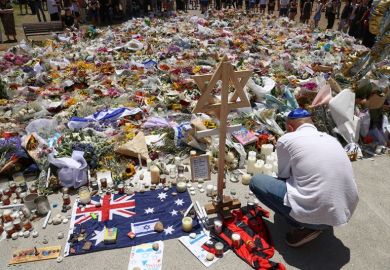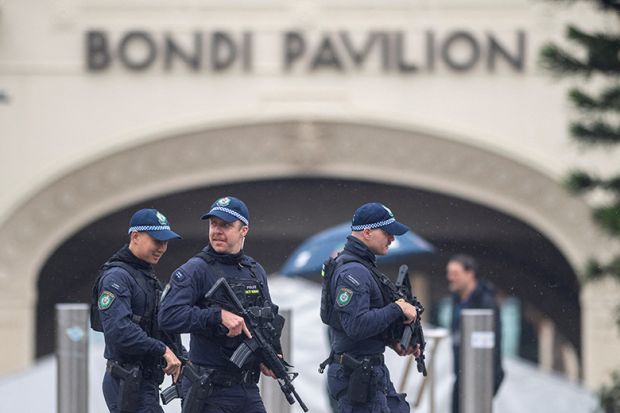
The regulatory and cultural repercussions of the Bondi Beach terrorist attack are still playing out on Australian university campuses, two months after the tragedy.
As former high court justice Virginia Bell heads a royal commission into antisemitism at a societal level, universities are receiving special attention from an education task force established days after the 14 December atrocity.
A February meeting of the task force examined the federal government’s efforts to boost the powers of the higher education regulator, Teqsa, amid a proposal that universities lose funding for failing to curtail antisemitism. The government has not spelled out whether it will do this but it plans to empower Teqsa to impose significant penalties.
A September consultation paper asked whether Teqsa needed more “timely enforcement approaches” – including civil penalties, injunctions and the power to appoint administrators to universities’ governing bodies – “when justified and in the public interest”. Education minister Jason Clare said Teqsa needed “better tools” to respond to systemic risks. “At the moment Teqsa has a sledgehammer and a feather, and not much in between.”
In a strongly worded letter to universities, issued the day after the task force’s meeting, Teqsa warned vice-chancellors to show “deliberate, visible leadership” in the aftermath of the Bondi tragedy. This included “intervening early” if “safety or inclusion” were put at risk.
“The community is watching closely,” the letter says. “A new academic teaching period presents an opportunity to demonstrate that higher education institutions can balance academic freedom and academic standards with their fundamental obligation to keep students safe. This teaching period and beyond is an opportunity to rebuild trust where it has been strained.”
Meanwhile, the first “report cards” on universities’ handling of antisemitism are due in May. The process will assess universities in four tranches, starting with the Group of Eight.
Former Australian Catholic University vice-chancellor Greg Craven, who has accused campus leaders of fostering a permissive environment for antisemitism by turning a blind eye to “vicious” protests, is leading the report card initiative.
An explanation of the report card process, leaked to The Guardian, says it will assess universities’ efforts in four “priority areas”: policies and procedures, complaint processes, awareness training and “integration” of a definition of antisemitism.
The confidential reports will grade each university from A to D overall and in each priority area. A second wave of assessments will “track progress and continuing problems” after an eight-week “period of reflection”.Jillian Segal, the government’s special envoy to combat antisemitism, will publish a sector-wide report card by the end of 2027.
The institutional assessments will examine issues including access to campus grounds, regulation of flags and “imagery”, and responses to protests and encampments. Universities’ policies must mandate “respectful discourse” consistent with “vigorous intellectual debate”, the document suggests.
Their processes must ensure that complaints are not “downplayed, deflected, disregarded or stymied”. Training must promote an understanding of the “shape-shifting and viral” nature of antisemitism and that “antisemitic language can end in violence or death”.
The document says the controversial International Holocaust Remembrance Alliance definition of antisemitism is “preferred” but an alternative developed by Universities Australia is “acceptable”. Either definition must be adopted in each university’s constitution or statutes “so as to control all inferior policies and procedures”.
The National Union of Students said the process, as described, would have “serious and far-reaching consequences” for academic freedom and legitimate political expression. “Peaceful protests, political symbols and flyers are not the drivers of antisemitism. Universities should not be compelled to police political viewpoints under the guise of anti-racism.”
Steven Schwartz, former vice-chancellor of Macquarie and Murdoch universities, said arguments about academic freedom had been used as cover for antisemitic behaviour and administrators’ reluctance to address it.
“There have been so many complaints over such a long time from Jewish students about feeling unsafe,” Schwartz said. “Universities have…spent years excusing antisemitism and avoiding decisions that might upset activists.
“We’re not…asking these leaders to figure out Middle East geopolitics. Just don’t let people harass and express hate towards other people. If government has to threaten to get universities to do what they should have been doing anyway by withholding money, that’s clearly an indictment of university leadership.”
Schwartz said many vice-chancellors had erred by allowing their institutions to take stands on political issues, as demonstrated by their public advocacy for the “yes” case in the referendum on an Aboriginal voice to parliament. This made it difficult for them to prevent academics taking activist stands on issues outside their area of expertise.
“University leaders have been equivocating about antisemitism. They’re really just going with the wind. They read the room for moral leadership. I would ensure that there were policies against antisemitism, make sure that the institution was neutral on geopolitical issues, and discipline anyone who crossed the line.”
Geoff Sharrock, honorary senior fellow at the University of Melbourne, said it was debatable that universities in general had tolerated antisemitism or “pandered to the most vocal group”. He said perceptions of universities’ behaviour had been based on a few “outrageous” cases that had garnered media attention – potentially overlooking many others that had escaped notice because they had been handled through universities’ confidential complaint processes.
Sharrock said it was extremely difficult for universities to balance their concurrent obligations to well-being and free expression. “It wasn’t that long ago that universities were being asked to step up on free expression. Now they’re being asked to crack down on excessive free expression across a spectrum of views that some people find outrageous and others don’t.”
He said legislative solutions on their own could not rectify campus antisemitism. Nevertheless, university administrators would be “dusting off” the changes they had made in the wake of the 2019 French Review of free speech on campus – when the government had pressured universities to comply with a “model code” produced by the review – to assess whether new changes were needed.
The model code ran to seven pages, demonstrating the sheer difficulty of producing a “snappy set of rules” to guide speech on campus. Sharrock himself has produced a simpler model code to support open debate on contested topics but said managing campus expression would always be a challenge. “It’s very hard to communicate those rules succinctly to staff, let alone students.”
Register to continue
Why register?
- Registration is free and only takes a moment
- Once registered, you can read 3 articles a month
- Sign up for our newsletter
Subscribe
Or subscribe for unlimited access to:
- Unlimited access to news, views, insights & reviews
- Digital editions
- Digital access to THE’s university and college rankings analysis
Already registered or a current subscriber?