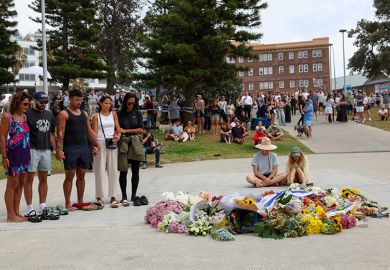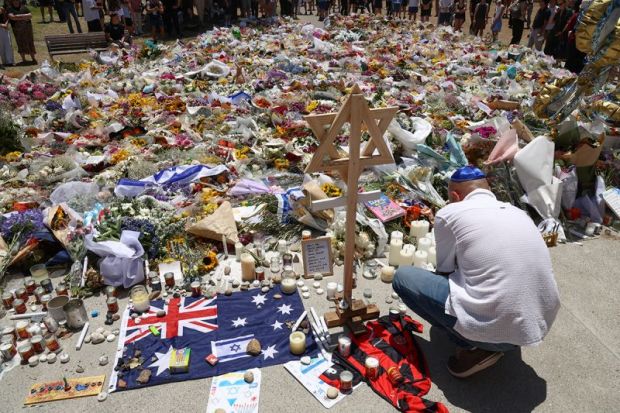
Australian universities will be assessed on their efforts to stamp out antisemitism on campus, and risk losing funding if they are found wanting, under government moves following the Bondi Beach terrorist attack.
Canberra has committed to rolling out the first “university report card” on antisemitism in 2026, as part of a hastily assembled response to the July report from Jillian Segal, the government’s special envoy to combat antisemitism.
Her report advocated the withholding of funding from universities, programmes or staff found to have facilitated or failed to act against antisemitism, along with mechanisms to terminate grants to researchers or academic groups engaged in “antisemitic or otherwise discriminatory or hateful speech or actions”.
The response to Segal’s report does not address her recommendations around university funding. However, Times Higher Education understands that the government plans to empower the higher education regulator, Teqsa, to impose significant financial penalties on universities.
Education minister Jason Clare outlined moves to boost Teqsa’s powers in September. The government wants to give the regulator tools to meaningfully punish universities for governance transgressions, including failures to manage antisemitism, without completely defunding or deregistering institutions.
While Teqsa has had the authority to shut down universities since it was created in 2011, observers consider it unlikely that the regulator would ever resort to such severe action.
The report card will assess universities’ “adoption of an appropriate definition of antisemitism, their delivery of training to staff, the accessibility and fairness of complaints processes, and governance responses to activities that may incite discrimination”.
Segal pressed ahead with the report card project ahead of the government’s 18 December response to her report. In November she appointed constitutional lawyer Greg Craven, former vice-chancellor of the Australian Catholic University, to lead the initiative.
In comments reported by The Australian, Craven denounced universities for contributing to an “authorising environment” where it was “more and more permissible to be fashionably antisemitic”.
“Every time you see a chanting, vicious protest on a university campus, it’s telling you that antisemitism’s all right. Every time nothing is done about that, it’s telling you it’s not wrong. The fact that universities, of all places, have not stood against it is a major factor in making antisemitism respectful.”
The government has also announced a new Antisemitism Education Taskforce as a “key” area of “accelerated focus” in response to Segal’s report. The 12-month task force will be led by outgoing UNSW Sydney chancellor David Gonski and will include Segal and Universities Australia chair Carolyn Evans, along with representatives of Teqsa, the interim Australian Tertiary Education Commission and other bodies.
The task force meets for the first time on 19 December. While school education will be its initial focus, it will also consider whether “further measures” are needed across the education system.
Evans said education and “the deepening of knowledge” were powerful tools for tackling hatred, challenging prejudice and building understanding. “I welcome the opportunity to engage with participants from all parts of the education sector on a unified approach to tackling antisemitism in our institutions.”
The government has also flagged additional support for Monash University to expand training in “recognising antisemitism” to staff and leaders of universities across Australia.
Daniel Aghion, president of the Executive Council of Australian Jewry, said education was “critical” in combating the “multiheaded hydra” of antisemitism. “We have to get the heat down in the universities and find a way to engage in respectful and responsible debate and freedom of speech without getting into hatred of Jews,” he told ABC Radio.
The government has attracted bitter criticism from the Jewish community for a perceived failure to tackle antisemitism, illustrated in its tardy response to Segal’s report. Aghion said he was “grateful” for the government’s actions but they were “two years too late and in consequence to a national tragedy”.
Register to continue
Why register?
- Registration is free and only takes a moment
- Once registered, you can read 3 articles a month
- Sign up for our newsletter
Subscribe
Or subscribe for unlimited access to:
- Unlimited access to news, views, insights & reviews
- Digital editions
- Digital access to THE’s university and college rankings analysis
Already registered or a current subscriber?