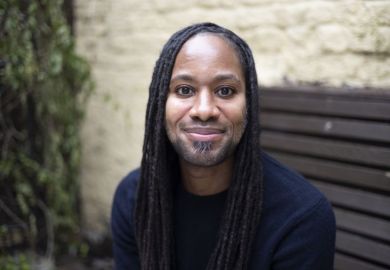
Australian universities must “dive headlong” into the social morass that contributed to the Bondi Beach terrorist attack, according to the head of Monash University’s Australian Centre for Jewish Civilisation.
Historian David Slucki said the sector should not react to the tragedy by steering clear of Israeli-Palestinian tensions to avoid exacerbating the trauma. “We need to grapple with it,” Slucki said. “The worst thing now would be to sort of cower into oblivion.
“We need to teach about it. We need to research it. We need to talk about it, and we need to do it from a place of generosity and goodwill and not suspicion and hatred and anger. We need to be brave.”
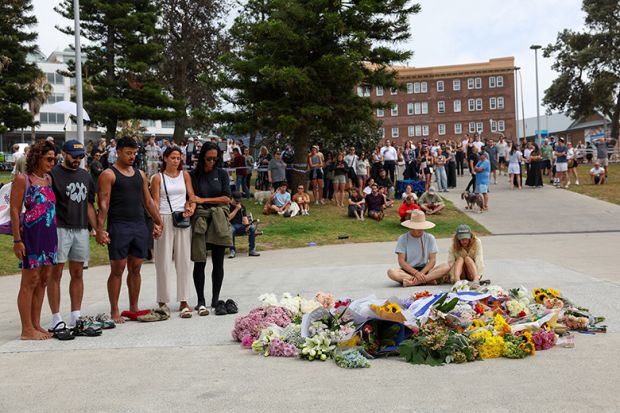
At the time of writing, the attack on a Hanukkah celebration at Australia’s most famous beach had claimed 15 victims. Another 27 remained in hospital, some in critical condition.
While the atrocity has shone a spotlight on escalating antisemitism in Australia, it also highlighted a neighbourly spirit that transcended religion, identity or politics – perhaps most graphically through the extraordinary heroism of a beachgoer, later revealed as a Syrian-born shop owner, who wrestled a rifle off one of the two gunmen.
The massacre occurred five months after lawyer and businesswoman Jillian Segal blew the whistle on escalating antisemitism in Australia. Her report, which is yet to elicit a government response, included a recommendation to withhold funding from universities that failed to adequately tackle the issue.
Meanwhile, a study into racism at the nation’s universities is due to be handed to the government imminently by race discrimination commissioner Giridharan Sivaraman. Education minister Jason Clare has warned that he expects the report to reveal “some pretty awful things”.
Slucki said universities were a microcosm of community tensions in a “polarised” world where issues such as the Israel-Palestine conflict were characterised “in terms of purely good and evil”, despite their “extremely complicated” histories.
“Universities should be…palaces of discourse where we can disagree compassionately. I think we’ve lost that muscle. Effective debate, respectful debate, productive debate – what does that look like? What are we willing to accept as part of the cost of doing business? Where are we talking about offence, and where are we talking about harm? How can we draw clear distinctions there and make sure we’re addressing harm when it appears?”
Campus resource: To combat antisemitism in HE, teach students about Jewish history
Fellow historian Daniel Heller, co-director of Monash’s “Brave Conversations” project, said constructive dialogue programmes could never be a “meaningful” or “effective” response to planned acts of extremist violence. But they could help foster a reconceptualisation of disagreement as an opportunity for connection.
“It’s not just about hearing someone’s perspective,” Heller said. “The university should be the place to test ideas. We need the signal from…our university leaders that this matters – that students aren’t just clients [and] we’re not just there to sustain budgets. There is significant room for our sector to make sure that what we are doing in the classroom is practising democracy, and giving our students the opportunity to do so as well.”
Slucki said it was “not just a Jewish problem. Today…the Jewish community [is] the target, but who knows who it is tomorrow?
“People on campuses are scared. Lots of…political positions you can take on any issue can land you being doxxed or harassed or publicly humiliated. We need to do our jobs better as a sector.”
Register to continue
Why register?
- Registration is free and only takes a moment
- Once registered, you can read 3 articles a month
- Sign up for our newsletter
Subscribe
Or subscribe for unlimited access to:
- Unlimited access to news, views, insights & reviews
- Digital editions
- Digital access to THE’s university and college rankings analysis
Already registered or a current subscriber?