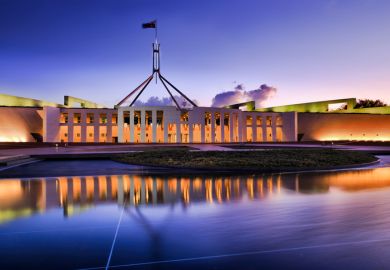
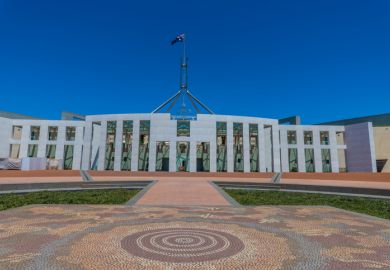
Australian universities should discard group assignments because students “hate them”, according to Australia’s shadow education minister.
Administrators should also consider mandating on-campus attendance and reintroducing invigilated assessments as a way of “buttressing the credibility” of their degrees.
In an address straddling policy and pedagogy, Julian Leeser will counsel the sector to safeguard qualifications against “future challenges” by rethinking teaching and assessment. “How can a degree programme…retain its worth when it is not reflective of intellectual effort?” he will ask the Universities Australia annual conference, according to speech notes.
“I am calling on you to get rid of group assignments. There is always that student who does the work, and that student who reaps the benefit. Students feel, instinctively, that in many cases it is deeply unfair to assess them individually based on others’ work. It cheapens the degree.”
Although he has been opposition education spokesman for less than five months, Leeser is no stranger to the conference. He was policy and strategy director at the Australian Catholic University before entering parliament a decade ago.
“I come to this role with real affection for universities, and with a clear view of what they can do,” he will say. “I am a friend who wants to see you be your best selves.”
While new opposition leader Angus Taylor has signalled a policy focus on immigration, Leeser will promise not to blindside the sector. “We will want to make changes to the settings around international students but…we want to work closely with you to develop these policies.
“We will approach this issue with sobriety, balance and in consultation with the sector.”
But he will question whether the concentrations of international students – who comprise more than 80 per cent of enrolments in many information technology programmes, and over half of several universities’ entire student cohorts – are “consistent” with community expectations.
Universities must consider the student experience, the quality of teaching and the impact on housing affordability, services and infrastructure, Leeser will warn. “When those impacts are not well managed, and spill out beyond the campus, they risk eroding your standing in the community.”
Leeser will reiterate the opposition’s scepticism about the government’s plan for a higher education “steward”, saying that the proposed Australian Tertiary Education Commission (Atec) will be a de facto regulator that “duplicates the functions of the Education Department”.
“Atec will be at least your 15th regulator,” he will say. “No one in the sector is telling me that you are under-regulated. We cannot regulate our way to innovation and growth.”
He will promise to address the sector’s “red tape and compliance burden” if the opposition parties regain government. “The thicket of regulation needs to be cut back.”
A prominent Jewish member of parliament, Leeser will also press university administrators to exercise “leadership” over antisemitism. “We’ve seen academics say that Jews don’t deserve cultural safety,” he will say. “We have seen academics deny that the rapes on 7 October even occurred.
“Hamas deniers are no different than Holocaust deniers.”
He will press vice-chancellors to adopt the controversial International Holocaust Remembrance Alliance (IHRA) definition of antisemitism “in full”, insisting that it does not preclude “legitimate criticisms” of the state of Israel.
“If IHRA is good enough for the Australian government, for state governments and for the Royal Commission, it is good enough for Australia’s publicly funded universities.”
Register to continue
Why register?
- Registration is free and only takes a moment
- Once registered, you can read 3 articles a month
- Sign up for our newsletter
Subscribe
Or subscribe for unlimited access to:
- Unlimited access to news, views, insights & reviews
- Digital editions
- Digital access to THE’s university and college rankings analysis
Already registered or a current subscriber?