The government should not resort to wholesale debt forgiveness to soothe escalating concerns about student loans in England, according to Antipodean experts who conceded that the approach had paid political dividends Down Under.
Higher education analyst Maxwell Yong said wiping debt could work as a “political stunt” but would not ease Britons’ day-to-day cost pressures. A preferable approach would be changing repayment arrangements to provide a sugar hit for struggling graduates, he said.
“If the objective is improving cost of living for graduates, raising the repayment thresholds will be one option to create relatively expedient cost-of-living relief,” said Yong, an honorary fellow at the University of Melbourne’s Centre for the Study of Higher Education. “However…it will [put] the government in more debt.
“Also, the less students pay, the higher their chance of not repaying the whole loan. That ends up becoming an effective subsidy from taxpayers.”
Keir Starmer’s government has come under increasing pressure to reform student loans following an outcry over its November decision to freeze repayment thresholds for students who started their courses between September 2012 and July 2023.
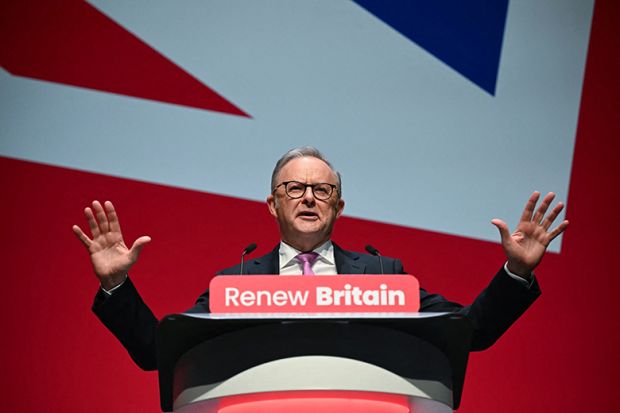
Starmer has promised to make student loans fairer, without specifying how. Lowering the interest rates or raising the repayment thresholds appear the most likely reform options. But the Liberal Democrats say public sector workers should have their student debts written off after 10 years of service, while a Labour MP wants Starmer to copy Australian prime minister Anthony Albanese’s tactic of wiping 20 per cent of accrued borrowings.
Yong, a teaching fellow and public policy postgraduate at Harvard University’s John F. Kennedy School of Government, said he knew “lifelong Liberal voters” who had backed Albanese’s Labor Party at the 2025 election in part because of the promise. “They thought it was a stupid policy, but you’re not going to vote against your own financial interests.
“That 20 per cent debt wipe policy sounds very sexy, but it…has poor distributional effects and requires huge trade-offs from a fiscal perspective. That’s five state-of-the-art hospitals that you can’t build.”
He said partially writing off debt, unlike raising the repayment threshold, did nothing to increase people’s disposable income unless they had nearly paid off their loans. “All it does is change the repayment period.”
Christchurch consultant Roger Smyth said the New Zealand Labour government’s 2005 elimination of interest charges had taken “a lot of the political heat” from the then fraught issue of student loans. “It was a bit of an electoral winner, actually,” said Smyth, a former head of tertiary education policy at New Zealand’s Ministry of Education.
“The British government [could] take a leaf out of that book [and] run the good news in the lead-up to a tight election.”
Smyth said a relatively small “sweetener” – reducing interest rates to the level of inflation, for instance – would be preferable to forgiving loans. But any reform would be expensive, given the magnitude of student debt which – in New Zealand’s case – was the third-biggest asset on the government’s books after public sector superannuation and the accident compensation scheme.
“If they touch an asset of that scale, there is no way [they] can do it without costing the Treasury an awful lot of money,” Smyth said. Any concession would also be “regressive”, forcing taxpayers to bankroll more benefits for graduates who “disproportionately come from higher socio-economic classes”.
Monash University higher education expert Andrew Norton said debt forgiveness was “terrible” policy – but less so in England than in Australia, where fees were generally lower and graduate salaries typically much higher.
“More of the debt here is actually recoverable,” Norton said. “The actual cost long term to taxpayers…is much higher than it is in England, where a lot of this debt is kind of an accounting fiction because so much of it will never be repaid.”
Norton said wiping student fees would be an appealing political stratagem for the Westminster government. It had proven a potent weapon against both progressive and conservative opponents in Australia’s 2025 election, arguably costing then Greens leader Adam Bandt his inner Melbourne seat.
“This was such an attractive promise from Labor,” Norton said. “Even though the Greens have been against student debt for a long time, Labor had a real promise that they could actually deliver in a way the Greens could not.
“Why did the margin of victory end up being so large? I think it was because they pushed this student debt thing in the last week, and sort of pulled a whole lot of marginal voters. I would say doing an Albo is actually pretty tempting.”
Register to continue
Why register?
- Registration is free and only takes a moment
- Once registered, you can read 3 articles a month
- Sign up for our newsletter
Subscribe
Or subscribe for unlimited access to:
- Unlimited access to news, views, insights & reviews
- Digital editions
- Digital access to THE’s university and college rankings analysis
Already registered or a current subscriber?