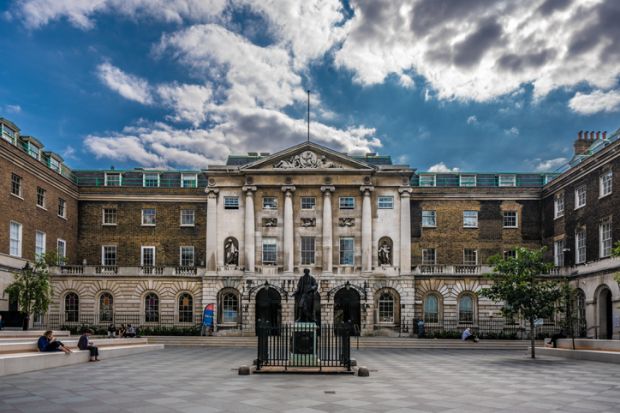
Unions fear that plans to merge Cranfield University with King’s College London will have an adverse effect on jobs and salaries, claiming they were “blindsided” by the announcement.
The coming together of the specialist postgraduate institution and the London giant was announced last week, in the second major merger agreed amid the sector’s financial crisis.
Staff at the London institution said they were unaware of any plans for a merger until they found out about it the morning before it was announced to the press.
Jamie Woodcock, chair of the KCL University and College Union (UCU) branch, said that the union had been in discussion with the university for the past year about its Strategy 2030 plan. However, in those discussions a proposed merger was never discussed, and he said the union felt “blindsided” by the announcement.
“We as a union have been trying to negotiate with them about this strategy but clearly there have been other plans that we haven’t been informed of. So I think people are quite shocked.”
He added that staff are concerned about potential job losses and cautioned that mergers involving the UK’s larger universities taking over struggling institutions could have unintended consequences for all.
“It’s not going to be as simple as some universities go under and some stay the same. I think this is the beginning of a sort of bifurcation of the sector. Universities like King’s, UCL, Oxbridge are going to win from some of these processes. I think we’re likely to see more mergers, and those competitive pressures playing out.”
The UCU branch is in a trade dispute over the protection of staff and academic freedom amid the Israel-Hamas conflict. The union has demanded that a clause be added to contracts at KCL to allow employees to “conscientiously object” to participation in any activity connected with the military, the arms trade or fossil fuels.
Cranfield’s reputation in defence studies was therefore “worrying” to staff, and “a big concern for a lot of our members”, Woodcock said.
A spokesperson for King’s College London said that it “already has a longstanding and internationally respected role in security, defence and national resilience”.
“Like many leading global universities, we deliver this work within clear ethical and legal frameworks that protect academic freedom and support rigorous, open inquiry.”
Another member of the UCU branch, who wished not to be named, noted that staff at King’s have lower salaries compared to colleagues at other London universities, despite it being “financially very healthy”. They said the rhetoric coming out of the university is one of “huge achievement”, but that is “disconnected to what the staff feel” amid stagnating salaries.
They said they felt it was “risky” to merge with a university in deficit, and was evidence of King’s putting expansion above its responsibility to its current staff.
“We see so many other universities commit to plans which then don’t work out. I’m just scared about universities trying to punch above their weight, instead of just trying to be a really good university.”
The King’s spokesperson said the merger was driven by “academic opportunity and a shared ambition to create a distinctive institution”.
They added that staff were informed at the “earliest possible opportunity” and “conversations will continue throughout this process”.
“The proposed merger would strengthen the UK’s capabilities in areas including engineering, technology, defence, security and environmental resilience, while creating new opportunities for students, staff, research and innovation.”
Although there was also concern at Cranfield, the mood in general was more optimistic.
Michael Kyriacou, regional support official for the eastern and home counties at UCU, said: “It’s a mixture of emotions that I think the staff are feeling. There are some who are excited by it and recognise there’s an opportunity for Cranfield.
“There are others who are nervous, and there are others who will probably be thinking: ‘What does this mean for me now? What does this mean for me in 2027, and what does this mean for me going forwards?’”
Cranfield has gone through “large-scale transformation” in recent years, involving job cuts, and Kyriacou said there was hope that the merger “could provide security” but there was “a bit of a wait and see” attitude.
He believed what was different about the merger compared with the one seen between the universities of Kent and Greenwich was “that this isn’t a merger where you’ve got a lot of duplication or overlap – what KCL offers and what Cranfield offers, I think, is fairly distinct”.
A spokesperson for Cranfield said: “The proposed merger is an intentional step to create a global university especially equipped for the changing world, bringing together two institutions with complementary strengths.
“It is not a merger driven by financial savings, but one predicated on growth and investment.
“There are of course several further legal and regulatory steps before the formal merger can occur, and a full consultation exercise with colleagues and trade unions will take place beyond our conversations so far.”
Register to continue
Why register?
- Registration is free and only takes a moment
- Once registered, you can read 3 articles a month
- Sign up for our newsletter
Subscribe
Or subscribe for unlimited access to:
- Unlimited access to news, views, insights & reviews
- Digital editions
- Digital access to THE’s university and college rankings analysis
Already registered or a current subscriber?