Australian universities may need to appoint “internal ombudsmen” to referee campus disputes, after a bruising week of Royal Commission hearings exposed the difficulty of ensuring safety in a polarised world.
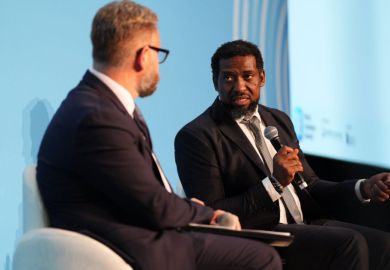
Marketing consultant Tim Winkler said vice-chancellors’ apologies over their handling of pro-Palestinian protests demonstrated that they had an antisemitism problem that they were unlikely to solve by simply updating their policies.
Winkler said the World Cup had demonstrated the need for on-the-ground adjudicators to determine whether rules had been broken, even in a highly codified game like football.
“Perhaps we need more umpires in our institutions to look at [things] quickly and deal with [them] in an objective manner,” he said.
“They won’t get it right all the time, but they will address things relatively rapidly and get people to move on. It’s pretty clear that if students and staff aren’t feeling safe, and institutions are saying they’ve failed in their current approach, new approaches are needed.”
The Royal Commission on Antisemitism and Social Cohesion, which spent an entire week of public hearings gathering evidence about antisemitism in universities, has delivered the latest blow to the besieged sector’s image. After students outlined harrowing experiences of antisemitic abuse on the Monday, and academics followed suit on the Tuesday, leaders of five of the country’s most prestigious institutions spent Wednesday and Thursday accounting for themselves.
University of Sydney vice-chancellor Mark Scott confessed that his institution had not “substantively” prepared for the two-month protest encampment on its front lawn because camping “hadn’t been part of the protest tradition” over its 175-odd years.
In a frank self-appraisal, Scott admitted to a “clear oversight” in not communicating more clearly about negotiations aimed at ending the encampment without involving riot police. He said he had only grasped how “menacing and threatening” the camp had been for some staff and students during subsequent training on the “intergenerational trauma” of the Jewish experience.
“Our Jewish students and staff paid a price for that as the encampment dragged on,” he told the hearing. “I’m sorry we did not keep them more closely engaged.”
The University of Melbourne’s interim vice-chancellor, Glyn Davis, acknowledged that his institution had exacerbated the “appalling” treatment of Jewish physics professor Steven Prawer – whose office had been occupied by protesters in 2024 – by refusing to share the names of the offenders or publicise the outcomes of 14-month disciplinary proceedings against them.
“This [is] a difficult question of both principle and practice,” Davis said. “We’re dealing with young adults at the start of their…professional career. The way the system of student complaints [is] structured is to try not to make a stain on the rest of their lives. That’s why it’s a confidential process.”
The tension between privacy and transparency is not the only “difficult question” for university administrators responding to campus antisemitism. Others include finding the right balance between reasonable protest and unreasonable disruption, between legitimate political expression and illegitimate personal vilification, between unimpeded 24-hour access and licence to camp, between safety from violence and safety from challenging ideas.
Winkler, publisher of the Future Campus news site and a former marketing director at Monash University, said there was “no one perfect solution” to any of these questions. But that did not absolve universities from trying. They “have to be seen to be better than the community”, he said. “They’re supposed to be higher-order institutions.”
He said universities that failed to rein in antisemitism would have solutions imposed on them, after the Royal Commission’s final report – due in mid-December – prompted another round of unflattering headlines. This would suit the government, because being a “hardliner” over universities’ “governance failings” gave it political cover to ignore funding issues like the mounting debts of arts students.
By appointing some sort of “internal complaints resolver”, universities may avoid fresh – and considerably more expensive – compliance obligations, Winkler said. “It’s one way forward. Some form of proactive approach that heads off some of that compliance and demonstrates good practice in terms of governance and responsiveness – I would have thought [that] would be very well received.”
Universities have already attracted more compliance responsibilities after Canberra responded to last September’s report from the Special Envoy to Combat Islamophobia. The government has vowed to establish an “Islamophobia Education Taskforce”, and its recommendations – together with those of the Antisemitism Education Taskforce announced in December – will be overseen by a “Social Cohesion Education Advisory Council”.
The council will also have the job of implementing a national “framework” for anti-racism in universities, as advocated in February’s Australian Human Rights Commission report. And the government has imposed a legal requirement for universities to prevent and respond to Islamophobia – along with other forms of racism, including antisemitism and discrimination against Indigenous Australians – under a revamp of regulatory standards.
Higher education consultant Justin Bokor, a former commercial director at Monash, said the “excess” regulation inflicted on Australian universities was counter-productive and would add a lot of cost.
“Academics and students should have every right to feel safe. You shouldn’t be threatening people and you shouldn’t be invading offices, but you should have every right to make your voice loud and heard within those constraints. This doesn’t seem like rocket science to me.”
Bokor said there were “extremists on both sides” of the Israel-Palestine debate, with one side “conflating Jewishness with support for the actions of the state of Israel”, and the other “trying to use the antisemitic card to prevent legitimate criticism of Israel”. Rather than buying into such arguments, universities should adopt simple, clear and consistently applied rules, he said.
Encampments, for example, should be allowed as long as the occupants acted respectfully and avoided “causing a major blockage”. But a “small fringe” shouting racist abuse should not be tolerated beyond one clear, unequivocal warning. “If you’ve got a handful of extremists in your encampment doing the wrong thing, the encampment as a whole should be shut down.
“The lines should be pretty clear. Safety should be black and white. People make it more complex than it is.”
Register to continue
Why register?
- Registration is free and only takes a moment
- Once registered, you can read 3 articles a month
- Sign up for our newsletter
Subscribe
Or subscribe for unlimited access to:
- Unlimited access to news, views, insights & reviews
- Digital editions
- Digital access to THE’s university and college rankings analysis
Already registered or a current subscriber?