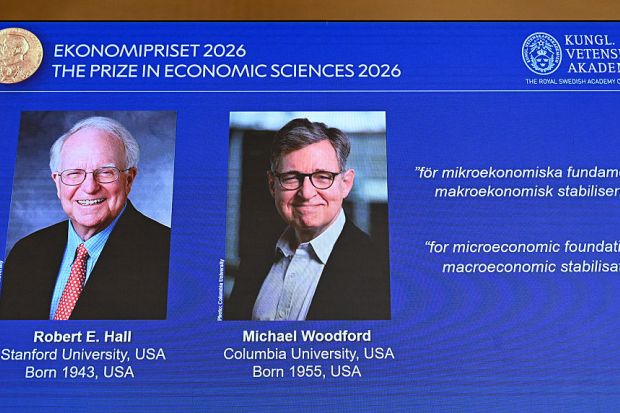
Two US professors have been awarded the Nobel Prize in Economics for demonstrating how interventions by central banks can help avert recessions.
Robert E. Hall and Michael Woodford earned the Nobel for their research into models used by central banks and governments to “smooth out” periods of boom and bust, it was announced on 12 October.
Hall, born in California and based at Stanford University, and Massachusetts-born Woodford, a professor at Columbia University, will share the SEK 12 million (£910,000) Sveriges Riksbank Prize in Economic Sciences in Memory of Alfred Nobel, which was established by Sweden’s central bank in 1968.
Announcing the prize for their research on the “microeconomic foundations of macroeconomic stabilisation”, the Nobel committee explained that the economists’ work had been crucial in looking beyond Keynesian models in which an economy cuts rates during a recession to stimulate growth and increases rates in a booming economy to stave off inflation.
Instead of just analysing macroeconomic variables such as inflation, production and consumption, Hall and Woodford showed how the combined effect of individual households and businesses affects the economy through their forward-looking decision-making, the Royal Swedish Academy of Sciences said in a statement.
“Since the new models’ introduction, they have been extremely helpful in dealing with the economic downturns that have affected us,” it added, noting how “on the basis of these models, well-timed fiscal and monetary policy measures can reduce the economy’s peaks and troughs”.
“With them, we are better equipped to deal with shocks in the economy, such as energy crises or sudden changes in how much households consume,” said John Hassler, chair of the Committee for the Prize in Economic Science.
Both of this year’s winners hold PhDs from the Massachusetts Institute of Technology, bringing the institution’s tally of economics laureates to 16, or 27 when other institutional affiliations are counted.
The latest accolade caps another successful Nobel prize season for US academia. Last week Karl Deisseroth shared the Nobel Prize in Medicine or Physiology for his work on optogenetics, while Belgian-US scientist Francis Halzen, based at the University of Wisconsin Madison since 1972, was the sole winner of the physics award, bringing the US’ overall total to four this year.
Other winners include Germany’s Peter Hegemann and Georg Nagel in the medicine category and chemistry laureates Henri Kagan and Kenso Soai from France and Japan respectively.
There were no Nobelists based or educated in the UK in 2026, with Roger Penrose’s physics win in 2020 the last time that an academic was based at a UK university when awarded a science Nobel. In 2024, the British Google Deepmind founder Demis Hassabis and the company’s research head John Jumper won the chemistry prize for their research into protein folding.
Philippe Aghion, who won the 2025 Nobel Prize in Economics, was affiliated with the London School of Economics alongside Paris’ Collège de France and INSEAD business school when he took the award last year.
Register to continue
Why register?
- Registration is free and only takes a moment
- Once registered, you can read 3 articles a month
- Sign up for our newsletter
Subscribe
Or subscribe for unlimited access to:
- Unlimited access to news, views, insights & reviews
- Digital editions
- Digital access to THE’s university and college rankings analysis
Already registered or a current subscriber?