“I’ve always enthused about artificial intelligence, but I’ve been completely blown away in the past year,” said Michael Levitt, the Stanford University biologist who won the Nobel Prize in Chemistry in 2013.
“It’s gone from being at the level of a junior research assistant to the level of a PhD student, then a postdoc and now Claude code is equivalent to a colleague,” he continued, referring to the Anthropic technology, the most advanced of which the US government recently imposed export controls on for fear that it might be misused by adversaries – before lifting them weeks later.
At that pace of development, he predicts that “in less than 10 years, all experiments will be done automatically. Graduate students, instead of pipetting, will be sitting at computers designing experiments that will then be done by robots.”
Another Nobel laureate, Craig Mello, who won the 2006 prize in physiology, predicted that AI might ultimately even run its own entire research programmes, without any need at all for human input – particularly if the AI were installed in a robot. That could allow it to address the big scientific questions, such as how life emerged on Earth.
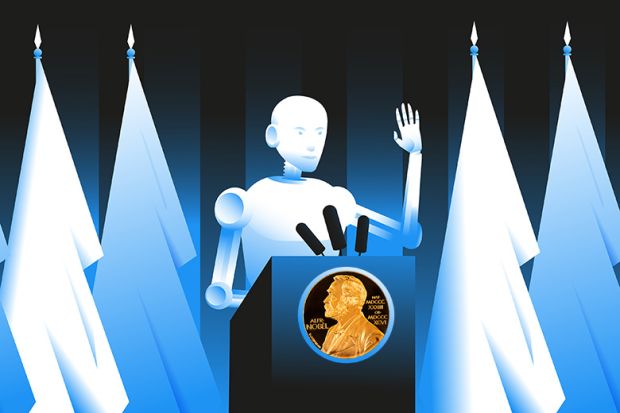
AI has already been involved in Nobel prizewinning discoveries, of course. Google DeepMind’s Demis Hassabis and John Jumper were jointly awarded the Nobel Prize in Chemistry in 2024 for using AI to develop the protein structure predictor AlphaFold. But might we see an AI credited one day soon with a Nobel prize of its own? Might the annual Lindau Nobel Laureate Meeting, where Levitt and Mello spoke to Times Higher Education earlier this month, one day be dominated by intelligent robots, mingling with a dwindling array of ageing humans – if such physical meetings retained any purpose in a tech-dominated scientific endeavour?
An AI’s first self-directed Nobel-winning discovery may be closer than many assume given the breakneck pace of technological advancement. That acceleration was described powerfully at Lindau by Omar Yaghi, who shared last year’s chemistry prize with Richard Robson and Susumu Kitagawa for their materials science research in the 1990s that enables the stitching together of molecules to become sponges for water or carbon capture.
While it previously took a research team three to 10 years to create a particular crystal capable of absorbing carbon directly from the atmosphere, the assistance of ChatGPT now brought this timeline down to a few weeks, explained Yaghi, who recently moved from Stanford University to Tsinghua University in China, where he leads an AI-assisted material discovery institute.
Recently, he said, “We wrote one and a half pages on crystal chemistry and what we were doing and the accuracy checks we needed and fed that into ChatGPT,” he told the auditorium, explaining that “most of what it turned out was obvious…but a few things it said [are things] we would never have thought about. And within three cycles [of experiments] we created something more crystallised than anything that had been reported [previously]. That was progress in two weeks, not 10 years, and it changed our work completely. My entire lab are now using AI robotics to explore how we can use this technology.”
Speaking to Times Higher Education after his keynote, the Jordan-born chemist said before AI, scientists had “operated in a world of scarcity, where, if you make a new material and it has a magnificent property, it leads to a much larger field and you get a Nobel prize. But in the future, “AI is going to be doing all of that for you”, generating many more results than humans had been able to generate by themselves. In that sense, “asking the right questions is going to be a lot more challenging than finding the answers,” he said.
And the people who win Nobel prizes in the future will be those who succeed in “changing the system” – by which Yaghi meant making a major impact on society. That might require a team of people “in the back room deciphering what [a certain] discovery is doing and connecting it with the world”, he explained.
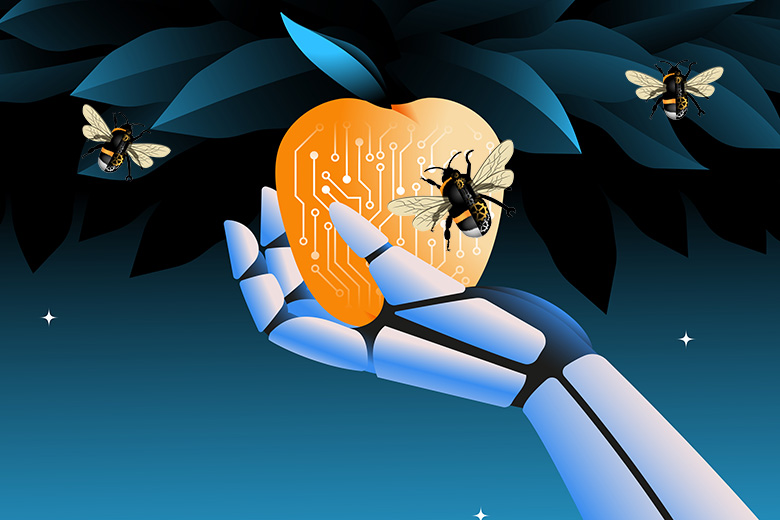
“In my world, that might mean connecting the material to the properties and choosing which material is going to get me from the molecule to society. That’s not going to be easy. That’s going to require a science in itself – the science of choosing the novel element. But it’s going to mean having a room full of bees working hard to arrive at an answer, even if the people who created that system are those who will ultimately get the credit.”
Stefan Hell, a German-Romanian physicist who won the Nobel Prize in Chemistry in 2014, also stressed the importance of recognising the significance of a finding.
“Making a Nobel-worthy discovery is not just making the discovery,” he said. “The truly creative scientist has to recognise what is worthwhile and what isn’t, then provide a way of showing how this will change science,” said Hell, who is director of both the Max Planck Institute for Multidisciplinary Sciences in Göttingen and the Max Planck Institute for Medical Research in Heidelberg.
“People have been very close to Nobel-winning discoveries but didn’t recognise the importance of their findings,” he said, likening the situation to the Vikings’ lack of credit for discovering America despite the fact that Leif Erikson reputedly reached the continent nearly 500 years before Christopher Columbus did.
“The Vikings came back and reported what they’d found but it did not make any difference – the world didn’t change. When the Spanish went west, thinking they were heading for India, then everything changed. This is what discoveries do – they change the world,” he said.
Without human guidance, then, an AI might find itself a modern Leif Erikson when it comes to the Nobel committee’s deliberations. “AI is coming up with all sorts of answers, but it won’t find a cure for cancer,” Hell said. “Someone will need to truly understand when AI is right, work in the lab to confirm that finding and make sure the world knows its importance.”
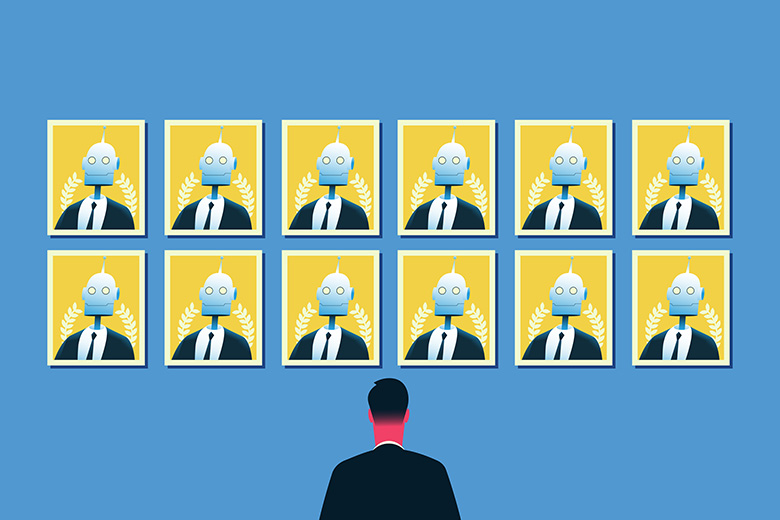
Walter Gilbert, the US molecular biology pioneer who won the Nobel Prize in Chemistry in 1980, is even more sceptical about whether AI could win such an accolade without major human help – not least because “these [AI] models are scraping scientific papers and people accept the results are absolute truth, but some of the results are made up or have errors”.
Indeed, the Harvard University scientist worries that over-reliance on generative AI could actually hold back discovery if researchers, guided by LLMs, converge on the same reductive questions.
“Big discoveries happen when your experiment finds something you did not expect, something that happened beyond your hypothesis. Deep understanding of a subject should be the focus, not waiting for Claude to write a program,” said Gilbert.
That view was reflected by several young scientists at the Lindau meeting, which brings together prizewinners and early-career researchers.
“You can tell from the first line of a journal [article] which LLM model has written it,” one junior delegate from Ukraine noted wryly in an informal group chat. And, echoing Gilbert’s criticism, she added that some early-career researchers felt under pressure to generate hypotheses using AI and test them, rather than pursue riskier but potentially more productive lines of inquiry. With LLMs using the same data and algorithms, teams often ended up tackling similar questions in similar ways.
Yet scientific fashions have always posed a risk of duplicated effort. And while AI could exacerbate this trend, Yaghi insisted that the “need for creativity [in the lab] won’t change. Complacent scientists will continue to be complacent, and the creative scientists will continue to be creative because what constitutes science and creativity within it doesn’t change. You will still need to be rigorous, focus on the facts, find corroborating evidence, and [generate] new ideas that depart from the norm. Those who understand these things are the people who are going to get ahead.”
In that sense, for all his optimism about what AI can do, Yaghi doesn’t think the technology will surpass human “creativity and judgement” any time soon.
“We will always have a way of being incredibly creative because we can operate in chaos much more flexibly than a computer,” he said. Hence, he does not foresee AI becoming more significant to Nobel prizewinning research than the humans involved any time soon: “That won’t happen in my lifetime.”
Nor will AI significantly speed up the time it takes for a discovery to win a Nobel, Yaghi believes – notwithstanding the mere two years it took DeepMind to go from AlphaFold launch to prize receipt.
“You get the Nobel prize because you open the door on something significant that has the potential to benefit humankind,” he said. But, typically, it “naturally takes time” to “develop the basis of that invention to the point where the utility to society is proven. Even if there’s an outstanding question out there that people have been asking for 30 years and now there is a newfound discovery or technique that immediately answers all those extremely difficult questions, you need to know this is not just a flash in the pan.”
Whatever AI’s Nobel prizewinning potential, Yaghi and other laureates are in no doubt that the technology will play a fundamental role in future breakthroughs. It is already “revolutionising the world and is making scientists much more productive”, said Mello. “I love it and want AI implanted in my brain,” he added, joking that this would remove the need for his frequent conversations with AI chatbots on his phone.
For his part, Stanford’s Levitt acknowledged that by reducing principal investigators’ need to recruit as many PhD students and postdocs as they currently do, AI could block the development of the next generation of PIs – and thereby hold back future scientific development that required human input.
“If an old guy with AI can do the same work as a research team, there is a tension here [for science],” he conceded.
But he was also very clear that there was no going back.
“If someone was selling a drug that made you 10 times more efficient and 30 per cent smarter, you would take it,” he said. “And that’s what AI does.”
Register to continue
Why register?
- Registration is free and only takes a moment
- Once registered, you can read 3 articles a month
- Sign up for our newsletter
Subscribe
Or subscribe for unlimited access to:
- Unlimited access to news, views, insights & reviews
- Digital editions
- Digital access to THE’s university and college rankings analysis
Already registered or a current subscriber?