A Nobel prizewinning scientist has urged world leaders to recognise that international cooperation between geopolitical rivals will be crucial to solving humanity’s biggest challenges.
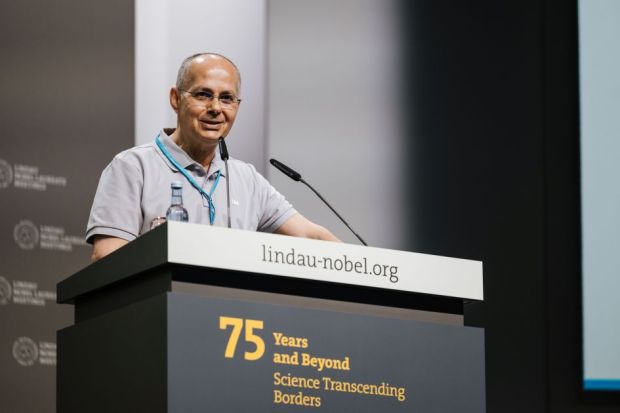
In a passionate defence of the unifying power of science, Omar Yaghi said efforts to extract millions of tonnes of carbon from the air, based on his Nobel-winning research, could reach the required scale only if G20 nations came together to invest in international science.
Scientists from Saudi Arabia, China, India, Russia, the US and other countries were collaborating on a project based on his work that harvests water directly from the air, even in arid countries, with the aim of making the technology commercially viable, explained Yaghi, a professor of chemistry at the University of California, Berkeley who won the Nobel Prize in Chemistry in 2025.
“That work is being done by countries that sometimes do not get along, but they get along in the lab,” Yaghi told an audience of young scientists at the Lindau Nobel Laureate Meeting, which is taking place in southern Germany from 28 June to 4 July.
The joint effort, Yaghi continued, has the potential to deliver water security for every person on the planet, potentially ending hundreds of years of suffering and conflict related to access to clean drinking water.
“Everyone can have their own water, and we will no longer have a water scarcity problem. Water – that should be a human right; science and chemistry are making this happen,” he told the summit on 29 June.
Yaghi, who was born to a Palestinian refugee family in Jordan and moved to the US aged 15, also praised the meritocratic nature of science. Scientific excellence would be recognised regardless of a researcher’s nationality, gender, seniority or social background, he said.
His own research on metal-organic frameworks, which re-engineer molecules to allow them to “take CO2 out of the air or pluck water from the air”, was highly influenced by the work of a female undergraduate who joined his crystallography lab, having previously been rejected by several universities, said Yaghi.
“That student was someone that no one wanted in their group – she was doing experiments that no one else dared to do,” he said, describing science as “the most magnificent equalising force in the universe”.
“Anyone can make a difference, provided you do the experiments,” he said.
At various stages of his career, many senior scientists had refused to believe his results, claiming that they were overstated. His critics came around only after a collaboration with a German laboratory confirmed the findings and instigated more fruitful collaborations, said Yaghi, whose team is now seeking to make carbon extraction commercially viable.
Extracting the excess 1,100 gigatons of carbon dioxide in the air created by pollution would require every one of the 706 cities with a population of more than a million people to build a CO2 capture plant, which, at $100 per tonne removal, would cost $100 trillion worldwide (equivalent to the world’s GDP), Yaghi explained.
With climate change projected to cost $38 trillion a year by 2049, refusing to dedicate significant sums to this problem was short-sighted, said Yaghi, who urged developed countries to pledge greater sums to achieving this goal.
Achieving net zero would cost $400 annually for every person living in G20 countries, said Yaghi, who observed: “If you go into a Hermès shop, then you pay $400 for a tie, or $1,000 for a scarf.”
Register to continue
Why register?
- Registration is free and only takes a moment
- Once registered, you can read 3 articles a month
- Sign up for our newsletter
Subscribe
Or subscribe for unlimited access to:
- Unlimited access to news, views, insights & reviews
- Digital editions
- Digital access to THE’s university and college rankings analysis
Already registered or a current subscriber?