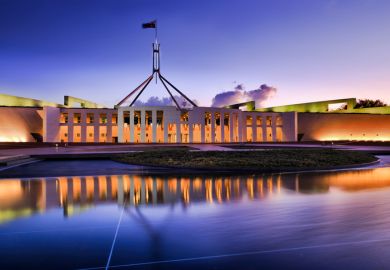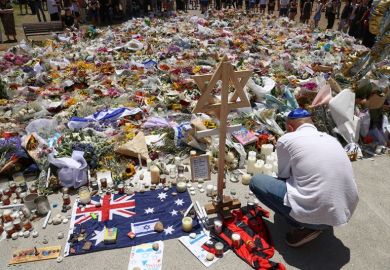
Canberra’s legislative response to the Bondi Beach terrorist attack risks suppressing academic expression on campus, despite last-minute attempts to revise a new bill’s most contentious aspects, critics worry.
The Combatting Antisemitism, Hate and Extremism Bill contains measures to “further criminalise hateful conduct” following the December tragedy, according to a 319-page explanatory document. Proposals in the original draft included a new “vilification” offence for “publicly inciting racial hatred”, as well as a scheme for listing “prohibited hate groups”.
Prime minister Anthony Albanese said the government would not pursue the vilification provisions, after they failed to win support from key opposition and cross-bench parties, but vowed to press ahead with the rest of the legislation. “We are going to proceed with what we can get through the parliament…tomorrow,” he told the ABC on 19 January.
Federal parliamentarians have been recalled from their summer break and given just one day, 20 January, to pass the mammoth bill. It prescribes up to 15 years’ imprisonment for involvement in listed hate groups, according to Griffith University criminologist Keiran Hardy.
He said that although it was difficult to criticise laws stemming from the Bondi atrocity, they risked constraining freedom of speech. “We don’t yet know which organisations might qualify as hate groups and be listed down the track,” Hardy explained in The Conversation. “We must think about the full scope of these laws and how they might play out in months and years to come.”
Universities Australia (UA) said the original bill had retained existing exemptions from prosecution over the public display of prohibited Nazi symbols for academic, educational or scientific purposes. But the bill’s vilification provisions had contained no “defence” to ensure that teaching, research and debate “done in good faith” were not “inadvertently captured”.
Universities are legally obliged to uphold freedom of speech and academic freedom, UA noted in a submission to the Parliamentary Joint Committee on Intelligence and Security. “[They] are required to facilitate rigorous examination of complex, contested and, at times, divisive issues.”
Other submissions similarly highlighted potential impacts on free speech and campus expression. “We must not end up in a situation where to state the facts of an active genocide become equivalent to hate speech under the eyes of the law,” Students for Palestine warned. “The definition of hate speech is vague and nebulous.”
Australians for Science and Freedom said the bill risked suppressing discussion of the most important social issues. “[It] casts free speech into the role of perpetrator of harm, without recognising its crucial role in defining and ultimately solving our country’s problems.”
The Free Speech Union (FSU) said the proposals risked forcing “racially supremist” views underground while criminalising legitimate criticism of government policies, including by Supreme Court judges. “Hate speech laws are well recognised to have the real-world effect of targeting minorities,” the FSU’s submission says. “They have documented Stalinist origins and…a long history of being abused by authoritarian regimes.”
Another criticism was that the bill targeted only racial hatred, overlooking vilification on grounds of religion, disability, sexuality or gender identity. The Australian Academic Alliance Against Antisemitism (5A), which supported the bill and recommended technical improvements to the vilification provisions, said broadening its scope beyond race would blunt the “reassurance” it offered Jewish Australians following the Bondi attack.
“Any expansion of the protections…dilutes that expression of reassurance and risks undermining it if protected attributes are included for groups that themselves disseminate antisemitism,” 5A’s submission says.
Co-signatory Holly Lawford-Smith, a University of Melbourne philosopher who has courted hostility over her gender-critical views, said an expansion of the bill’s scope beyond racial issues risked exposing organisations that advocated on topics of legitimate community interest – against the medical gender transition of juveniles, for instance – to political suppression.
“I think that because it was restricted to race, and because the terrorist attack was so serious, we were willing to support the bill’s general approach,” Lawford-Smith told Times Higher Education. “However, our academic freedom in teaching and research would be hindered by expansive restrictions on allegedly hateful speech.”
She said universities may have left the government with no choice other than political intervention in their activities, by allowing criticism of Israel’s government to morph into antisemitism. “Many people inside universities don’t distinguish their personal activism from their job. It’s possible that the conditions were a bit permissive in crossing that line.
“At some point internal change becomes extremely difficult because the dissenters just get stamped out. What can you do to reform an institution when all the incentives have become so stacked toward conformity with particular views?”
Register to continue
Why register?
- Registration is free and only takes a moment
- Once registered, you can read 3 articles a month
- Sign up for our newsletter
Subscribe
Or subscribe for unlimited access to:
- Unlimited access to news, views, insights & reviews
- Digital editions
- Digital access to THE’s university and college rankings analysis
Already registered or a current subscriber?