A group of little-known academic journals has been publishing “AI slop” papers under the names of professors who did not write them, sparking concerns that academics’ identities are being misused, an investigation has found.
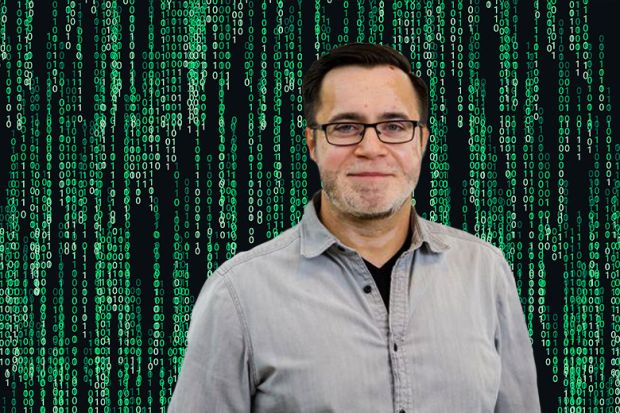
Alan Said, professor of computer science at the University of Gothenburg, came across the journals after he received a notification from Google Scholar about a paper published under his name in the American International Journal of Research and Innovation (AIJRI).
The article, titled “Intelligence Systems Supporting Sustainable Global Development”, was loosely related to his research on artificial intelligence and sustainability but he did not write the paper.
“It wouldn’t be surprising if I wrote a paper on something around this topic, but just looking at this paper and looking at the citations in the paper, it looks AI-generated. It has no content, it’s like slop,” he said.
He reported the incident to the journal’s domain registrar, who told him that the article had been removed. But the paper remained online and his name had been replaced with another individual. Screenshots shared with THE show that two days later the author had changed again, leaving three versions of the same paper attributed to different authors.
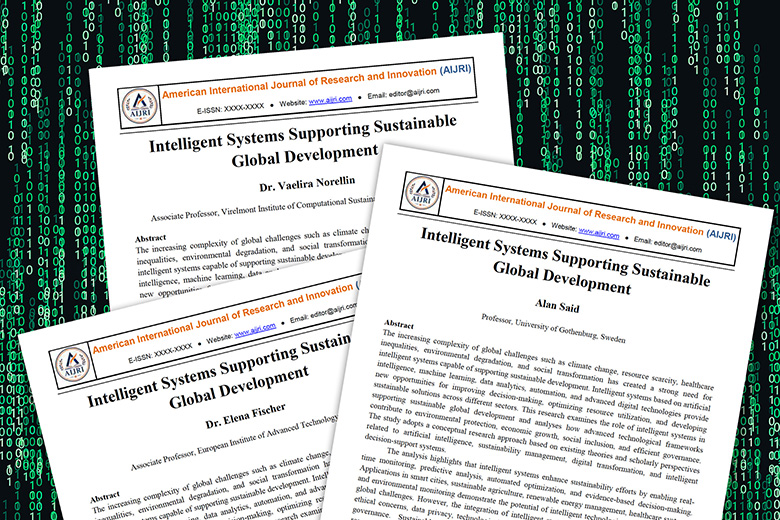
Said also came across the American Journal of Advanced Multidisciplinary Research and Innovation (AJAMRI) and the American Journal For Multidisciplinary Research (AJFMR) – two other journals using similar graphics, with the same editor-in-chief and board members. The former has published dozens of papers attributed to high-profile academics, including Stanford computer scientists Fei-Fei Li and Christopher Manning and Berkeley professors Michael I. Jordan and Stuart Russell.
All three domain names were registered in 2026 but the websites show archives of papers supposedly published several years earlier. The journals all describe themselves as “peer-reviewed, open access and multidisciplinary”. The websites also advertise publication fees. AIJRI and AJAMRI said they charge US$200 (£150) for papers written by five or more non-Indian authors, while the AJFMR charges US$80 for one to four authors or US$10 for five or more authors.
“They all seem to be the same type of operation. Very shallowly written or generated,” Said said. “I’m concerned because if a new PhD student were to see my name in this journal, they might think it’s OK to submit there too, and I would really not want that to happen.”
Several academics listed in the journals have confirmed that they did not write the articles or consent to their name appearing there.
Jure Leskovec, professor of computer science at Stanford University, is among those named as an author in the journal. “I can confirm that I did not write this paper, was not involved in its submission and did not authorise the use of my name. I was also unaware of its existence until [THE’s] email. This is quite concerning,” he said.
All three journals identify their editor-in-chief as Denish Brown and have a Whatsapp number with a US area code. Times Higher Education contacted the journals but did not receive a response before publication.
The journals also list dozens of editorial board members affiliated with mostly Indian higher education institutions.
One of them, Kanakaraju Manupati, a postdoc fellow at Virginia Commonwealth University, told THE that he had not agreed to serve on their boards. “I was not aware of the existence of this journal and was not associated with it. I just checked the journal website, surprised to see my name on the editorial board,” he said.
THE has contacted others on the editorial board.
Register to continue
Why register?
- Registration is free and only takes a moment
- Once registered, you can read 3 articles a month
- Sign up for our newsletter
Subscribe
Or subscribe for unlimited access to:
- Unlimited access to news, views, insights & reviews
- Digital editions
- Digital access to THE’s university and college rankings analysis
Already registered or a current subscriber?