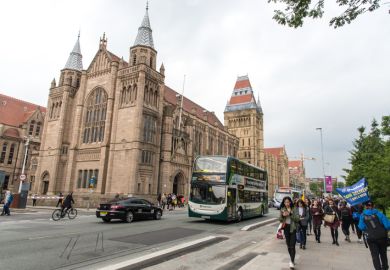
When vice-chancellor Duncan Ivison announced plans to compel all undergraduates at the University of Manchester to take part in some form of work placement during the summer, he conceded that the university had “no choice” but to take the step to “give some hope and aspiration to young people” amid a “difficult labour market”, a “very volatile political situation” and “AI transforming people’s lives in all kinds of ways”.
To that, Ivison – who worked closely with new prime minister Andy Burnham when he was mayor of Greater Manchester as part of the region’s civic alliance of universities – might well have added increasing public scepticism about the value of degrees. The specific circumstances might be unique but the debate about the value of work experience within degree programmes goes back decades. And Manchester is arguably not the first institution to conclude it is so valuable that everyone should benefit from it.
Although Manchester’s announcement grabbed the headlines, “a lot of people in the sector thought, ‘So what? We already do that,’” said Christina Matthews, executive director of student life at the University of Staffordshire. At her institution, every on-campus, full-time undergraduate already has the chance to do work experience, including as a sandwich placement in their third year of study, as a shorter-term placement alongside their degree or as an internship.
At Staffordshire, one of the five “pillars” of course frameworks is employability, Matthews said. Staff in her team conduct capability assessments for students to see how their skills are progressing as they move through their degree and work experience options.
Universities are “missing a trick”, Matthews said, by “separating careers and employability out from other services”. She believes that employability should be the focus of all support services, including those aimed at those with additional learning needs. And embedding work experience within degrees is a no-brainer, she believes, noting the high number of employers “who will say, ‘I can’t get these graduates to [even] read an email.’”
Roger Brown, former vice-chancellor of Southampton Solent University and author of books including Everything for Sale? The Marketisation of UK Higher Education (with Helen Carasso, 2013), agreed that Manchester’s plans were “hardly a new initiative”.
Brown’s experience includes a stint as chief executive of the Committee of Directors of Polytechnics in the 1980s – institutions in which “sandwich” courses, which included industrial placements, were common. He noted that there had been early government attempts to support work placements in universities, too, such as the Enterprise in Higher Education programme, which ran from 1988 to 1993. Funded by the Department for Education’s training agency, it supported institutions to introduce “enterprise into the curriculum” by fostering links with employers.
Although Brown understood modern universities’ need to publicly demonstrate their commitment to graduate employability, he was unconvinced by the argument that every student would benefit from an offering of this kind – not least since “the world has changed” and it is well established that “most students…are working in term time or actually employed in term time – so in effect they’re getting their work experience anyway”.
The problem is that “there’s a nasty strain in our society that is simply anti-university and that is feeding upon the problems of our labour markets. [But] if there aren’t enough graduate jobs, it’s not because there are too many graduates, it’s because…British employers won’t invest in the necessary opportunities and training.”
Work-integrated learning also has a long history in Ivison’s native Canada. According to Glen Jones, professor of higher education at the University of Toronto and former dean of the Ontario Institute for Studies in Education, the leader in this area is the University of Waterloo, where what is known in North America as cooperative education has been an option for students ever since the Ontario institution was founded in 1957.
Waterloo students pursuing a co-op usually take about five years to complete a degree, during which they undertake between four and six “work terms” – each about four months in duration. And other Canadian universities have followed suit, whether via “service learning” opportunities – where work experience might involve placements in not-for-profit organisations abroad, supporting issues such as global health or community development – or other forms of “experiential learning”, Jones said.
“Students are extremely interested in obtaining work-integrated learning experiences, so that they leave the university with work experience linked to their academic programme,” he said. “It becomes an important component of their resume…they will probably also have references from the employer, and that becomes quite important in what is now a highly competitive job market in many fields. In some cases, the company they worked for will be interested in offering full-time employment following graduation.”
Importantly, Waterloo students must receive remuneration for their work for it to count towards their degree credits. But taking on interns and work experience students can impose costs on employers given that the value of the intern’s work might not outweigh the staff time costs of training and supervising them. Why would companies queue up to take on paid interns?
The answer is that several federal government funding programmes subsidise these paid internships, and some provinces also support these initiatives through grants or tax credits, said Jones.
Matthew Percival, the Confederation of British Industry’s works and skills director, said government subsidy would also be necessary in the UK if every university student were to graduate having undertaken some kind of work experience. Professional placements had a “clear role to play in supporting young people’s transitions into the labour market”, he said, and “many businesses offer work experience placements. But the barrier to them providing more is often cost, [such as] the time of employees who make the experience valuable, [alongside] broader cost pressures – from energy and tax to employment and tariffs – eroding the headroom that firms have to invest in these areas.”

Waterloo is not the only North American university whose relationship with internship providers goes back decades and which has a significant staff base to organise and support placements. Boston’s Northeastern University has been running its own cooperative programme – full-time, months-long work experience undertaken while studying for a degree – for 117 years. The institution has 250 employees working specifically “on co-op”, Ken Henderson, the university’s chancellor and senior vice-president for learning, told Times Higher Education, helping students source approximately 90 per cent of the more than 12,000 co-ops that take place each year.
Northeastern’s comprehensive approach is “unquestionably…unique in the way we do it and the level that we do it, across all majors”, Henderson said. “Many universities will have pockets [of work-integrated learning] but our whole university is organised around this.”
From theatre to accounting, all degrees are covered. Each co-op is six months long, with most students completing two or three by the time they graduate. More than half (58 per cent) of students receive a job offer from one of the companies that hosted them – and three quarters have a job offer by the time they graduate.
Such figures look great in promotional literature, especially at a time when so many other universities in the Western world are encountering increasing public and political scepticism about the value of their degrees. Accordingly, more than 105,000 people applied for just under 6,000 undergraduate places at Northeastern last year.
“The value proposition is very clearly understandable,” Henderson said.
Nevertheless, he insisted that experiential learning was about more than attracting students. It is in the institution’s DNA, “a signature of how we run residential life, classes and faculty”, he said.
Traditional lecture-based teaching models, for instance, are dispensed with in favour of applying learning practically. “It’s a much more engaging way to attack the problem than learning from a textbook or an instructor alone,” Henderson said. A learning outcome is “critical and obvious when you put it in the context of co-op...students need to understand how to actually execute that task in order to achieve that [goal] appropriately”.

Although such vocational approaches might be good for students with clear career goals, there are still many who attend university to study a subject they like in the hope that a degree from a respected institution will demonstrate to employers their ability to apply themselves and their likely possession of various soft skills, such as critical thinking.
For that reason, Robert Eaglestone, the English Association’s lead for cross-sector educational policy and professor in the department of English at Royal Holloway, University of London, is among those who are not convinced work placements should be mandatory in degree programmes.
“The evidence shows that people with degrees earn more money over their careers than people without, [although] earning money isn’t the be all and end all,” he said. “I think that degrees prepare people really successfully for the world of work; they also prepare them to be active and engaged citizens. They prepare them for social enterprise, and they prepare them for lifelong learning.”
Asked whether it is more vital than ever, in an era of diminishing trust in higher education and the rise of artificial intelligence, that universities prepare their students for a transformed labour market, Eaglestone insisted that universities should stick to “teaching their intellectual subjects”.
“I can’t teach people how to do their job,” he said. “On the other hand, one of the things we know about academic disciplines is implicitly they do teach you all these amazing skills and capabilities which help you manage in the world of work. Learning those skills of communication and collaboration throughout the humanities, particularly from English, are vital in the contemporary job market.”
The historian Peter Mandler is similarly wary of going too far down the vocational path in degree-level study, suggesting that a more appropriate time to do work experience would perhaps be during secondary schooling.
“Secondarily, [I’d ask] the question of what kinds of life skills universities should have responsibility for,” he said. “To me, [the answer has] nothing really to do with either [institutional] prestige or qualification or degree subject. It has to do with which adult skills schools teach and what skills higher education teaches.”
There are “generic skills” most degree programmes could teach, Mandler said. But “it would be a waste of time and energy to try to develop skills suited for particular jobs because you can’t really predict what jobs people will go into…you can’t predict what the skills required in the future labour market will be. The famous case that’s cited nowadays frequently, and I think rightly, is that for a long time we said we must teach all young people how to code. [But] those who did learn how to code mostly made no use of it [and] now we’ve discovered that, actually, AI codes better than humans.”

He did not rule out practical work experience when it augmented academic understanding – and, indeed, has been instrumental in embedding interactions with Cambridge’s museums and collections in its history syllabus. “As a result, a number of our students have gone on to work in the museum and heritage sectors, so that’s great,” he said. “But those are skills and practices that are part of the academic enterprise and part of the world of work.”
More generally, Mandler found it “very hard to imagine what kind of specific work experience you would prescribe for most degree subjects, not just history or philosophy. And Cambridge still discourages students from working alongside their studies, urging them to “consider the impact this may have on their studies” and to “discuss the matter with their tutor”.
“We want them to focus on their academic work,” Mandler conceded. “But it doesn’t mean that their academic work is disconnected from the wider world. To the contrary.”
Burnham, of course, is a Cambridge graduate himself. But his political identity, dubbed “Manchesterism”, was shaped by his time in Manchester.
“I think he’s going to really lean into the devolution agenda and he’s going to want to see universities working closely with local combined authorities, the FE system [and] the private sector to create opportunities for people in those communities,” Ivison told THE ahead of Burnham’s appointment as prime minister. He added that Burnham had challenged him to think about how to support the 60 per cent of young people in Manchester who don’t go to university.
Whether such a focus on meeting local skills needs is consonant with a traditional, academia-first approach to employability remains to be seen. But Manchester’s move to embrace work placements, if it proves viable, could be one that even other Russell Group universities feel the need to replicate.
Register to continue
Why register?
- Registration is free and only takes a moment
- Once registered, you can read 3 articles a month
- Sign up for our newsletter
Subscribe
Or subscribe for unlimited access to:
- Unlimited access to news, views, insights & reviews
- Digital editions
- Digital access to THE’s university and college rankings analysis
Already registered or a current subscriber?