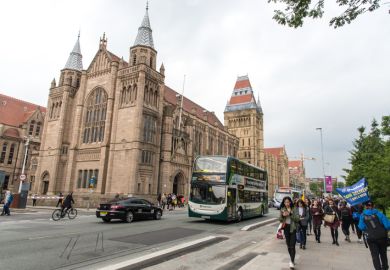
The days of studying for a degree without any practical exposure to the professional world are over, according to university leaders after the University of Manchester committed to ensuring all its students take part in work experience.
Vice-chancellor Duncan Ivison recently announced every undergraduate student would leave the Russell Group institution having participated in some kind of work placement or exchange.
The proposals were aimed squarely at a public increasingly sceptical of the value of degrees, with a slowing graduate jobs market leading to questions about whether higher education is “worth it”.
But, while many academics welcomed the plans, they had unanswered questions about how it will work in practice.
Manchester told Times Higher Education it was yet to attach a budget to the idea and that it represented a “long-term” strategy rather than a “programme”.
Jenn Hallam, vice-president for teaching, learning and students, said Manchester’s plans would help ensure students “thrive after graduation”, but insisted “strong academic degrees remain essential and always will”.
“What is changing is the expectation that universities should help students connect academic learning with the skills, experiences and networks they need to thrive after graduation,” Hallam said. “Our ambition is to demonstrate that academic rigour and meaningful professional experience are not competing priorities, they strengthen each other.”
Earlier this year, research by the Office for Students (OfS) found 90 per cent of graduates felt they faced a barrier relating to their levels of preparedness for life after university. Some 43 per cent cited a lack of relevant work experience, and 40 per cent a lack of professional network.
Hallam added: “This is not simply about creating more placements. It is about redesigning aspects of education so external engagement becomes a purposeful and integrated part of learning.”
Those at universities already used to emphasising the need for professional skills say the shift to encouraging placements is overdue.
Nick Jennings, vice-chancellor and president of Loughborough University, said he “personally” doesn’t believe anyone should graduate without some form of workplace experience.
“I think the days of just going to university and just caring about what you’ve learned in a classroom, and the main thing that you come away with is a degree certificate and an academic mark…that’s really gone away,” he said.
“Employers and students are increasingly looking at what else comes with a high-quality degree.”
Since the 2015-16 academic year, every undergraduate programme at Loughborough has included the option of a year-long placement, with about half the students taking up the opportunity over the course of their degree.
The value, Jennings said, is even reflected in academic outcomes. Over a rolling four-year average, 94.5 per cent of undergraduate graduates who completed a placement achieved a 1st or 2:1 degree, compared with 79 per cent of those who did not.
Since 2011 meanwhile, Simon Sweeney has helped up to 85 undergraduate students annually undertake a year in industry at the University of York.
An option that forms part of their business and management degrees, these students “do exceedingly well” and are paid a “proper salary” for the time spent in the workforce, Sweeney said.
Like Jennings, he suggested the “added value” when it comes to professional placements as part of a degree is “really, really considerable”, particularly when “compared with a student who has stayed in York, [and] maybe worked in the student union in a bar or a retail outfit over the summer”.
“[Those experiences are] not to be sniffed at,” Sweeney added, adding: “I say to students who have not done any of these things, ‘for goodness’ sake, get some employment experience’.”
But Manchester will find ensuring that its work placement initiative is successful will require diligent supervision, Sweeney warned.
“To what extent does the university have oversight or monitor what the student is going into,” he asked. “Is there a proper health and safety check, how are they initiated into the working culture…I think it’s a wonderful ambition and I applaud what Manchester is doing. But it would be interesting to know more.”
Times Higher Education asked whether Manchester had applied any kind of cost expectation to the work opportunities push, with Hallam saying the institution is “not attaching a single cost figure at this stage”, regarding the initiative as “a long-term strategic direction rather than a stand-alone programme”.
On the question of whether staff recruitment will be necessary, she said the university “expects capacity and capability to grow over time as opportunities expand and new partnerships are developed”.
“A year in industry will be valuable for some students, but it cannot be the only model,” Hallam continued.
“Different subjects, student circumstances and employer contexts require flexibility.
“The aim is to create a broader ecosystem of meaningful opportunities, including micro-internships, short placements, live projects, civic engagement and year-in-industry experiences, so that all students can apply their learning in ways that are relevant, accessible and impactful.”
Register to continue
Why register?
- Registration is free and only takes a moment
- Once registered, you can read 3 articles a month
- Sign up for our newsletter
Subscribe
Or subscribe for unlimited access to:
- Unlimited access to news, views, insights & reviews
- Digital editions
- Digital access to THE’s university and college rankings analysis
Already registered or a current subscriber?