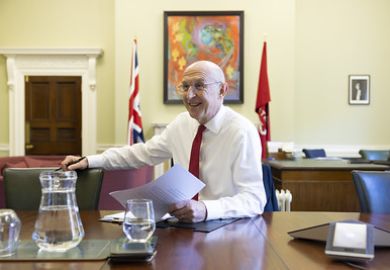
The Office for Students’ new chief executives, Ruth Hannant and Polly Payne, began what they refer to as their “work marriage” shortly after Hannant came back from maternity leave following the birth of her son.
Seventeen years later, the boy has just begun university and the duo have taken over at the English regulator tasked with protecting his interests, and millions like him.
Although their job share has become “slightly second nature” to them, it still stands out as a rarity in the higher education sector where occasional experiments with co-vice-chancellor roles have struggled to catch on.
As they begin their mission of overseeing the next stages of development at a watchdog that hasn’t always seen eye-to-eye with the sector, Hannant and Payne believe that their own ability to “talk out” their differing opinions on certain matters will be a strength.
“We’re tackling some things about the culture here,” Payne said. “We’re really determined that the OfS is really open to challenge and I think that in a way having two of us helps, because we’re quite challenging of each other.
“If one of us makes a decision, the other will always stand behind it, but while we’re getting to that decision point we sometimes come from different views, and we talk it out quite openly.
“Hopefully that helps with making everyone else feel that they can do that to each other, but more importantly, to us.”
Being “open to challenge” is not how many vice-chancellors would describe the regulator to date. Created nearly 10 years ago as part of the Higher Education and Research Act, the watchdog has long been criticised for its overly adversarial nature – with “boots on the ground” inspections, threats of fines and clashes over everything from academic freedom to punctuation standing in stark contrast to the much gentler Higher Education Funding Council that came before it.
A reset in relations begun by previous chief executive Susan Lapworth was derailed by the fallout from losing a High Court case to the University of Sussex after the regulator had tried to fine it for alleged free speech breeches.
The OfS has since signified a “no surprises” approach to regulation and Payne said they were aiming to be more consensual.
“I think we need [the sector] to challenge us but also to support us and collaborate with us because ultimately I think we all want the same thing, which is a really strong, thriving sector which delivers for students.
“We might have slightly different views within the sector and that’s fine, that’s healthy. I think we just have to work on understanding where each other is coming from and where we disagree, understanding why.”
Hannant and Payne previously worked as director generals at the Department for Culture, Media and Sport, with responsibilities that included stewarding the government art collection and oversight of the tourism and visitor economy.
But their work at the OfS might feel like a homecoming, with their earlier positions including directors of higher education and higher education reform at the Department for Education and, before that, the Department for Business Innovation and Skills.
At the time of their appointment in March, then education secretary Bridget Phillipson said they brought the “experience needed to lead a strong, effective regulator” at a time of “real financial pressures” and a graduate landscape likely to look very different in the future.
Hannat said the pair felt passionately that their model “brings a lot of value to the organisation, because you get two brains on any problem”.
And Payne suggested that job-sharing in senior leadership roles was becoming “more and more” common, with the theatre industry “a really good example”.
The pair referenced the likes of the Royal Shakespeare Company, led by co-artistic directors Tamara Harvey and Daniel Evans.
“We care about job shares. I think there’s lots more collaborative leadership even in private companies beginning to happen,” Payne continued. “I think it’s showing [the world] it works.”
Register to continue
Why register?
- Registration is free and only takes a moment
- Once registered, you can read 3 articles a month
- Sign up for our newsletter
Subscribe
Or subscribe for unlimited access to:
- Unlimited access to news, views, insights & reviews
- Digital editions
- Digital access to THE’s university and college rankings analysis
Already registered or a current subscriber?