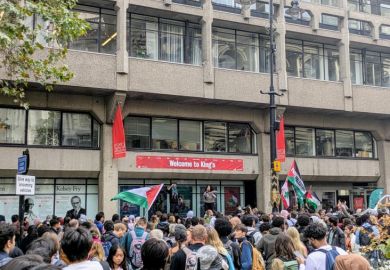
Universities have worked together to share “repressive responses” to pro-Palestinian protests on campuses, according to a review by Amnesty International, which found that actions by leadership teams “often didn’t meet the high bar” in law for interfering with political speech and peaceful assembly.
The human rights charity’s Silencing Dissent report, published on 20 October, covers the period between 7 October 2023 – the date on which the militant Islamist group Hamas killed more than 1,200 people in an attack on Israel – and 30 September 2025, by which time an Israeli counteroffensive had killed more than 60,000 people and injured 170,000 in Gaza.
According to Amnesty International, some institutions’ attempts to restrict protests and dialogue have undermined universities’ role as “places of open enquiry”.
“In several instances, universities treated peaceful protest as trespass, even in public or student spaces such as campus squares, foyers and union buildings,” the report finds.
Meanwhile, some universities resorted to mechanisms such as court injunctions to impose “blanket prohibitions” on gatherings – allegedly “exposing students and staff to risk of fines and imprisonment for engaging in protest”.
The findings are based on an analysis of the pro-Palestinian European Legal Support Centre’s dealings with the higher education sector, as well as 40 original interviews with people from 26 British universities.
The report says that sanctions including suspensions and campus bans have been levied on staff and students for seemingly trivial actions such as chanting and clapping.
Some cases involved “prolonged investigations” during which students were kept in the dark about timelines, outcomes or routes to appeal, it alleges, adding that universities often relied on overly broad disciplinary procedures.
One of Amnesty’s case studies involved the University of Birmingham, which the report accuses of “prolonged and educationally disruptive disciplinary procedures”, focusing on the experience of student Mariyah Ali, who was accused of “behaving in an intimidating and disorderly manner” towards staff during a protest in May last year.
According to Amnesty, the university’s investigation into the situation “had a substantial impact” on her academic experience, given its “length and intensity”. In the end, however, she was cleared by a misconduct hearing.
The case, the report says, “illustrates how disciplinary procedures, even when discontinued, may function as a form of sanction”.
Another case study, looking at the response by the London School of Economics to a seven-strong student protest in July 2024, goes so far as to accuse the institution of potentially violating rights to freedom of expression.
The protest, which called on the university to divest from companies supplying arms to Israel, led to precautionary campus bans for those involved. The LSE has told Amnesty that the bans had been adjusted periodically to ensure that the students affected could access online and in-person support.
Amnesty says universities are “not acting in isolation…but are operating within a network which encouraged repressive responses”.
Actions were shaped by “direct government pressure, regulatory direction, lobbying by advocacy groups, and advice from private law firms and security contractors”.
Some universities have “shared legal strategies, received instructions from the Department for Education, and shared their security planning” to “clamp down” on protests, the charity claims.
The Amnesty report also alleges that, in some cases, the Prevent duty – which requires institutions to monitor and report individuals who appear at risk of radicalisation – may have been “mobilised” in response to Palestine-related speech and activism.
Specifically, it highlights disciplinary proceedings begun in August 2024 against members of the University of Essex’s Palestine Solidarity Society, which saw six members placed under police and university investigation after sharing Instagram posts expressing sympathy for a member of Hamas killed by Israeli forces.
The police did not pursue the case any further, suggesting that Essex may have used “broad counter-terrorism laws without the quality of evidence that would stand up in court”, Amnesty’s report claims.
A spokesperson for Essex said it was a university that "values academic freedom and freedom of speech within the law".
"As a university, we have a range of legal and regulatory obligations," they added. "We believe that, in this case, the university acted appropriately and responsibly in responding to an issue where our students may have broken the law and our code of student conduct."
Arif Ahmed, the free speech director at the Office for Students, says in the report that universities’ policies on managing protests must be “proportionate”, with institutions required to “identify why it is doing it, what the legitimate aim is, and why it is the least intrusive measure it could take”.
Kerry Moscogiuri, chief executive of Amnesty International UK, said the findings demonstrated that there had been “an attack on our freedom of speech and the right to protest from the very institutions who are supposed to encourage free thought”.
Calling on universities to commit to the organisation’s Defend Dissent Charter, which involves institutions pledging to “treat peaceful protest as a presumptive right”, Moscogiuri added: “Universities should be an environment in which students feel safe in coming together and demonstrating on the issues they care about.”
Birmingham and the LSE have been contacted for comment.
Register to continue
Why register?
- Registration is free and only takes a moment
- Once registered, you can read 3 articles a month
- Sign up for our newsletter
Subscribe
Or subscribe for unlimited access to:
- Unlimited access to news, views, insights & reviews
- Digital editions
- Digital access to THE’s university and college rankings analysis
Already registered or a current subscriber?