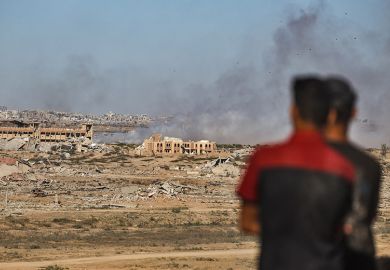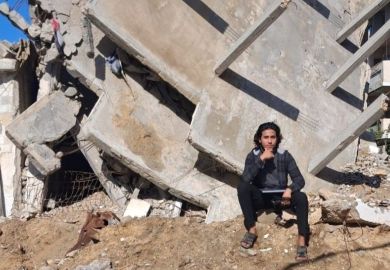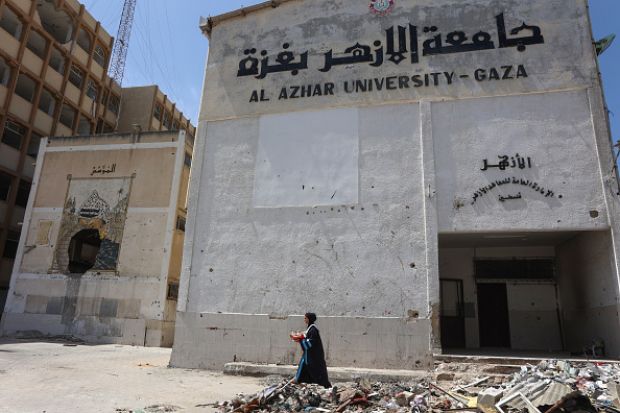
In the 34 years Ahmed Abu Shaban has studied and worked at Gaza’s Al-Azhar University, his department has been destroyed four times – most recently, like much of the rest of Gazan higher education, in Israel’s bombardment of the strip following the 7 October attacks.
So, despite facing a long road to recovery, Abu Shaban, who studied his undergraduate degree at the university, before rising through the ranks to become dean of the Faculty of Agriculture and Veterinary Medicine, said the mood in the sector is one of “resilience”. After all, they have managed to rebuild themselves many times before.
A new report by the Friends of Palestinian Universities has attempted to draw together the extent of the physical damage, highlighting how Unesco has put the overall cost at $373 million (£278 million) since 2023. Of 206 university buildings assessed, 195 were destroyed or severely damaged.
The damage to life is far greater. More than 1,372 university students and more than 246 academics and university staff have been killed, the report, titled Scholasticide in Gaza, found, including three university presidents and nine college deans.
These attacks are not “collateral damage”, it says, but form part of a “scholasticide”: “a deliberate strategy of systematic annihilation and erasure of education”, it argues.
Abu Shaban helped spearhead Gazan universities’ move to online education during the bombing. With a university population of 14,000 at Al-Azhar, he said he had hoped 1,000 students would sign up to continue their studies online. To his amazement, 10,000 did, reflecting that for Gaza’s youth, higher education is a “lifeline” and “something to give them a hope that a future is coming”.
An Emergency Committee of Universities in Gaza was established in 2024, bringing together Gaza’s three largest non-profit public universities to advocate for the sector.
Abu Shaban – who is a member – said one of the committee’s biggest projects has been the establishment of the ISNAD scholarship scheme, which raises funds to directly cover students’ tuition fees.
One £800 donation can fund the tuition fees for one student for a whole academic year and means universities can continue receiving tuition fee income.
A much cheaper option than sending students abroad, Abu Shaban said, the scheme has supported 6,274 students to attend university in Gaza since 2024, and has seen more than 2,000 students graduate as a result.
Omar Melad, the president of Al-Azhar, said while the reconstruction of some universities’ facilities has begun, the ceasefire which began last October has done “little” to alleviate conditions, and building materials are still not permitted into Gaza.
Speaking to Times Higher Education through a translator, he said universities are part of the “social fabric” of Gaza and offer hope to students amid bombardment. He criticised international attempts to rebuild Gaza’s higher education system without the involvement of its existing universities.
In 2024, a plan was put forward by a group of British, American and Middle Eastern business people and private equity firms to develop a “Technical University of Reconstruction”, which it described as “the first purpose built institution of its kind” in “a new mixed-use quarter in a regenerated area of northern Gaza”.
Concerns that Gaza’s future will be determined by foreign influence have been compounded by US president Donald Trump’s “New Gaza” plan announced in February, which featured mock images of skyscrapers where towns, houses and schools once stood.
But Melad insisted that Gaza’s future is for Palestinians to determine, and rejected the notion that new, foreign-built universities are needed in Gaza’s reconstruction.
Melad said that the sector would “reject any attempt to restructure higher education in Gaza” by external agencies because “it has not been annihilated…It continues, and we are the people that are going rebuild it”.
Analysis in the report by Friends of Palestinian Universities found that little of the money supposedly donated to universities in Gaza makes it to them, instead remaining in their donor countries.
It found that in 2023, the latest year for which data is available, donors committed a total of $44.1 million in higher education aid to Palestine. However, less than one-fifth of this aid ($8 million) actually reached Palestinian higher education institutions, with a large proportion instead remaining in the donor country for scholarships.
“Without a decisive shift towards direct support for institutions, the existing aid model risks abandoning Palestinian universities at a critical moment and may even contribute to their collapse,” the report says.
Abu Shaban said such schemes do not help rebuild Gaza’s university sector more widely, and there needs to be an “institutional” approach that centres direct collaboration with its universities.
Melad, who is currently living in Egypt after his home in Gaza was destroyed, said Palestinian university leaders “owe” it to their students to rebuild the sector. “Our role as university leadership is to bring hope to our students and our faculty,” he said.
“We want to tell them that we are still there for them, that we are not giving up on them, and that we’re not leaving.”
Abu Shaban has witnessed several of his students die amid the war. While these deaths have been “heartbreaking”, students’ resilience and commitment to their studies have been deeply inspiring and serve as a testament to the importance of higher education in the country.
He explained that one student, Salim, was in a hospital with his family, when it became surrounded by tanks after they had refused to leave following an evacuation order. But amid this, he messaged Abu Shaban. The message was not about the incoming tanks, but a simple remark about an upcoming exam.
“I didn’t know whether to cry or laugh. But I did learn one thing: we should never give up,” he said.
While hundreds of students have died, “Salim is still there, and thousands like Salim are still there”.
Register to continue
Why register?
- Registration is free and only takes a moment
- Once registered, you can read 3 articles a month
- Sign up for our newsletter
Subscribe
Or subscribe for unlimited access to:
- Unlimited access to news, views, insights & reviews
- Digital editions
- Digital access to THE’s university and college rankings analysis
Already registered or a current subscriber?