Australian students are crying out for guidance on how to disagree constructively, despite refusing to share space with their ideological opponents and even advocating violence against them, a Canberra conference has heard.
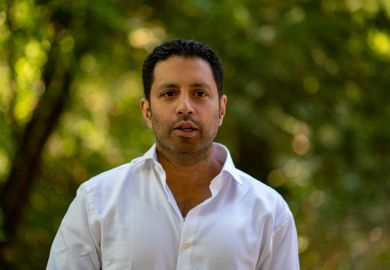
Sociologist Susan Carland said a survey conducted as part of Monash University’s “campus cohesion” project had revealed students’ widespread desire to be taught “how to have difficult conversations”.
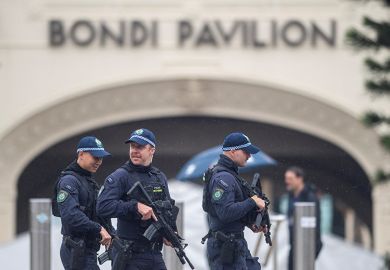
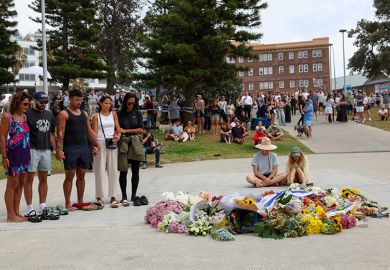
This was “good news” at a time when community turmoil – evidenced most dramatically in the Bondi Beach terror attack – was threatening the fabric of democracy.
Carland, deputy director of research, impact and engagement at Monash’s School of Social Sciences, said democracy contained the seeds of its own destruction by encouraging open communication where “whoever is most persuasive wins”, and illiberalism “or even fascism” were as likely to prevail as liberalism.
“There is no guaranteed outcome with democracy,” she told the Universities Australia conference. “One of the most protective factors against just being persuaded by whoever has the loudest, most persuasive voice…is a discerning and educated citizenry. When students are coming to us and saying, ‘please, teach us how to have these difficult conversations’, this is such good news for universities.”
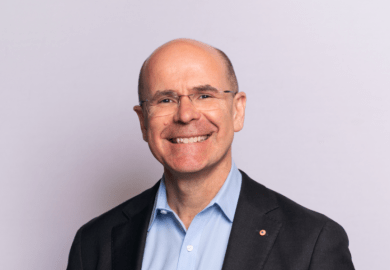
Former New South Wales premier Mike Baird said a study by the McKinnon thinktank, which he heads, had found that 21 per cent of young people no longer considered it feasible to have friends with different political views. And around 16 per cent thought violence was an acceptable way of resolving political differences. “People feel disempowered…and they start to take things into their own hands,” he told the conference.
Baird said people had lost the ability to hear alternative views as part of the “normal” process of education. Universities’ role was to “teach us to think critically; to listen to debates on all sides. Democracy is about resolving differences of opinions peacefully.”
University of Canberra vice-chancellor Bill Shorten, a former federal opposition leader, criticised the Westminster system’s “politics of destruction” where “if one side has an idea it’s generally killed by the other side by lunchtime”.
Campus spotlight guide: Dealing with division: the polarised university
Shorten said universities should nurture a culture of listening to opponents rather than destroying them. “It’s a lot harder to hate what you know,” he told the conference.
“We’ve got to encourage a safe place where people with contesting ideas can talk to each other. It’s not happening in the parliament. We should be the gathering place where the tribes come together and work for a bigger good. There’s a positive role for universities to bring people together…at the right time, when they’re ready, to talk.”
Carland said universities also needed to be “patient” with people who were not ready to talk. “If they’re forced before they’re ready, it can actually do more harm than good. But…we [need] to leave a seat at the table for them when they are ready.”
Carland said universities must avoid reproducing the “toxic role of shame” that was evident in online culture. “We love to humiliate people. We love to shame them.
“It’s so hard for people to be willing to change their minds if they feel that they’ve been humiliated or dehumanised. Even when people say things that we find deeply distressing, horrifying, offensive, never demonise them to the point where they don’t have an offramp anymore.”
David Slucki, director of Monash’s Australian Centre for Jewish Civilisation, said universities needed to adopt “broader holistic” solutions when free expression crossed the line into abuse or vilification. “We turn so readily to punishment and policy and disciplinary procedures and complaints handling processes as the path forward,” he told the conference.
“How do we bring people in a room and focus on things like healing, on difficult discussions, on bravery, and not just…throwing the book at someone because we didn’t like what they said or did?”
Register to continue
Why register?
- Registration is free and only takes a moment
- Once registered, you can read 3 articles a month
- Sign up for our newsletter
Subscribe
Or subscribe for unlimited access to:
- Unlimited access to news, views, insights & reviews
- Digital editions
- Digital access to THE’s university and college rankings analysis
Already registered or a current subscriber?