A Palestinian student who spent three years putting together an application to study computer science at an Irish university said he has been left “heartbroken” after his visa was refused by the country’s justice minister and is urging the government to reconsider its decision.
Ahmed Abuhassan, 22, who remains in Gaza, has been offered a place at University College Dublin (UCD) to begin his undergraduate studies this year. But he now faces the prospect of losing that opportunity after he lost an appeal on 9 October.
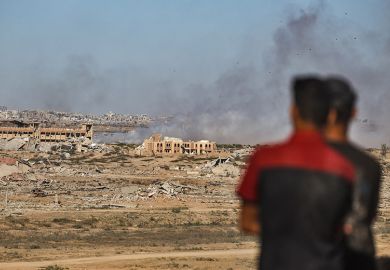
“I can’t find the words to describe how it felt seeing the rejection letter. It was devastating. It broke me,” he told Times Higher Education, adding that he had put together his application from a tent on a “borrowed laptop with a cracked screen” after his family home was partially destroyed in an Israeli airstrike in Gaza City.
“It took enormous effort to meet all the government’s requirements,” he said. “A visa refusal stays on my record, and I will have to declare it in every application I make to study anywhere in the world. If this refusal stands it will follow me [in] every chance I have left, while I wait in a war zone for an answer [from the government] that does not come.”
Abuhassan was among four Palestinian students who brought High Court challenges after Ireland’s justice minister, Jim O’Callaghan, initially refused their visa applications. The cases were settled earlier this month after the minister agreed to expedite decisions on their appeals, which could otherwise have taken up to a year. Three students have been granted visas, but Abuhassan’s appeal was rejected.
He said the refusal letter from the government rested on a “doubt about funding” and came “without a single question to me or to my university”.
He shared the letter from the Department of Justice with THE, which acknowledged that UCD had awarded him a full scholarship, including an annual stipend of €10,000 (£8,300) for living expenses, which met the department’s published financial threshold. But it questioned whether the money would be immediately available to him, citing concerns about the source of funding, which involved a private donor and crowdfunding.
Abuhassan said UCD Foundation, a registered charity that supports the university, immediately wrote to the department after the verdict confirming its financial sponsorship and requesting urgent reconsideration. He said he had received no response from the department more than a week later.
“The university has given enormous support to me. They were immediately replying to each email I have sent,” he said. UCD has given him a 2 November deadline to take up the place. “I have sent almost 300 emails to anyone and everyone who may have the ability to help me. I’m trying to do everything to change this reality,” Abuhassan said.
THE contacted the department and UCD Foundation for comment.
Sinéad Marmion, a solicitor at Phoenix Law who is representing Abuhassan, said the refusal was based on concerns that the funds were not “readily accessible” and originated from a private donor rather than the university, despite the foundation guaranteeing the scholarship.
“We went back to the minister and told him he made an error and we also shared a letter from UCD that confirms they’ve received the donor’s funds and that they are guaranteed in any event by the foundation. So if the donor did default, they would cover the fees,” she added. “We are aiming to go back to court for him,” she said.
She said Abuhassan’s circumstances were similar to the three other students whose visas were granted, including two applicants awarded fully funded scholarships by Trinity College Dublin and South East Technological University.
Marmion is also representing 29 other Palestinian students who have fully funded offers from Irish universities but whose visa applications have been rejected. In Ireland, 114 students in total have been refused visas this year.
Their cases are part of the growing legal challenge over Ireland’s treatment of Palestinian students seeking to take up scholarships in the country. Students have seen their visas rejected on grounds including financial evidence, gaps in education or employment and doubts they would return after their studies.
Lawyers representing the students have argued that the requirements are unrealistic because the civilian infrastructure, such as banks and post offices, needed to get the records no longer exists in the war-torn enclave.
A separate High Court challenge involving Shaymaa Abudalu, a Palestinian student awarded a fully funded scholarship to study engineering at University College Cork, was heard this week. Her lawyers have argued that the refusal of her visa was unlawful and irrational, pointing to requirements such as providing bank statements despite the collapse of much of Gaza’s banking infrastructure.
Abudalu’s case is being treated by her legal team as a lead challenge that could potentially have implications for other Palestinian students contesting visa refusals.
Register to continue
Why register?
- Registration is free and only takes a moment
- Once registered, you can read 3 articles a month
- Sign up for our newsletter
Subscribe
Or subscribe for unlimited access to:
- Unlimited access to news, views, insights & reviews
- Digital editions
- Digital access to THE’s university and college rankings analysis
Already registered or a current subscriber?