Trinity College Dublin
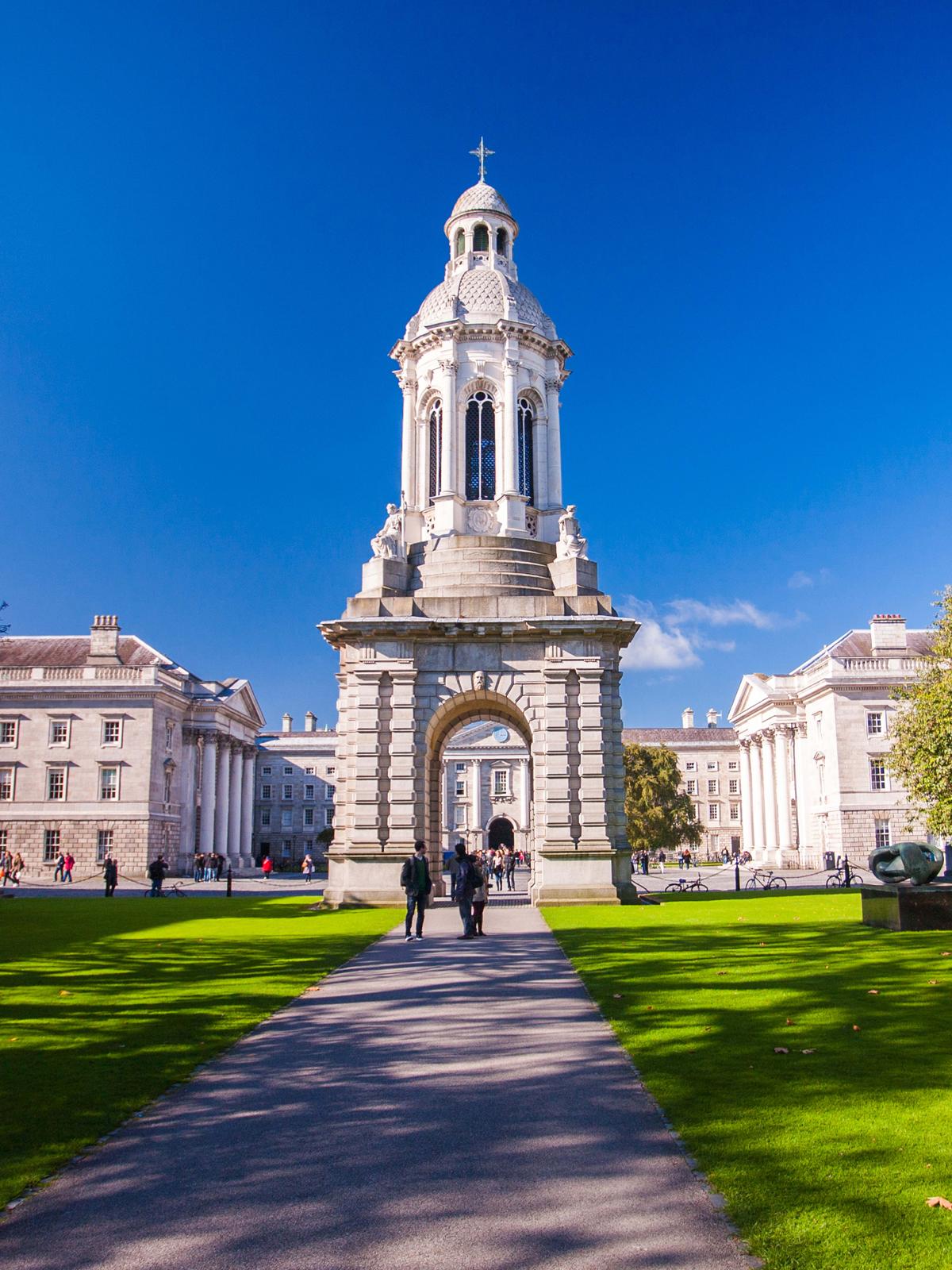

About Trinity College Dublin
Basic information and contact details for Trinity College Dublin

Founded in 1592, Trinity College Dublin, the University of Dublin, is Ireland’s leading university, ranked number one in Ireland by Times Higher Education.
Located in the heart of Dublin, Trinity is home to more than 22,000 undergraduate and postgraduate students, offering an inclusive, comprehensive education across three faculties: Arts, Humanities and Social Sciences; Science, Technology, Engineering and Mathematics (STEM); and Health Sciences.
Curiosity-driven research
Trinity is internationally recognised for its strengths in Health and Life Sciences; Artificial Intelligence and Digital Technologies; Climate and Sustainability; Culture, Heritage and the Humanities; and research addressing major global societal challenges.
We champion curiosity-driven research, recognising its power to transform lives, shape societies and deliver long-term impact.
We harness our collective expertise for the greater good through five research institutes and a wide range of research centres across multiple academic disciplines. Trinity hosts two of the seven new Research Ireland-funded Rinn centres, Rinn Quantum and Rinn Advanced Therapies, with combined funding of approximately €90 million. We are also one of five coordinating institutions in a third, Rinn Artificial Intelligence, and our researchers are principal investigators in the other four.
The Trinity Long Room Hub Arts & Humanities Research Institute brings scholars, the public, policymakers and political leaders together. Through research, creativity and critical thinking, it explores how the arts and humanities can strengthen democracy and shape the future.
This rich environment informs our research-led teaching, ensuring that students learn from academics who are advancing knowledge in their fields.
An international community
Ranked as the 24th most international university in the world by Times Higher Education, we welcome students and staff from 131 countries, making our campus truly diverse and international. Our alumni network involves 170,000 alumni from 150 countries.
Trinity works with over 300 universities globally, offering opportunities from exchange programmes to joint education partnerships; and we have over 500 industry partners.
Our international institutional collaborations include the League of European Research Universities (LERU), Charm-EU, the Coimbra Group, Consortium for Advanced Studies Abroad (CASA), European University Foundation (EUF), and the International Association of Universities.
With over four centuries of international collaboration, almost half of research publications involving international partners, and a diverse international student body, Trinity is well positioned for impactful global engagement.
Sustainability
Trinity is shaping a more sustainable world by tackling climate change, restoring biodiversity, and creating healthy futures. This is being done through our research, operations, community and education to protect and restore our planetary home for future generations.
Rankings
Select the type of rankings below to see stats
Sustainability Impact Ratings
Select the type of ranking below to see stats
Key Student Statistics
A breakdown of student statistics at Trinity College Dublin
- Student gender ratio

- 62 F : 38 M (1)
- International student percentage

- 42% (1)
- Students per staff

- 19.4 (1)
- Student total

- 20776 (1)
Based on data collected for the (1) World University Rankings 2027
Subjects Taught at Trinity College Dublin
See below for a range of subjects taught at Trinity College Dublin
Arts and Humanities
- Archaeology
- Art, Performing Art and Design
- History, Philosophy and Theology
- Languages, Literature and Linguistics
Business and Economics
- Accounting and Finance
- Business and Management
- Economics and Econometrics
Computer Science
- Computer Science
Education Studies
- Education
Engineering
- Chemical Engineering
- Civil Engineering
- Electrical and Electronic Engineering
- General Engineering
- Mechanical and Aerospace Engineering
Law
- Law
Life Sciences
- Biological Sciences
- Sport Science
Medical and Health
- Medicine and Dentistry
- Other Health
Physical Sciences
- Chemistry
- Geology, Environmental, Earth and Marine Sciences
- Mathematics and Statistics
- Physics and Astronomy
Psychology
- Psychology
Social Sciences
- Communication and Media Studies
- Geography
- Politics and International Studies
- Sociology