A public university in Georgia has condemned the government’s decision to limit which courses institutions can teach, saying that the controversial move will “destroy” many of its faculties, including humanities and social sciences.
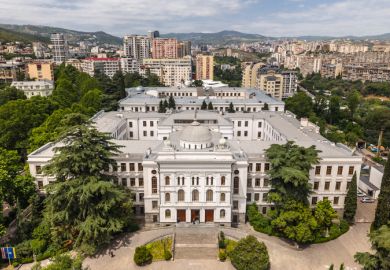
Ilia State University says in a statement that restricting the university to teaching only pedagogy and some Science, Technology, Engineering and Mathematics (STEM) fields would mean the end of many of its internationally recognised programmes. “This harmful decision affects not only more than 17,000 students and up to 3,000 employees of Ilia State University, but also the broader society,” it adds.
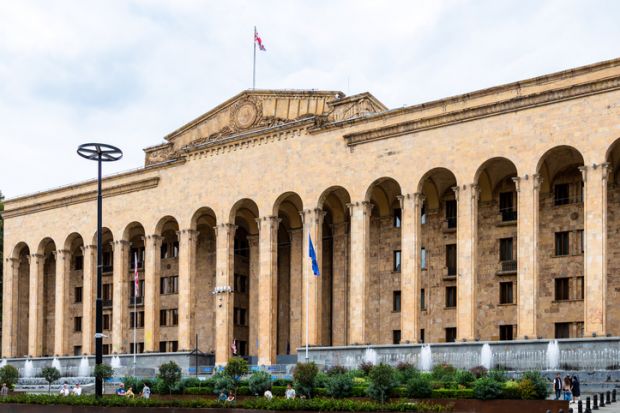
The university’s comments come after the Georgian government announced a major restructure of public universities. Each university is being assigned specific fields of study and they are not allowed to offer programmes outside that profile. They are also subject to student admission quotas based on “labour market needs”, local media reported.
The measures are part of controversial higher education reforms dubbed “one city – one faculty” that have drawn widespread criticism from the academic community. Georgia’s education minister, Givi Mikanadze, has said the changes are being made because student enrolment does not always align with labour market demands and that the reshuffle “reflects each university’s traditional [academic] profile”.
Ilia State, one of the hardest-hit institutions, currently offers programmes in a wide range of disciplines. It said the government’s move means it could no longer use its labs and research centres across Georgia nor run programmes in most fields outside STEM and pedagogy, including humanities, social sciences, life sciences and physical sciences.
Keti Tsotniashvili, associate professor of education policy at the university, said the restructure had not been discussed with the university.
“The decision eliminates the full range of accredited programmes developed over the past 20 years through the dedicated work of faculty, effectively pushing the university back toward its Soviet-era status as a narrow pedagogical institute,” she said in a post on Linkedin.
“While Ilia State University – well-known as a liberal academic space – appears to be a primary target, the implications of harsh governmental interventions extend to the entire higher education system.”
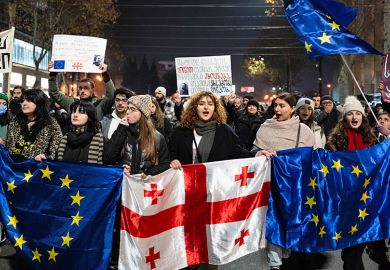
Earlier this week, the Georgian government scrapped its decision to merge the country’s largest universities – Ivane Javakhishvili Tbilisi State University (TSU) and Georgian Technical University (GTU) – following protests from students and faculty members.
But the two universities are still affected by the latest reforms because each must now focus on specific disciplines.
Sandro Tabatadze, an assistant professor at TSU, said the academic community welcomed the decision to cancel the merger, but added that the government had not reversed other controversial aspects of the wider reform programme.
He said staff and students had raised several issues with the university. “There was no consultation with the university community about their preferences,” he added.
Under the restructure, TSU will be limited to offering programmes in humanities, law, economics, social and political sciences, and natural sciences. GTU has been allocated engineering and technical disciplines.
Stephen Jones, a professor of modern Georgian history at Ilia State and the founder of the Georgian Studies programme at Harvard University’s Davis Center of Russian and Eurasian Studies, said the restructuring should not be viewed simply as an administrative reform - as it has been framed by the government - but an attempt “to end the independence of the universities in Georgia”.
Jones criticised the ruling Georgian Dream party, a conservative and populist party, saying that it was purposefully targeting universities and would “further isolate Georgian intellectual life from Europe and the European Union”.
Register to continue
Why register?
- Registration is free and only takes a moment
- Once registered, you can read 3 articles a month
- Sign up for our newsletter
Subscribe
Or subscribe for unlimited access to:
- Unlimited access to news, views, insights & reviews
- Digital editions
- Digital access to THE’s university and college rankings analysis
Already registered or a current subscriber?