
Whose vulnerabilities get seen? Whose get missed?


You may also like
Universities are full of support systems designed to assist student well-being and identify the students who may be in need. They have early-alert analytics, indicators for poor assessment results, referral pathways, and attendance and hardship tracking.
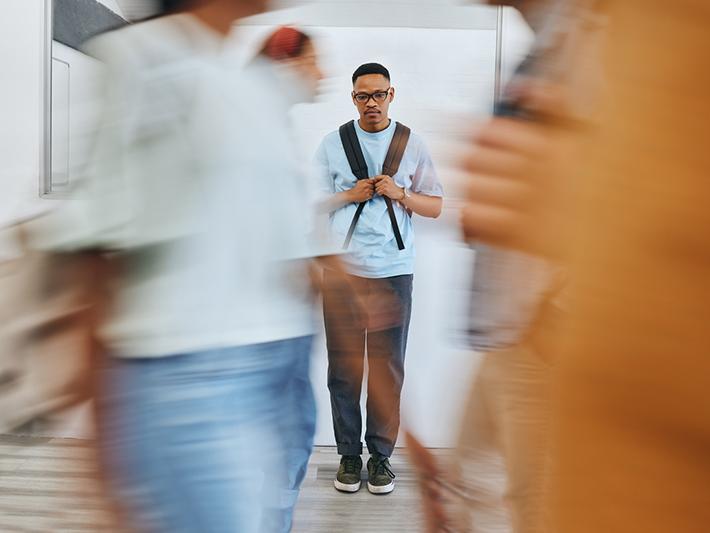
Yet despite this infrastructure, many students across the Australian higher education sector remain invisible to the system until they reach a crisis point.
This is partly because vulnerability is not something individuals “have”. It is not an intrinsic characteristic. It is something that powerful observers – such as institutions, managers, policymakers, the media and educators – produce when they identify, categorise and represent particular groups, as our recent research on observed vulnerability helps to explain. Crucially, which “categories” of hardship are overlooked can be as consequential as those that are observed and monitored.
- Build community partnerships for safer campuses
- Why fixing student problems one by one does not work
- Effective support means meeting university students where they are
The problem of institutional invisibility
At universities, visibility largely results from institutional categories such as international student, first-in-family, low socio-economic status, disability registered or Indigenous student. These categories guide funding, support and policy decisions, but they also create blind spots. Certain groups are hyper-visible while others remain unseen.
In between are students who fall into the invisible category despite experiencing significant hardship, including:
- students working 30 to 60 hours per week (in areas like hospitality, logistics, care work and retail)
- international students who are not classified as “at risk” but who face severe housing stress, overcrowding or exploitative work conditions
- students with caring responsibilities for themselves, partners or family members
- students who do not identify with equity labels – even though they meet the given criteria, they may not identify with the label or perceive that the categories relate to problems, shortcomings or weaknesses they want to escape.
Vulnerability is not always obvious. To survive in a cost-of-living crisis or live away from home, some students are forced to work, which takes them away from their study time and even classes. Precarious visa conditions can add to the stress for international students who may avoid disclosure for fear of stigma or bureaucratic consequences.
These students rarely appear in institutional data because the categories that universities use to “see” hardship don’t recognise elements of their experience. They become, in the terms of our research, “unobserved subjects of vulnerability”.
When invisibility turns into exclusion
When institutions fail to acknowledge certain groups, those groups are not intentionally excluded, but they are often missed by the system, making it harder for them to connect with care, resources or even public concern.
A similar dynamic appears in universities as students who go “unseen” often:
- do not access financial assistance, even when eligible
- do not request special consideration despite major responsibilities or stress
- disengage or quietly quit from subjects without raising flags
- experience instability in their relationships, housing, food or work that creates stress but never shows up in the university’s formal support systems.
This kind of invisibility has real consequences. When universities do not recognise a group’s circumstances, their difficulties can deepen, not because the students themselves are inherently vulnerable but because the system does not see, recognise or respond to their conditions. In practice, this means hardship grows quietly, out of sight, until it becomes much harder to address.
Rethinking how we ‘see’ students
If the labels and categories we use to identify students can create vulnerability, then reducing that risk means rethinking the way we categorise students in the first place. Universities can:
1. Move beyond administrative categories
Equity categories are necessary, but these can miss students who are struggling in ways the system does not track. That is why universities need both the top‑down categories that guide funding and bottom‑up ways of noticing students whose hardship is not captured by those labels.
People working directly with students (such as tutors, lecturers, advisers and professional staff) play a crucial role here. By creating small moments of openness in conversations, classes or check‑ins, educators can give students the chance to share contexts that do not fit neatly into existing categories. This helps the university recognise the students who would otherwise remain invisible.
2. Prioritise relational forms of visibility
Students often reveal hardship long before anything appears in university data, and this usually happens through everyday interactions with frontline staff. Small cues, such as exhaustion, repeated absences, disengagement, apologetic emails or rushed participation between work shifts, can be early signs that something is wrong. At the moment, educators notice these things informally and inconsistently. To truly reduce invisible hardship, universities need to treat this bottom‑up insight as a core part of student support: by training staff to recognise these signs, knowing how to respond and creating simple ways for educators to flag concerns so students who fall outside formal categories are not overlooked.
3. Design teaching for all students
Assessment flexibility, multimodal participation, extended deadlines and trauma-informed communication can support all students – those who come forward but also those who never ask for help.
Taking responsibility as observers
Student support often depends on visibility, and visibility is shaped by the observers – that’s us. If universities are to reduce student hardship, especially in a high-cost, high-pressure environment, we need to reconsider who is being seen, who is being missed, and how our own practices shape those distinctions.
Reducing invisible hardship requires universities to build formal mechanisms that support bottom‑up insight. This means not only training frontline educators to recognise early signs of student stress, but also giving them clear pathways to escalate concerns, share observations and access follow‑up support. When staff know what to look for, who to contact and how their input will be used, small moments of disclosure can translate into meaningful action. Investing in these processes – alongside existing top‑down categories – helps ensure that students who fall outside formal labels are still seen, supported and connected to care.
Observed vulnerability reminds us that vulnerability is not simply “out there” in our students; it is also produced by the ways universities look, categorise and respond. By seeing students differently, we support them differently. And by supporting them differently, we help ensure that no student remains invisible.
Sorush Sepehr is a consumer and marketing researcher and lecturer, and David Waller is a professor and former head of the Marketing Discipline Group, both at the University of Technology Sydney. Ranjit Voola is an associate professor in the University of Sydney Business School. Subhasis Ray is a professor at XLRI Xavier School of Management, India.
If you would like advice and insight from academics and university staff delivered direct to your inbox each week, sign up for the Campus newsletter.
