Explore the list of the world’s top universities
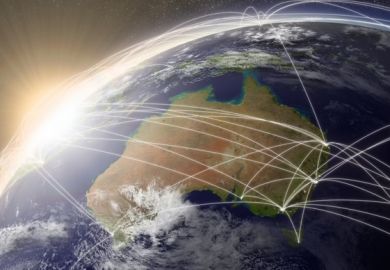
Australia has shown “real resilience” in dodging the “tectonic shifts” that are propelling Asian aspirants ahead of their North American and European rivals, the results of Times Higher Education’s World University Rankings 2027 suggest.
The country has six universities in the top 100 and 10 in the top 200, in a repeat of last year’s performance. Twenty-four institutions achieved much the same ranking as last year, with six slipping down the ladder and seven moving up.
The improvers included the sector-leading University of Melbourne, which strengthened its position from 37th to equal 34th, and the University of Sydney, which climbed from equal 53rd to equal 51st.
While the higher education strongholds of the US and UK monopolised the top 10 spots globally, their grip on the leaderboard is increasingly tenuous. Beijing’s Tsinghua University is knocking on the door in 11th place after leapfrogging continental Europe’s front-runner, ETH Zurich.
The UK relinquished one position in the top 200 and the US surrendered two, leaving the pair with 25 and 53 respectively – the lowest number ever, in America’s case.
France also renounced two top 200 places while Belgium, the Netherlands, Spain and Russia jettisoned one each. Their losses were mainly Asia’s gains, with China claiming an extra four spots. Malaysia’s University of Malaya broke into the top 200 for the first time, while Germany and Italy also improved their top 200 tallies by one each.
“We are witnessing a historic realignment of academic power from West to East,” said THE’s chief global affairs officer, Phil Baty. “While Australia in particular has shown real resilience…the underlying data show that we are entering a new era that will remake the geography of academic excellence.”
Rankings expert Angel Calderon said public disquiet about Australian universities’ governance did not appear to have affected survey respondents’ judgement of their quality, while revenue decline from international education was yet to seriously dent the country’s research metrics. “I still think people view Australia favourably,” said Calderon, director of strategic insights at RMIT University.
However, Australia’s front-runners had limited scope to ascend the leaderboard because of modest public investment and poor research productivity. “Tinkering around the edges” would only produce “incremental improvements” rather than the “transformative gains” needed to overtake higher placed institutions, Calderon warned.
He likened the challenge to economic competition. If Australia could only manage 2 per cent growth while the leading countries were achieving 3 per cent, “then sooner or later we run out of puff”.
While Australia’s overall score dipped slightly because of declines in research productivity, research strength, staff-student ratios and the doctorate-to-staff ratio, the country charted improvements in reputation, citation impact and research and institutional income. Melbourne chancellor Jane Gunn credited her institution’s improved standing to enhanced scores for teaching and research reputation.
“These latest results reflect the quality of our education and research, the dedication and talent of our students and staff and the enduring partnerships that support our work around the world,” Gunn said.
While half of the research-intensive Group of Eight (Go8) institutions moved up the league table, the other half went backwards. “Australia should not mistake resilience for permanence,” warned Go8 chief executive Vicki Thomson.
“Countries that are investing strategically in research capability, advanced skills and international partnerships are strengthening their position, and the global research landscape is being reshaped before our eyes. The challenge now is not simply to maintain Australia’s standing, but to strengthen it by backing research, supporting the next generation of researchers and deepening partnerships with trusted international collaborators.”
Calderon said that like its economy, Australia’s research profile had benefited enormously from collaboration with China, but the relationship is now under threat from geopolitical tensions and concerns about national security.
Australia’s research performance is also jeopardised by a reluctance to take risks – a by-product of a burgeoning compliance regime, he said – and research integrity issues reflected in an abundance of “highly prolific” authors, the use of artificial intelligence and a growing toll of journal article retractions.
Calderon said Australia’s ranking performance had also benefited from a recent methodological change.
Register to continue
Why register?
- Registration is free and only takes a moment
- Once registered, you can read 3 articles a month
- Sign up for our newsletter
Subscribe
Or subscribe for unlimited access to:
- Unlimited access to news, views, insights & reviews
- Digital editions
- Digital access to THE’s university and college rankings analysis
Already registered or a current subscriber?