ADVERTISEMENT
The journal article is too static for the world it now serves
Scholars should be allowed to update published research papers to reflect emerging trends in their field, argues Ali Ghaffarian
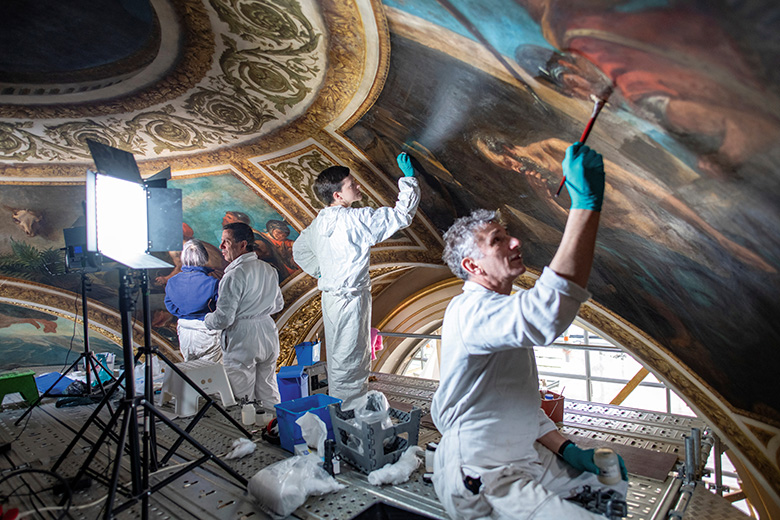
Source: Virginie Clavieres/Paris Match via Getty Images
I often tell research students to be careful with older papers. In some fields, “older” now means something published more than three or five years ago. That is not because older work has no value. It often has great value. But in areas shaped by artificial intelligence, climate transition, digital infrastructure, health evidence or public policy, the conditions around a claim can change very quickly.
There is an awkwardness here. We warn students that knowledge moves fast, then we point them towards a publishing system built around finality. A journal article goes through review, is accepted and is published – after which it remains largely frozen. It may be corrected or retracted, but in most cases it simply sits there until readers decide for themselves whether it has aged well.
I understand why the published article became fixed. Citation depends on it. So does accountability. If authors could alter a paper whenever they wished, the scholarly record would quickly become unreliable. But fixing the record should not mean pretending that the knowledge around it has stopped advancing.
This is becoming harder to defend in fast-moving fields. A paper may be sound at the time of publication yet soon become incomplete in ways that matter. A dataset may be overtaken. A policy environment may shift. A method may be replaced. A technology may make the study’s assumptions look dated. None of this means that the original article was weak. It means that the article captured a moment while the field continued to move.
At present, the burden falls heavily on the reader. A student, practitioner or policymaker has to work out whether a paper is still current, partly current, superseded or useful only as a historical reference. Experienced scholars can often make that judgement. New researchers and non-academic users may struggle. The article itself rarely helps them enough.
ADVERTISEMENT
We already have pieces of a different system. Living systematic reviews are updated as new evidence appears. Preprint servers allow work to circulate before formal publication. Some publishing platforms support open review, versioning, corrections and update notices. Crossmark helps readers identify whether a document has corrections or changes attached to it. These are useful developments, but they have not altered the basic expectation that the journal article is a finished object.
I think that expectation now deserves challenge.
The better direction is not to have two competing articles, one static and one live. That would create confusion. Which one should be cited? Which one carries authority? What happens when they begin to disagree? A better model is one article with a transparent version history.
In such a system, the article remains a single scholarly object, but it is allowed to move through reviewed versions. Earlier versions remain accessible and citable. The current version is clearly marked. Every change is dated, attributed and classified. A reader can see what has changed, why it has changed, and whether the change was editorial, technical or fully peer reviewed.
The distinctions matter. Correcting a spelling error is not the same as revising a conclusion. Updating a dataset is not the same as changing the interpretation built from it. Adding recent literature is not the same as altering the conceptual framework. The larger the intellectual consequence of the change, the stronger the review should be.
This is not especially strange outside academia. Standards, guidelines, technical manuals and software are revised through controlled versions. Their authority does not depend on immutability. It depends on clear rules for change. Academic publishing has the technical means to do something similar. Digital identifiers, metadata, archives and version control already exist. The harder problem is cultural and institutional.
Who is responsible for an article after publication? How long should authors keep it current? What happens when authors leave the field or retire? Who decides whether an update needs peer review? Who reviews it, and how is that work recognised? Would a major update count as a new publication or as stewardship of an existing one?
ADVERTISEMENT
These questions are uncomfortable because they expose a weakness in our academic reward system. We value producing the next output more than maintaining the reliability of the previous one. Yet in some fields, keeping an influential article current may be as valuable as publishing another small paper. If journals and universities want living articles, they will need to treat maintenance as real scholarly labour.
This should not apply to every paper. Many articles can and should remain fixed. Historical studies, theoretical essays and tightly bounded empirical papers may not need continuing updates. The case is strongest where research changes quickly, where evidence directly informs practice, or where outdated claims could lead decision-makers astray.
A versioned article would also help readers. Instead of seeing only a publication date, they could see a status: current, updated, corrected, superseded, under review or retired. That would be useful information. It would not remove the need for judgement, but it would make judgement better informed.
The journal article has served universities well. It gives scholarship discipline and a public record. But we should not mistake the form for the principle. The principle is not that knowledge must be frozen. The principle is that scholarly claims must be accountable.
If knowledge now changes faster than our publication formats, then the format should evolve. Not into an editable free-for-all, but into a governed record of versions. The article would still be citable. It would still be reviewed. It would still preserve its past. It would simply stop pretending that publication is the end of the conversation.
Ali Ghaffarian is professor and head of the School of Future Environments at Auckland University of Technology.
Read more about

Related articles


Featured jobs
ADVERTISEMENT