A University of Birmingham professor is shortlisted for the Booker Prize for a witty campus novel reflecting on masculinity, sexual politics and academic infighting.
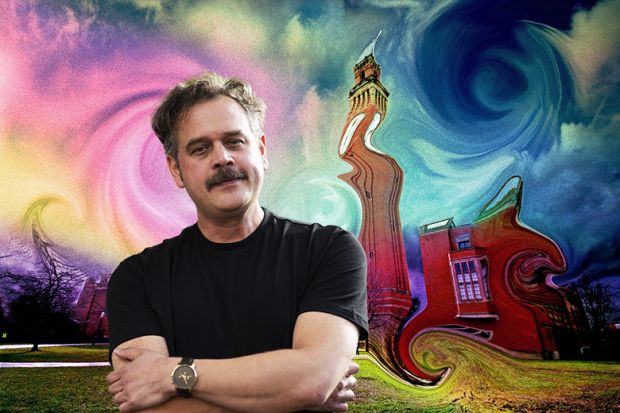
If that sounds like the introduction to yet another appreciation piece about David Lodge, who died last year, that is understandable: the professor of literature was nominated for the UK’s top literary award in both 1984, for Small World, and 1988, for Nice Work. But it actually refers to Luke Kennard, professor of creative writing at the red-brick institution, whose third novel, Black Bag, is tipped to take this year’s £50,000 prize on 9 November.
Kennard’s shortlisting has been celebrated for several reasons. He is one of four UK nationals among the six writers vying for an award whose shortlist has been increasingly dominated by American authors since it was opened up to those from outside the UK and the Commonwealth in 2014. Moreover, Black Bag’s high-concept premise – its unnamed narrator is asked to sit in silence at the back of a lecture theatre inside a large black bag – recalls the 1980s and 1990s heyday of the Booker, when Lodge and other British literary heavyweights such as Martin Amis, Beryl Bainbridge and Julian Barnes mixed social commentary with compelling characters in well-told, enjoyable reads.
An award-winning poet before turning to fiction, Kennard told Times Higher Education that he was consciously trying to do “something slightly different” with Black Bag – but also “reach back to the really great British writers of the past like David Storey, Beryl Bainbridge and Iris Murdoch”.
In that sense, “There was some ambition to write a really strange but also really good novel that people might actually want to read – not something that’s just a bit worthy, a bit thematic, like the kind of plays that my narrator hates”.
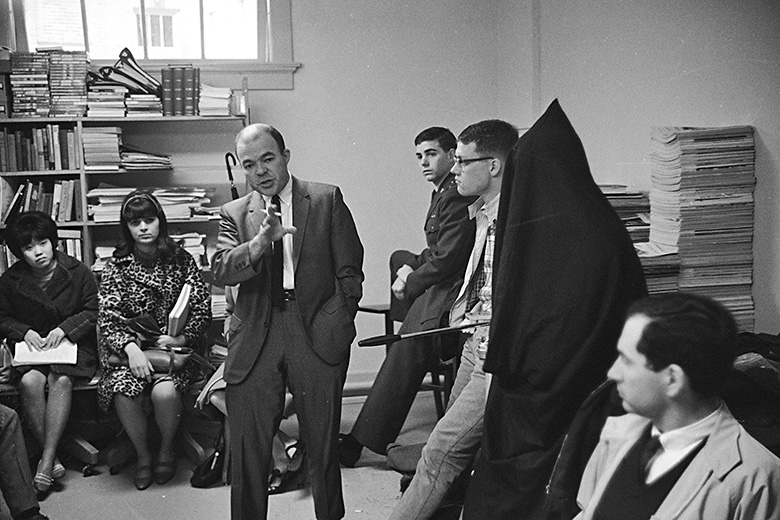
Black Bag’s strange premise is based on a real experiment that was conducted at Oregon State University in 1967 to test students’ attitudes towards the unspeaking figure. The book revives the campus novel format with a zany originality that is removed from Lodge’s more familiar tales of British lecturers’ mishaps in unfamiliar settings in his Campus trilogy (California, the international academic conference circuit and a Midlands factory close to Rummidge, his fictionalised Birmingham).
But Kennard did not set out to deliberately reject the traditional campus novel, he insisted. In fact, the 45-year-old picks up many of Lodge’s themes.
“His novels are deeply honest about the low-level humiliations of working as a lecturer. That was where Lodge was funniest: he was brutally honest about how something that seemed like an ‘ivory tower’ wasn’t that even then,” Kennard reflected. “He was very good on kind of awkward sex as well.
“I love David Lodge and have been reading him since I was very young. There’s a beautiful portrait of him in the university library, and he still has a pigeonhole in the mail room in the English department. You can’t help but occasionally venerate it. I was really excited in 2008 to start lecturing at Birmingham because, you would think, ‘This is Rummidge. This is David Lodge’s university’.”
Not that Lodge made Rummidge/Birmingham look glamorous. “He was telling the truth in a comedic way. He was telling the truth about the job and the endless department meetings,” Kennard said. And he was always clear about the relative poverty of British universities back then: “The American campuses in his novels are more glamorous because American universities are like theme parks, based on what they imagine English universities are like. They’re a sort of Disneyland version of Oxford or Cambridge colleges,” said Kennard.
But even on the eastern side of the Atlantic, academia retained a “little bit of romance” that has since waned, Kennard conceded. “One of the things that’s different is that people had more time back then, which is true of society in general and definitely true of academia now. It’s quite rare to have a common room where, like in Don DeLillo’s White Noise, they’re just all hanging out and talking about philosophy and holding forth, maybe slightly excessively.”
In that sense, “It’s easy to get a little bit cynical and [think], ‘Oh, academia is just not what it was. It’s a terrible job now’. But it isn’t. It’s just you are expected to work a bit harder, focus on your students, and for that to be your priority, rather than hanging around drinking endless cups of coffee and talking about Hegel,” he said.
“Maybe they were pretty bad at their jobs because all they did was sit around and self-indulgently hold forth to each other and barely listen to each other either. It wasn’t interdisciplinary; it was just showboating”.
For critics, the ability of dons such as CS Lewis, JRR Tolkien, Iris Murdoch, AS Byatt and Lodge to knock out novels regularly reflected an undemanding schedule of occasional lectures and conference talks. But that was never true of Birmingham or Lodge, who quit the university in 1987 to focus on writing, insisted Kennard. And although “some people still try to live that professorial lifestyle, where you just do as little as you can get away with for as much money as you can possibly squeeze”, Birmingham’s professorial staff “visibly did a lot”, when he began working there as an entry-level lecturer.
“They marked a shedload, convened courses and had big admin roles,” he said. “I really liked that, and it’s probably one of the reasons that I’ve stayed here – because that’s a way of caring for each other. I’m not comfortable with getting paid more than [a junior lecturer] and doing half as much work as you. That’s not OK.”
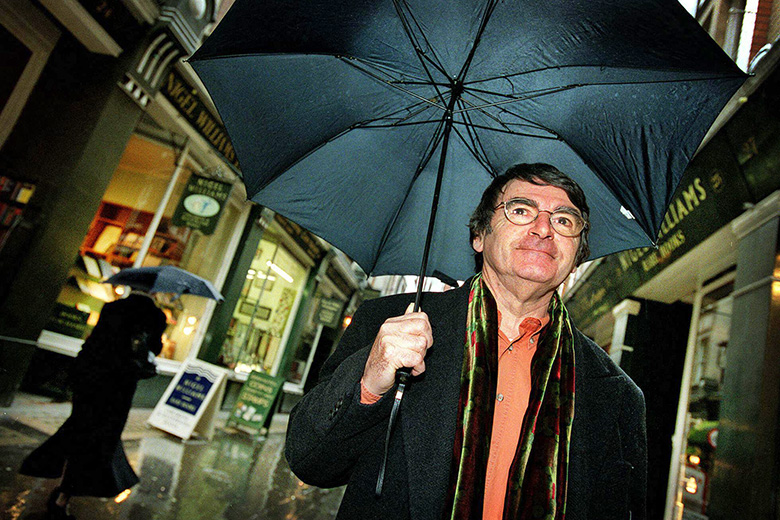
If Kennard is pulling his weight as a full-time professor, how does he find time to his write novels? “Like most writers I know, the time you have is those couple of hours before you just pass out at night. That’s just the norm,” he explained on why full-time fiction writing is not economically feasible for 95 per cent of authors.
“Regardless of your class, you’re going to be working full time if you want to pay the bills. It’s mostly graft and crushing disappointment. You have to just be prepared for that.”
Even those lucky few who are published will not make a living from it and will need a back-up plan, he continued, explaining that he is asked to mentor would-be writers alongside teaching literature.
“When a writer whose debut is about to get published – an advanced point which not many of us get to – one of my roles is to say, ‘This might connect with people but most of the time that’s not going to happen,” he said, recalling the “peaks and troughs” of his own 24-year writing career.
“Mostly you’re going to have a couple of weeks of attention, maybe some nice reviews, again if you’re lucky – because only 20 per cent of books gets reviewed. And then it’s going to…more or less sink without a trace,” he said. “The childlike, hurt part of you will be left feeling like ‘I might as well not have bothered for all the impact it’s had, for all the people who have read it outside of my immediate circle of friends and well-wishers.’
“You’re going to need to deal with those feelings, probably for decades if you keep doing this. Stay grateful. Stay humble. Don’t get embittered or resent other people for their success…work hard at it [but only] because you love doing it.”
Kennard’s background as a poet was useful, he believes, because “one of the things that’s nice about poetry is that nobody really cares if you fail – you get to try again over and over again with a variety of indie presses who still believe in you, even if nobody else does. It’s a bit how bands [progressed] in the 80s – they could have five albums before they hit big,” he said.
“Unfortunately, the brutality of our culture means there is now pressure [to get a hit], even in literary fiction, which is supposed to be anti-commercial. Of course, you want it to land with people as much as possible but, at the same time, the best work that we write is when we are sticking our neck out quite a long way, and [aiming for something that is] weird and...idiosyncratic. There is a risk that you’ll be the only one who’s amused…but that feeling that I’m writing to order just doesn’t interest me.”
For that reason, Kennard deplores the use of AI for creative endeavours, including academic essays – the consequences of which he explores in Black Bag.
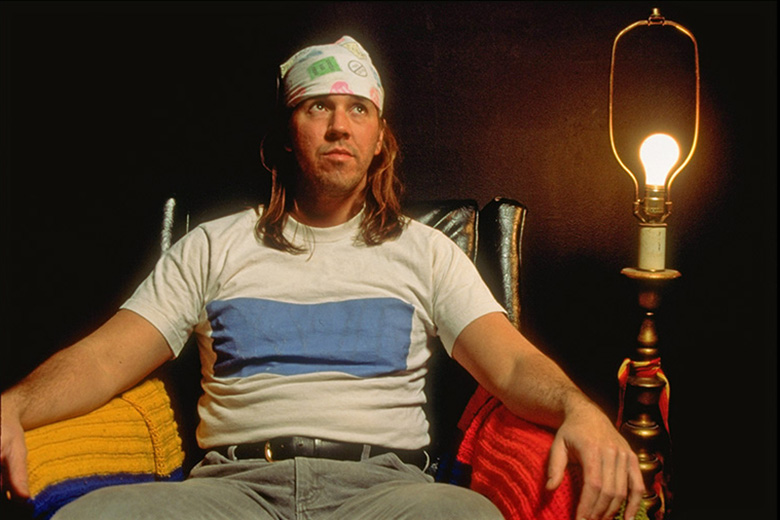
“The thing that makes art and literature worthwhile is its flaws: some of the greatest novels ever written are deeply flawed,” he said, citing American writer and academic David Foster Wallace’s 1996 novel Infinite Jest: “On the one hand, that is a terrible novel, awful. It’s about 80 per cent too long, full of 10-page-long footnotes and endnotes. It’s incredibly self-indulgent. But that’s also why it’s good,” he said.
“It’s good because it’s a work of obsession – it needs to be that kind of baggy monster of a novel to find that vivacity and convoluted intelligence. AI can’t do that because it tries to optimise everything.”
There have recently been several cases of apparently AI-assisted novels only being flagged as such after they have been published and achieved some success. One was even nominated for France’s equivalent of the Booker, the Goncourt prize. But Kennard believes that even if AI improved further, readers would still be able to tell that it was AI-generated because “it’s going to be this homogenised, generic kind of slop in the same way as an idealised photograph of a sandwich that actually looks slightly uncanny and wrong.”
In the case of students, he can “tell within two sentences if an essay is AI-written” But the problem of students submitting such essays is “over-reported”, in his view.
“The statistics are that, like, 98 per cent of people are using it. That’s bullshit. I’ve had two cases out of about 2,000 pieces of work that I’ve been involved in assessing where AI was clearly being used and being leaned on too much. It’s as rare as plagiarism.”
Moreover, students who use AI are “cheating themselves more than they’re cheating lecturers,” he continued: “They may think they’re getting one over on you by getting an essay through when they haven’t even opened a book. They’re not.”
To illustrate that, he says students should be asked: “What kind of a life do you want? Do you want a life where you become, say, a secondary school English teacher on bogus qualifications? You’ve never actually even written an essay yourself. Every hour, every day, you’re terrified in the classroom because you’re teaching students of all ages how to write essays when you don’t know that yourself because you’ve never done it. That’s a miserable existence. You do that until you retire, and then you die, and then somebody uses ChatGPT to generate your eulogy. What kind of life is that? Everyone knows that’s awful…it’s only tech bros who are pushing it because they are so vulgar and so stupid that they can’t grasp…how completely soul-sappingly empty it all is.
In that sense, the rise of AI is part of a wider “corporatisation” that comes alongside a “lack of respect for the arts and humanities”, Kennard believes – in universities as much as in wider society.
“I feel lucky to be at the place that I am, where [a humanities department] does feel quite valued,” he said. “But I have a lot of friends who are brilliant academics, who are more accomplished writers than me, whose jobs are at risk because their institutions have arbitrarily decided to halve the size of the departments.”
And although the increased accountability of senior academics might be a positive change since Lodge’s day, the biggest disparity between then and now is much less positive, Kennard believes: the modern “idea of the university as a corporation or money-making scheme…run by people who couldn’t make it in an actual corporation. They’re not good business people and they’re also certainly not very good or very principled educators. They don’t really care about the legacy of their own specific institutions,” he said.
“Universities are something that we should be deeply proud of in this in this country. But parts of them are being sold off…by people with very little in the way of a soul, let alone intellect.”
Such people, he believes, struggle to see the value of the arts and humanities in particular, and Kennard resents the duty that that imposes on academics in those disciplines to make the case for their departments’ ongoing existence.
“To repeatedly have to defend the arts and humanities is so galling,” he said. “It’s tedious. It’s insulting. Why on earth did all of you people make English a core subject at GCSE if you are suddenly going to say, ‘There’s no point in it’. It’s pathetic. I refuse to engage on those terms. I will not deliver statements like ‘Our writings are about what it is to be a human being’ because it doesn’t need saying again: we won that argument in roughly the 16th century.”
Many academics will be hoping that if Kennard succeeds where Lodge failed and lands the Booker prize, his views on such matters will be heard more widely – and help ensure that the next generation of campus novelists still have a department to write about.
Jack.grove@timeshighereducation.com
Unexpected baggage
During my master’s degree at King’s College London, a fellow student boldly entered our seminar room 10 minutes late, dressed in an oversized, florescent yellow gilet.
Our lecturer had already dimmed the lights for her Powerpoint slides and we all watched as the gilet – carefully manufactured to distinguish itself from regular high-vis vests one might wear if out cycling – headed for the front row. My thought was that its wearer knew exactly what she was doing, casually exhibiting a cool aura via a look that only she seemed capable of carrying off. I shrank back in my River Island duffle coat, jealous of her apparent audacity to be totally and entirely herself.
I am inclined to think that she would have looked just as cool even if she had been dressed entirely in a black leather bag, like the protagonist of Luke Kennard’s Booker Prize-nominated dark satire of academia, Black Bag. But the intention of Kennard’s fashion pioneer isn’t so much to impress his peers as to shake them up.
The University of Birmingham professor’s warped, surrealist campus novel might be described as a macabre and absurdist critique of masculinity. It pokes fun at contemporary society, the male ago, sexuality and intimacy but also raises serious questions about love, loneliness and power. And it offers a remarkably disorienting glimpse into university life.
A man in a black bag appears in the lecture hall and suddenly everything shapeshifts into a weird netherworld in which the university campus and the current decimation of the arts is disrupted by the presence of an enigma, an oddity. Kennard’s seated, “‘giant leather bag” imagery has the same deadpan pathos as an Edward Gorey illustration, with a heart beneath its zipper. And, notably, academics are seeking solace in the book and the very timely gut punch it delivers, both mesmerising and deliriously funny.
Kennard’s premise is actually based on a social experiment conducted by Charles Goetzinger at Oregon State University in 1967. One of Goetzinger’s students attended classes for an entire semester dressed in a large black bag. As he sat there in silence, students gradually became accustomed to his presence and his perceived threat diminished. He was apparently even offered friendship (what that amounted to we can only guess at).
In Kennard’s novel, the black bag is worn by its narrator, a 37-year-old millennial facing depressing prospects as an out-of-work actor. A dubiously named Dr Blend invites the actor to be his experiment. However, times have changed since 1967 and the university campus is now a site of Ballardian levels of dystopia. The black bag’s appearance in the lecture hall is like something out of an urban fairytale, and soon it is being worn beyond the campus in “secret”, far beyond the constraints of the experiment.
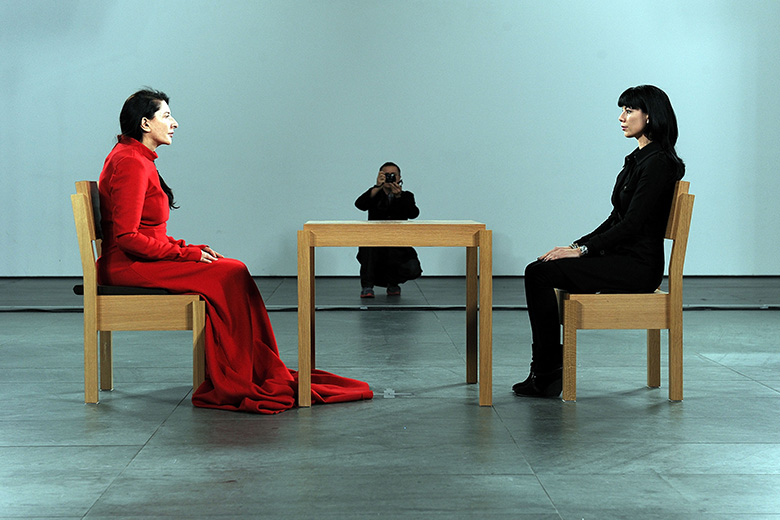
Black Bag repurposes the increasingly corporate, functional space of the campus. It manifests mysterious pleasures, subversive humour and uncanny wonder. The campus is recast as a stage for Black Bag’s narrator to encounter a wide range of characters, calling to mind “The Artist is Present”, performance artist Marina Abramović’s 2010 piece that involved her sitting continuously for three months in New York’s Museum of Modern Art, silently staring into the faces of gallery goers who pulled up a chair opposite her – and who often ended up crying.
As news stories continue to highlight the erosion of the arts by UK higher education institutions, Black Bag offers academics a human-shaped salve, so delightfully and disarmingly diverting beneath its outer layer of stark obscurity.
Davina Quinlivan is fellow in the Department of English and Creative Writing at the University of Exeter. She is author of Possessions: A Memoir of Transformation in an Era of Precarity (September, 2026) and Shalimar: A Story of Place and Migration (Little Toller, 2022).
Register to continue
Why register?
- Registration is free and only takes a moment
- Once registered, you can read 3 articles a month
- Sign up for our newsletter
Subscribe
Or subscribe for unlimited access to:
- Unlimited access to news, views, insights & reviews
- Digital editions
- Digital access to THE’s university and college rankings analysis
Already registered or a current subscriber?