The closure of university departments provokes familiar accusations: cultural impoverishment, managerial philistinism, privileging STEM over the humanities. The University of Nottingham’s decision, recently finalised, to close its music department, as well as those in languages, is no exception. The Royal Musical Association (RMA), for instance, protested against the earlier suspension of music recruitment with a statement citing the department’s research, contribution to musical life and regional importance.
Having watched a range of UK music departments and programmes close over more than two decades, I understand the feelings. The losses are real, and universities’ claims of financial necessity need proper scrutiny. But the value of a discipline does not justify maintaining every existing department and programme. And while the fate of university departments is rarely decided on the basis of what the national health of a discipline requires, that does not entail that every closure is bad when viewed from that perspective. And it is a perspective that academics, as well as university managements, have to consider seriously.
Music is a good example to look at, not only because it is my original field but also because it is a field in transition, encompassing various kinds of provision that illustrate the breadth of purposes for which a university education is pursued – and which different kinds of institutions emphasise to greater or lesser extents.
As a musician and musicologist, I want proper scholarly music education to survive. But this requires asking questions about how many students choose to study it, how thinly they are distributed, and what their courses actually contain. And the answers reveal a more uneven picture than a simple assault on the arts – and distinguish the preservation of scholarly enquiry from the expansion of vocational training.
Publicly available Higher Education Statistics Agency (Hesa) data (my primary source here unless indicated otherwise) show that UK undergraduate music cohort figures rose slightly from 29,365 in 2023-24 to 29,465 in 2024-25. But that was still an overall fall of around 5.5 per cent since 2020-21. These figures represent total undergraduate cohorts, not annual intake, and include students on four-year Scottish degrees, foundation years and courses of varying lengths. They are expressed as full-person equivalents (FPE), which apportion students on combined-subject degrees between their subjects, rather than full-time equivalents (FTE), which account for study intensity.
Private providers accounted for 6,295 FPE and conservatoires (which focus on instrumental and vocal training) 5,320 in 2024-25, together accounting for nearly two-fifths of the whole. Excluding these and nine specialist institutions or colleges leaves 17,045 across 89 providers, with average cohorts of 191.5 – equivalent to fewer than 64 per year on a hypothetical three-year course.
The table below shows the distribution. Post-92 institutions account for 51 per cent of providers and 40 per cent of students. Pre-92 institutions accounted for less than one-fifth of undergraduate music students in 2024-25, despite representing almost 30 per cent of providers.
| Provider group | 2023–24 | 2024–25 | |||||
| FPE | Providers | Mean FPE | FPE | Providers | Mean FPE | FPE proportion | |
| Russell Group | 3,210 | 18 | 178.3 | 3,010 | 18 | 167.2 | 10.2% |
| Established non-Russell Group | 2,435 | 16 | 152.2 | 2,485 | 16 | 155.3 | 8.4% |
| Post-92 | 11,645 | 59 | 197.4 | 11,550 | 55 | 210.0 | 39.2% |
| Other | 760 | 8 | 95.0 | 805 | 9 | 89.4 | 2.7% |
| Specified conservatoire group | 5,315 | 9 | 590.6 | 5,320 | 9 | 591.1 | 18.1% |
| Specified private-provider group | 6,000 | 6 | 1,000.0 | 6,295 | 7 | 899.3 | 21.4% |
| All providers | 29,365 | 116 | 253.1 | 29,465 | 114 | 258.5 | |
Note: Mean FPE = total FPE divided by the number of distinct providers. A provider is an institution that had a cohort of five or more during the period in question.
Nottingham recorded 80 undergraduate music FPE in 2024-25, the lowest number for any Russell Group department; Birmingham and Bristol each had 95. Even lower numbers were found elsewhere in that year, including Bangor (75), Kingston (65), Anglia Ruskin (60), Keele (50), Liverpool John Moores (40), Brunel (35) and Derby (25), most of them consistent with preceding years. Small cohorts do not by themselves establish financial non-viability but will always raise questions.
Compared with a cross section of other subjects, music’s overall cohort sizes don’t look particularly unhealthy, as the following table (ordered according to the rightmost column) reveals. However, as we shall see, overall cohorts provide only limited information relating to specifically academic study of the subject.
| Subject or specified combination | 2023–24 | 2024–25 | ||||
| FPE | Number of providers | Mean FPE | FPE | Number of providers | Mean FPE | |
| Business and management selected | 264,695 | 188 | 1,408.0 | 280,715 | 191 | 1,469.7 |
| Nursing | 126,775 | 94 | 1,348.7 | 121,205 | 95 | 1,275.8 |
| Computing | 131,080 | 160 | 819.2 | 142,445 | 168 | 847.9 |
| Law | 101,750 | 128 | 794.9 | 102,950 | 127 | 810.6 |
| Psychology | 101,990 | 131 | 778.5 | 101,085 | 132 | 765.8 |
| Design and related | 60,125 | 113 | 532.1 | 58,710 | 115 | 510.5 |
| Economics | 43,045 | 99 | 434.8 | 43,060 | 100 | 430.6 |
| Sociology | 52,725 | 116 | 454.5 | 49,830 | 119 | 418.7 |
| Mathematics | 29,880 | 90 | 332.0 | 30,035 | 90 | 333.7 |
| Mechanical engineering | 28,555 | 90 | 317.3 | 29,685 | 90 | 329.8 |
| History | 32,135 | 99 | 324.6 | 31,810 | 99 | 321.3 |
| Physics | 17,075 | 55 | 310.5 | 17,115 | 55 | 311.2 |
| Language and area studies | 22,395 | 74 | 302.6 | 20,590 | 67 | 307.3 |
| Music | 29,365 | 116 | 253.1 | 29,465 | 114 | 258.5 |
| Chemistry | 16,025 | 69 | 232.2 | 16,330 | 68 | 240.1 |
| English studies and literature | 25,040 | 113 | 221.6 | 24,410 | 110 | 221.9 |
| Media studies | 23,835 | 119 | 200.3 | 24,680 | 118 | 209.2 |
| Art | 13,225 | 74 | 178.7 | 13,020 | 74 | 175.9 |
| Creative writing | 6,710 | 96 | 69.9 | 6,575 | 92 | 71.5 |
Note: Business and management includes all in the Hesa categories of business and management (non-specific), business studies, management studies, and others in business and management.
Institutional differences are very revealing. In 2024-25, English studies and literature averaged 566.8 FPE in the Russell Group: much higher than the 233.3 in other pre-92s and 91.6 in post-92s. History’s corresponding figures were 780.4, 306.4 and 119.2. But this ordering is different for music: its post-92 average is larger than for either of the other groups. Physics averaged 503.3, 251.3 and 51.7 across these three institutional categories, while mathematics averaged 800.4, 342.2 and 55.0. Small subject populations, in other words, can be found outside the arts and humanities.
As for disciplinary differences, music’s mean subject population per provider is smaller than those for history, mathematics and physics, but higher than art, English and chemistry. However, combining art with design, or English with creative writing, produces averages of 602.8 and 260.4 respectively, counting institutions offering both subjects only once in each calculation – compared with 258.5 for music.
And, of course, the difficulties for music also relate to the fact that the subject entails many costs for instrumental tuition, practice and rehearsal facilities and studios – costs made harder to meet in England since the halving of additional funding for high-cost performing and creative arts subjects in 2021, although the sum lost – about £120 per full-time student per year – is small compared with the real-terms erosion of the tuition fee.
This mix of scholarly and vocational courses means that when you are debating whether there is too little or too much provision, it is important to distinguish the two. As I have previously argued, musical scholarship and professional training can interact fruitfully but are not interchangeable in their purpose or staffing requirements. Interviewed by Ivan Hewett in 2024, Katharine Ellis, professor of music at Cambridge, bemoaned university managers for overlooking music’s connections with philosophy, science, history and religion. But this description scarcely captures the broader music HE sector.
A separate analysis of more granular Hesa data on undergraduate entrants from 2016-17 to 2020-21, categorising courses by their titles and published descriptions, reveals how far provision has shifted towards the vocational. In 2020-21 university departments specifically (not private providers, conservatoires or the few others) admitted 7,072 students to music-related courses, of whom 2,337 were in production, technology and sound; 645 in popular, jazz, folk and commercial music; 1,509 in musical theatre; and 220 in other performance-related courses. Together, those students accounted for two-thirds of all music students by FPE.
Such courses can feature a certain amount of scholarly study, but this is not their primary purpose.
Share of total intake accounted for by vocational categories
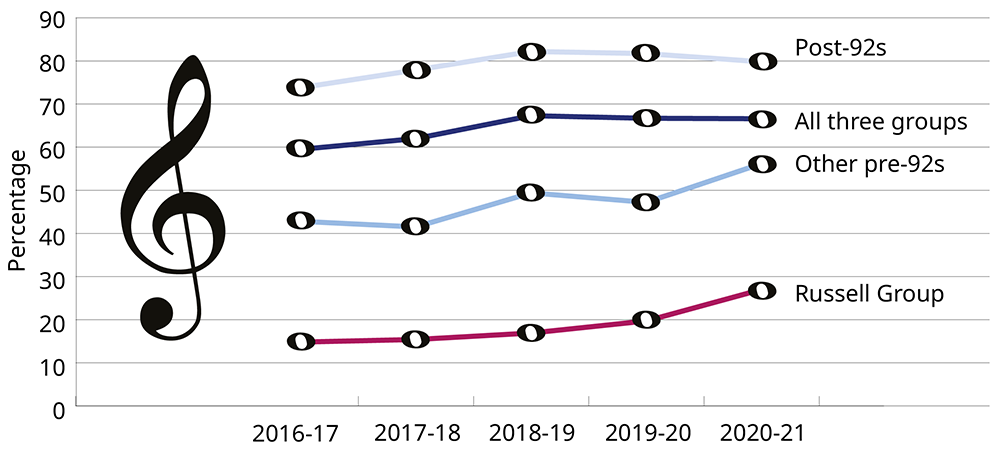
Vocationally oriented undergraduate courses, which already account for practically all offerings at private providers and conservatoires, were a clear majority by the end of this period in all parts of the university sector except the Russell Group, overwhelmingly so in post-92 institutions. The balance of undergraduate recruitment had already shifted markedly before the latest closures, with these four vocationally oriented categories increasing their share from 59.5 per cent in 2016-17 to 66.6 per cent in 2020-21. Their intake grew by about 18 per cent, while intake on the remaining courses fell by about 13 per cent.
Even courses that are not explicitly vocational are not always guaranteed to feature sustained musicological study – meaning historical, analytical, critical or ethnomusicological enquiry, supported by engagement with scholarship and substantial assessed work. Many combine significant vocational and non-vocational elements. We must distinguish available options, compulsory scholarly sequences and the students who actually take them. A few contextual lectures or reflective commentary accompanying a practical project are not equivalent.
There are harder questions, too, associated with an increasing “vocational turn”. Courses principally preparing students for producing recordings, commercial performance, or musical theatre need professional experience much more than PhDs or academic publications. There are some staff who offer both (I like to think of myself in that category), but these are definitely the exception – and neither achievement alone guarantees teaching ability. Universities need to ask whether research-oriented staffing models are necessarily appropriate for this type of provision.
All this matters to the defence of the arts and humanities. Growth in courses on music production or commercial performance – or in creative writing or commercial design – does not necessarily amount to growth in the scholarly study of music, literature or art. And the closure of courses or whole music departments supporting demanding historical and analytical work, such as Nottingham’s, is not offset because another university recruits more students to vocational courses. Tellingly, Nottingham plans to maintain some music-related research within its School of Computer Science.
Nor should the Cardiff department’s reprieve from closure obscure the uncertainties surrounding its future: despite an undergraduate music cohort of 135 FPE in 2024-25, its provision is undergoing restructuring, curriculum changes and planned staffing reductions. The apparent resilience of music enrolment conceals a much more uncertain future for music as a scholarly discipline.
Degrees marketed as preparation for artistic employment need to provide credible evidence of graduate outcomes. Yet, as Pierre-Michel Menger has demonstrated, artistic labour markets are characterised by precarious employment, highly unequal earnings, multiple occupations and unpredictable demand. UK data found only 42.1 per cent of performing arts graduates (a category that includes music) working full-time 15 months after graduating, compared with 56.4 per cent across all subjects. One in five of those working were in retail, catering or bar jobs, and even after 10 years, music graduates were earning a lower average salary (£31,300) than a typical graduate earns after five.
As I argued in Times Higher Education in 2023, the advent of AI adds further uncertainties, especially for routine creative production, while increasing the premium on advanced technique and artistic perception. Some vocational provision might therefore be better delivered through specialist institutions, short courses or modular study. Scholarly education in the arts has a different purpose and need not be justified principally by direct entry to artistic employment.
The pressures on scholarly music education also raise the question of how effectively the research community is defending its distinctive intellectual contribution. The Vanderbilt-Washington University music report offers an indication of changing disciplinary priorities in the US. It found mentions of canonical composers in meeting documents of the American Musicological Society (AMS) fell from 59.7 per 10,000 words in 2001-05 to 12.2 in 2021-25, and that 47.9 per cent of 505 papers at the 2025 AMS meeting were framed primarily in terms of political, social or identity issues, with only 8.5 per cent primarily formal or analytical.
An equivalent investigation is needed in the UK. My own preliminary application of the report’s keyword tests to RMA conference programmes and books of abstracts, over a shorter period, gives a more mixed result. Between 2016-20 and 2021-25, vocabulary of social justice and activism rose from 1.5 to 5.7 occurrences per 10,000 words, gender and feminism from 4.7 to 7.7 and race from 0.3 to 1.8. But mentions of canonical composers also rose, from 19.4 to 21.2, and analytical vocabulary remained relatively stable.
These are keyword frequencies, not classifications of individual papers, and a wider survey would be needed for firmer conclusions. Nonetheless, this evidence points to UK musicology having retained more of its core than its US counterpart, even if some of the vocabulary is moving in a similar direction. This makes it especially important that the discipline’s representative bodies make the case for that core. When weighed against other disciplines, the distinctive intellectual content of music serves as its primary justification, rather than its capacity to serve as a vehicle for wider social and political critique, amply offered by other disciplines.
Until the Higher Education (Freedom of Speech) Act came into force in 2025, it was far from uncommon to see job adverts in which musical expertise was emphasised less than adherence to particular EDI objectives. The RMA’s 2023 council recruitment notice explicitly sought candidates who would advance diversity initiatives, but I have seen little comparable priority assigned to musical knowledge, discipline-specific skills or freedom of criticism. The contribution of the association in the form of public challenge or genuine alternatives to the current direction of travel has been at best limited. Keeping the peace is no substitute for intellectual leadership, especially when it means avoiding difficult and potentially divisive debates about the future of the discipline.
My more granular Hesa analysis reveals very little undergraduate degree provision explicitly identified in course titles with niche ethnomusicology or sound studies fields, and little evidence in this data of substantial cohorts recruited under such labels. Those who seek to establish such courses in place of established traditions of musicological enquiry, in the name of decolonisation and the like, risk imperilling their profession’s future.
As Alexandra Wilson writes in her new book, Culture Vultures: When Activism Meets the Arts, “Young people tend to choose to study arts subjects at university because music, literature or drama is their personal enthusiasm”. But “why will anyone want to study an art form they are told is elitist or bound up with inequality?” Students interested principally in such questions might better choose politics, sociology or cultural studies, where they can encounter a broader body of knowledge, stronger theoretical and methodological foundations, and arguments tested across different subjects and settings.
A more self-critical discipline should consider the extent of what Paul J. DiMaggio and Walter W. Powell called “institutional isomorphism”. Why have curricula, departmental structures and disciplinary fashions so often been duplicated – in contrast to earlier decades when “new” university music departments tried to offer something different? Has there been what Robert Merton describes as a “displacement of goals”, by which established procedures become ends in themselves rather than means to educational ends?

I believe that music as a scholarly discipline needs to be prepared to sustain fewer departments, but with clearer purposes, stronger provision, and more concentrated cohorts, rather than maintaining provision across almost 90 non-private, non-conservatoire providers, many forced to compromise their offerings to compete desperately for students.
Scholarly music requires research-based teaching, proper historical, analytical and global study, and students who are equipped to undertake it. Professional training, by contrast, requires appropriate practitioners, facilities, credible occupational expectations, and student numbers commensurate with the last. Different missions have different staffing requirements.
Among the places I would currently look to sustain substantial scholarly provision are Oxford, Cambridge, Durham, Newcastle, Leeds, Manchester, Liverpool, Nottingham, Birmingham, Bristol, Edinburgh, Glasgow, Cardiff and a few others. This cannot of course amount to a permanent prestige-based entitlement, and some of these institutions currently have small cohorts.
For music, the total 17,045 undergraduate FPE for 2024-25 would average 387 per institution across 44 providers, or 487 across 35, compared with today’s 89. That 487 figure would be comparable to the average for economics.
English could attain a similar figure across 51 providers rather than 110, and history across 66 rather than 99. The music total, though, includes the vocational majority. If anything like the 2020-21 balance of entry still holds, at most around a third of those 17,045 FPE – about 5,700 – study on courses with a substantial scholarly core. Spread across 35 providers, that would mean around 160 each, slightly less than today’s Russell Group average. Cohorts of around 100 a year could be sustained in fewer than 20 scholarly departments on existing numbers.
These are illustrative calculations rather than forecasts or optimal estimates: not all students would transfer, and vocational provision would require different arrangements. But they make the point that greater concentration can bolster sustainability.
Of course, concentration must also try to avoid creating more of the “cold spots” for provision analysed by the British Academy. This will require regional planning, collaboration between universities, shared specialist teaching, foundational provision and support for travel or relocation. The disappearance of a sole regional provider is a worse outcome than consolidation among institutions in a major city.
This argument extends across the arts and humanities, although the pattern differs by subject. In English and history, undergraduate FPE averages at post-92 institutions are just 91.6 and 119.2, compared with 566.8 and 780.4 in the Russell Group; scholarly provision has been spread thinly across many providers. In music, post-92 growth has come mainly through vocational courses, and the thinning out of scholarly provision is especially evident in the pre-92 sector, with averages of fewer than 170 FPE. Serious scholarship did exist in some polytechnics, but the wholesale removal of the binary divide has led to a dispersal of provision without a corresponding assurance of student demand, preparation or resources.
The massification of higher education in the UK did not mean that young people suddenly arrived at university with the prior skills required for demanding disciplinary study. In music, such preparation is becoming harder to come by, with provisional figures suggesting only 4,635 enrolled on A-level music in England this year, 41 per cent fewer than in 2013.
Making widening participation meaningful means developing those capacities rather than rendering them unnecessary. Efforts in that area could involve increased support and provision for those who wish to pursue two-year degrees, undertake part-time study, build degrees from modules at different institutions, or simply to take such modules as short courses.
The closure of Nottingham’s department of music, the only major scholarly one in the East Midlands, should prompt more than another round of petitions and recriminations. If universities and academics do not develop sustainable models for scholarly education in the arts and humanities, successive financial emergencies will determine what survives.
Smaller disciplines need not be intellectually poorer ones. But strengthening such disciplines requires academics to confront not only managerial and political decisions, but their own priorities.
Register to continue
Why register?
- Registration is free and only takes a moment
- Once registered, you can read 3 articles a month
- Sign up for our newsletter
Subscribe
Or subscribe for unlimited access to:
- Unlimited access to news, views, insights & reviews
- Digital editions
- Digital access to THE’s university and college rankings analysis
Already registered or a current subscriber?