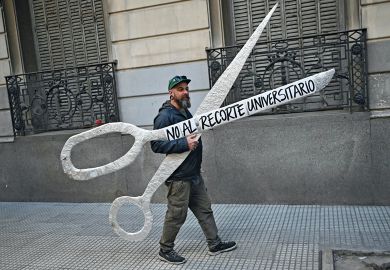
University workers in Argentina are holding what they say will be one of the largest education strikes in the country’s history, as they continue their fight against a controversial funding veto.
Conadu (the National Federation of University Teachers), is attempting to “summon the whole of Argentinian society” in its bid to “swamp the streets” with protesters on 15 October.
The public university sector is at odds with president Javier Milei over his refusal to release funds consistent with the country’s University Financing Law.
Secretary general of Conadu, Clara Chevalier, has accused Milei’s government of wanting to “disarm” access to education in Argentina.
Milei, a right-wing president and former economist, assumed power at the end of 2023 partly on a platform committed to slashing high public spending and increased privatisation, including in the higher education sector.
Under his leadership, university professors say their pay cheques have declined roughly 33 per cent when adjusted for inflation. Last year’s budget for higher education, meanwhile, was about 35 per cent lower than it had been in 2023.
The related unrest – which has seen strikes, walkouts and protests take place across this year and the two years prior – pushed the president to take some concessionary action, including a pay increase for university workers, but levels remain below what is stipulated by the University Financing Law.
That legislation, which multiple judges have ordered Milei to abide by, links salaries to inflation. Estimates suggest fulfilling it would mean adding between 2.5 and 3.1 trillion pesos (up to more than £1 billion) to the annual budget.
As recently as 30 September, public university workers initiated a 72-hour strike to demand the increase once more.
Now, Conadu is organising yet another walkout, demanding the money be provided for as part of next year’s budget. The march, it says, is in the name of “education, sovereignty, and democracy”.
Workers and supporters will walk towards the National Congress Palace in Buenos Aires, the seat of Argentina’s parliament.
The Confederación General del Trabajo (General Labour Confederation) of Argentina has urged its followers to support the march, describing public education as “an indispensable tool for the development of a sovereign nation with equal opportunities”.
Meanwhile, workers from public institutions including the National University of Rosario (UNR), Universidad Nacional Arturo Jauretche and the National University of Córdoba are set to join.
Marco Fernández, a professor and researcher in the School of Government and Public Transformation at Mexico’s Tecnológico de Monterrey, told THE that the demands of the sector were “multiplying” in the Argentinian context of “austerity and adjustment” – but argued that many in public universities were also hesitant to work more closely with private companies, which could bring in more money.
“Most public universities in Latin America are free of charge,” Fernández said.
“In all of them there is an increase in [student] enrolment, which is not accompanied by an increase in the budget. And this has meant that most of the institutions’ budgets are committed to paying teachers’ salaries, with little room to strengthen infrastructure, improve laboratories, and update software for cutting-edge research.”
He continued: “Higher education is competing with other areas of social spending, such as pensions and health.
“As long as there is resistance to improving the conditions under which spending is carried out in some public universities, [including] making it appropriately transparent, and to actually strengthen cooperation with the private sector to produce co-funded research that makes it possible to bring in more resources…it will be very difficult to overcome the precarious conditions of higher education in the region.”
Register to continue
Why register?
- Registration is free and only takes a moment
- Once registered, you can read 3 articles a month
- Sign up for our newsletter
Subscribe
Or subscribe for unlimited access to:
- Unlimited access to news, views, insights & reviews
- Digital editions
- Digital access to THE’s university and college rankings analysis
Already registered or a current subscriber?