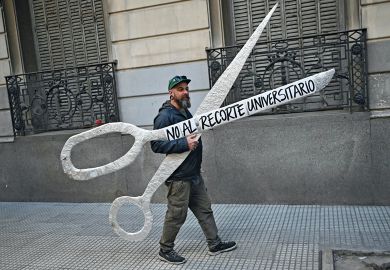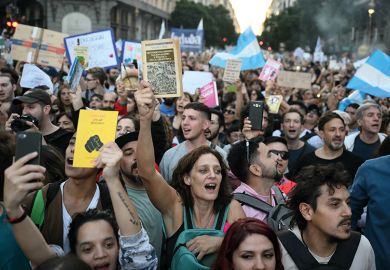
A 24-hour strike in Argentinian universities has marked the latest escalation in an ongoing dispute over what onlookers say is a higher education system on the brink of being “dismantled”.
Following on from industrial action earlier this year, Conadu (the National Federation of University Teachers) led the day-long disruption on 8 September to demand president Javier Milei comply with the country’s University Financing Law.
More than 65 of Argentina’s public universities and an estimated 2 million students were impacted by the standstill between the sector and the right-wing government.
For some time, Milei has attempted to veto the legislation, which would improve lecturers’ salaries and restore cancelled student scholarships. It was passed by Argentina’s National Congress in 2025, and Milei has been instructed by the judiciary to enact the bill, but has so far refused.
The president, who prior to his current role was known as an economist-turned-television personality, is pursuing stringent austerity measures out of his commitment to reducing government expenditure and opposing socialism.
His cuts to university budgets provoked unrest in the Argentinian capital in 2024 but the most recent action represents a total strike across all national universities. Students have already faced more than 30 strike days this year.
It follows what Conadu has called a “breakdown” in discussions between government officials and its representatives on 1 September.
The union has also announced intentions to organise further action in the form of a march next month in support of universities, stating that it is “convinced that urgent salary and budgetary needs cannot wait” and refuses “to stand idly by while the national university system is dismantled”.
Diego Sazo, a researcher at the London School of Economics, told Times Higher Education that Milei’s refusal to implement the funding bill had turned a “wage dispute into a broader conflict over the rule of law”.
“Conceding would weaken his zero-deficit commitment, while sending police on to university campuses would carry considerable political costs in a country where memories of the dictatorship remain powerful,” Sazo said. “The government has instead relied on vetoes, decrees, court appeals and partial offers, while depicting parts of the university movement in highly confrontational terms, including describing some teachers and students as ‘terrorists in disguise’. The likely consequence is degradation without institutional collapse.”
Jerónimo Rilla, a postdoctoral researcher at UCL and a British Academy international fellow, told THE that the “untenability of the situation” has had “very concrete consequences”.
“I personally know colleagues who have resigned, or who now work in entirely unrelated jobs simply to make ends meet – a philosopher-turned-real-estate agent, for instance,” he said.
Academics at CONICET, the agency for science and technology research in Argentina, said the situation could rebound on the country’s entire education system. “The ‘drip-by-drip’ process of thousands of faculty members resigning from public universities continues,” write chemist and researcher Valeria Edelsztein and Claudio Cormick, a philosopher and lecturer.
“They are leaving the country, abandoning teaching altogether, or moving to elite private universities. This represents an unprecedented increase in educational inequality in a country where high-quality education had traditionally been provided free of charge by the state.”
They added: “The government has been unable to advance its highly regressive budgetary agenda through a new funding law, but at the same time it continues to buy time as the months go by without adjusting faculty salaries. From this perspective, we believe the next major battle will come when the bill setting the budget for the entire public sector for 2027 begins to be debated.”
Register to continue
Why register?
- Registration is free and only takes a moment
- Once registered, you can read 3 articles a month
- Sign up for our newsletter
Subscribe
Or subscribe for unlimited access to:
- Unlimited access to news, views, insights & reviews
- Digital editions
- Digital access to THE’s university and college rankings analysis
Already registered or a current subscriber?