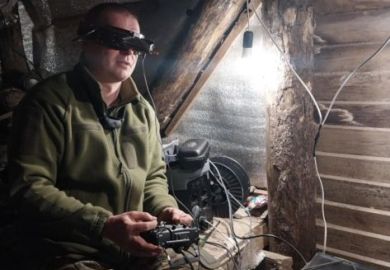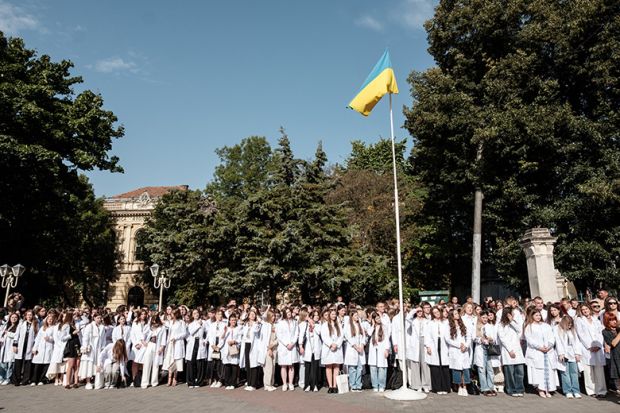
Ukrainian universities are talking about safety. Shelters. What to do during an air raid alert. How to hold a class when there is no electricity for hours. How to get through another winter. How to work with people who are exhausted by war.
This is not the wrong agenda. It is our reality. But while we are occupied with survival, the world has not paused the development of medical education. At the schools setting the pace, the professional discussion keeps getting more sophisticated, more precise, more technical. In Ukraine, the conversation about who exactly we are training, how we do it and how we know we have succeeded often simply does not get the attention it needs.
Formally, the competency-based approach has long been part of Ukrainian medical education. There are standards, learning outcomes, curricula, lists of competencies. But between the word “competency” in a document and competency-based education itself, there is a vast distance – and assessment is where that gap is easiest to see. In other words, the competencies are often only on paper.
This is not a new complaint, and it is not confined to any one institution. In September this year, a physical therapy student at Lviv National Medical University described, in a widely shared social media post, learning anatomy on plaster bone models more than 50 years old, alongside a shortage of textbooks and generally poor facilities.
She said she regretted turning down a place abroad for what she had assumed would be a better education at home – “I naively thought it would be better here.” The replies were the real story: a Ukrainian student now studying medicine in the US contrasted the resources and respect she gets there; others called their own training in Ukraine “one collective trauma” and said little had changed since the late 1990s. One added, pointedly, that not every Ukrainian medical school is as under-resourced as this one.
What struck me was not any single complaint – it was how unsurprised everyone in the thread seemed to be. That the complaints are familiar to many of us matters because it complicates a simple story about the war. The war did not create this gap in training quality but it made it far harder to close, and far more expensive to ignore. This problem has been left to compound while the resources that might once have gone toward fixing it now go toward keeping the lights on – literally.
But between the standard and the reality of a lecture hall there is another, critical layer – the internal quality-assurance system of the university. That university must translate a list of competencies into curriculum content, teaching methods, transparent criteria, real feedback and, ultimately, a student’s day-to-day experience.
This is where I think one of the biggest gaps sits today. A positive accreditation result often reflects, above all, the enormous work of a programme’s leadership – their skill at navigating a complex system of regulatory requirements, describing processes correctly, gathering evidence, steering a programme through the procedure. That is a real competency in itself. But it does not, on its own, mean that what is described on paper is what is happening in the clinic or the simulation centre. An accredited programme and a genuinely good day-to-day educational experience are not the same thing. You can describe competencies correctly, hold all the right documentation, and still leave the central question unanswered: are students learning what we promised to teach them and are we assessing this fairly?
This doesn’t mean Ukrainian medical education is inherently weak. There are strong teachers, new programmes, simulation centres, international partnerships and people who keep pushing education forward even in wartime.
But you do not need to move backwards for the gap to widen. It is enough to move forward more slowly than everyone else. Ukraine, in its fourth year of full-scale war, spends an enormous amount of human, financial and administrative resource simply keeping the system running. Countries not fighting a war can invest that same resource in development.
This is one of the less visible long-term costs of the war. We talk a great deal about destroyed hospitals, university buildings, laboratories, about the loss of people and money – visible losses we can at least try to count. Far harder to count is the loss of innovation.
Despite everything, new and outstanding educational initiatives keep appearing – proof that the instinct to build rather than merely endure has not gone anywhere. One such island is a new medical school at the National University of Kyiv-Mohyla Academy in partnership with Dobrobut medical network, which has just welcomed its first cohort of students.
It was built, deliberately, the opposite way round from what students usually describe: real clinical skills from the first days, not competencies that exist mainly on paper; an explicit emphasis on human dignity, respect and the absence of the corruption that still shadows parts of Ukrainian medical education; alongside a humanities curriculum for future doctors and training in military medicine, a skill this generation of Ukrainian physicians cannot avoid needing. It has backing from Maastricht University and a wider network of European partners and through a Swiss-funded programme for developing medical education in Ukraine that I work on myself.
Innovation and gaps in medical education and in healthcare are unevenly distributed. Russia’s full-scale invasion against Ukraine has driven also rapid advances in trauma care, wound treatment, rehabilitation, and in general service provision, co-creating (usually together with international surgeons and other practitioners) expertise from which other countries can learn. Yet innovation at the point of care does not automatically reach the classroom: medical education must find ways to capture this experience, examine it critically and prepare future professionals to use it.
Progress does not mean chasing every new educational trend. That would be neither realistic nor wise. But it is critical not to drop out of the international conversation on medical education entirely. Ukrainian educators need to argue about student-centred learning, to think through how to assess not just what a student knows but how they behave, communicate and decide. That is why international conferences, professional communities, exchanges, mentorship and university partnerships matter more than they might look like they do right now.
After the war, Ukraine will not only have to rebuild buildings. It will have to rebuild institutions, bring people back, rethink programmes, change how it teaches and assesses. If, by then, we have spent years absent from that international discourse, catching up will be far harder and far more expensive than the cost of staying in the room now.
Tetiana Chernysh is associate professor of School of Healthcare Management at Kyiv-Mohyla Academy in Ukraine. The author works on a Swiss-funded programme supporting the development of medical education in Ukraine which backs the Kyiv-Mohyla Academy mentioned in this piece.
Register to continue
Why register?
- Registration is free and only takes a moment
- Once registered, you can read 3 articles a month
- Sign up for our newsletter
Subscribe
Or subscribe for unlimited access to:
- Unlimited access to news, views, insights & reviews
- Digital editions
- Digital access to THE’s university and college rankings analysis
Already registered or a current subscriber?